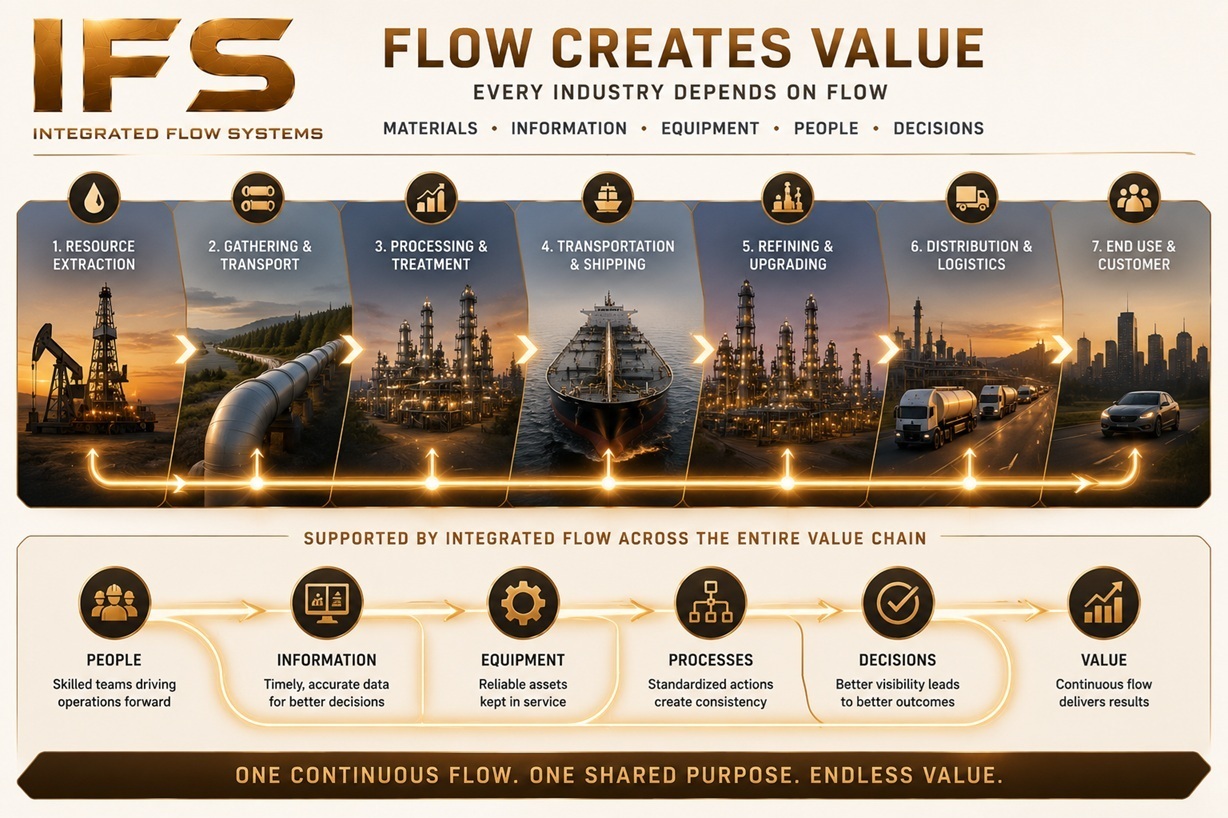
Every industry exists because something needs to move.
Raw materials move from extraction to processing. Products move through manufacturing and distribution. Information moves between people, departments, and organizations. Equipment, resources, decisions, and capital move through interconnected systems that must work together to create value.
Whether the operation is an oil field, a mine, a shipping network, a manufacturing facility, a pulp mill, or a water treatment plant, the underlying challenge remains the same: maintaining consistent flow across an increasingly complex environment.
When flow is maintained, operations become more efficient, predictable, and profitable. Resources are utilized effectively. Bottlenecks are reduced. Communication improves. Decisions are made with greater confidence. Performance becomes more consistent from shift to shift, department to department, and site to site.
The most successful organizations understand that value is not created by individual activities alone. Value is created when every part of the system works together toward a common objective. The ability to see, manage, and improve those connections is what transforms operational activity into measurable results.
Integrated Flow Systems was built around this principle: better flow creates better outcomes.
Consistent Flow. Better Decisions. Stronger Results.
Most operational losses do not originate from a single catastrophic event.
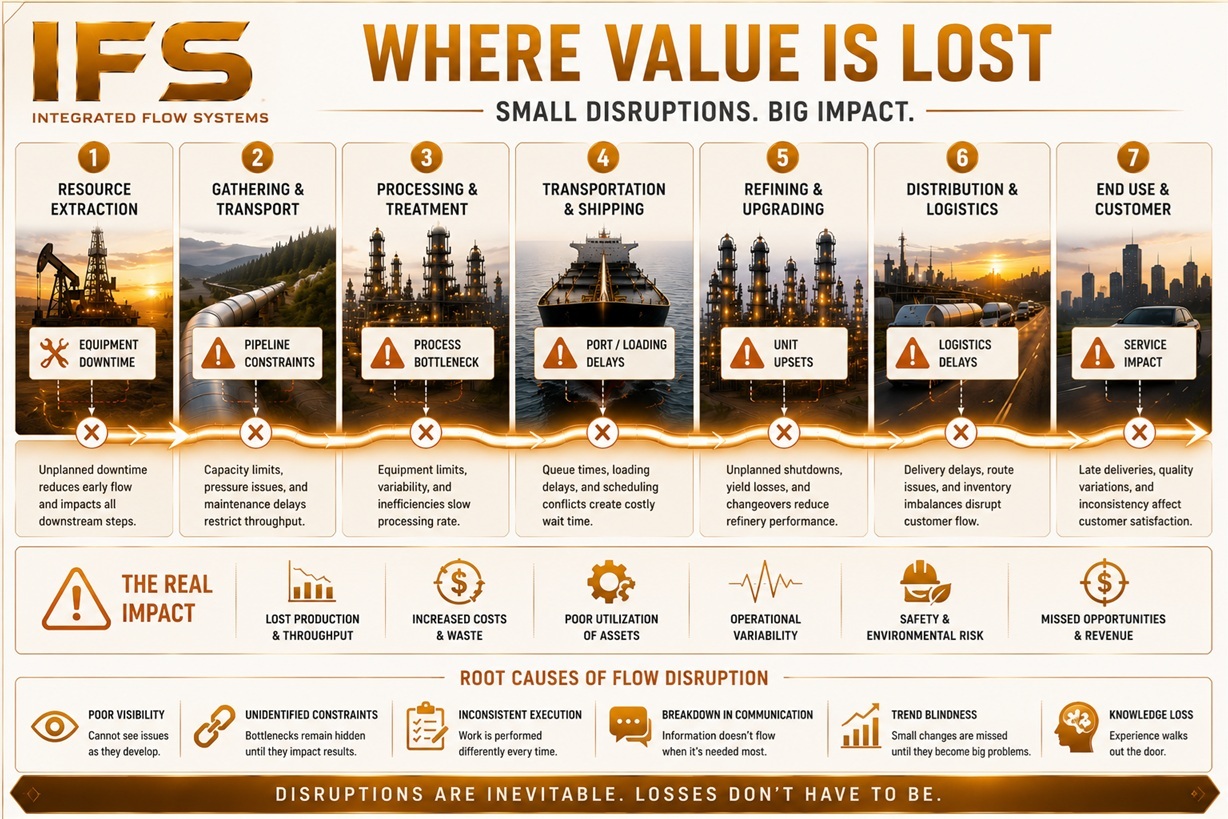
They develop gradually through dozens of small disruptions that occur every day across an operation. A delayed decision. An unnoticed bottleneck. A missed handover. Incomplete information. Equipment downtime. Scheduling conflicts. Communication breakdowns. Individually, these issues may appear minor. Collectively, they create significant impacts on performance.
As disruptions accumulate, flow becomes restricted. Production slows. Costs increase. Resources are underutilized. Variability grows. Safety risks increase. Opportunities are missed. What begins as a small inefficiency at one point in the system often propagates downstream, affecting multiple departments, processes, and outcomes.
Many organizations focus on correcting the visible symptoms of these problems after they occur. The greater challenge is identifying the underlying causes before they compound into larger operational losses. Poor visibility, unidentified constraints, inconsistent execution, communication gaps, trend blindness, and knowledge loss often remain hidden until measurable performance has already been affected.
Understanding where value is lost is the first step toward improving operational performance. The ability to identify disruptions early, monitor developing trends, and maintain consistency throughout the operation creates the foundation for stronger decision-making and more predictable results.
Disruptions are inevitable. Losses don't have to be.
Integrated Flow Systems does not attempt to eliminate complexity.
It provides a structured way to manage it.
Every operation contains constraints, competing priorities, changing conditions, and countless decisions that must be made every day. The challenge is not simply collecting more information. The challenge is understanding which information matters, where constraints exist, how conditions are changing, and what actions will have the greatest impact on overall performance.
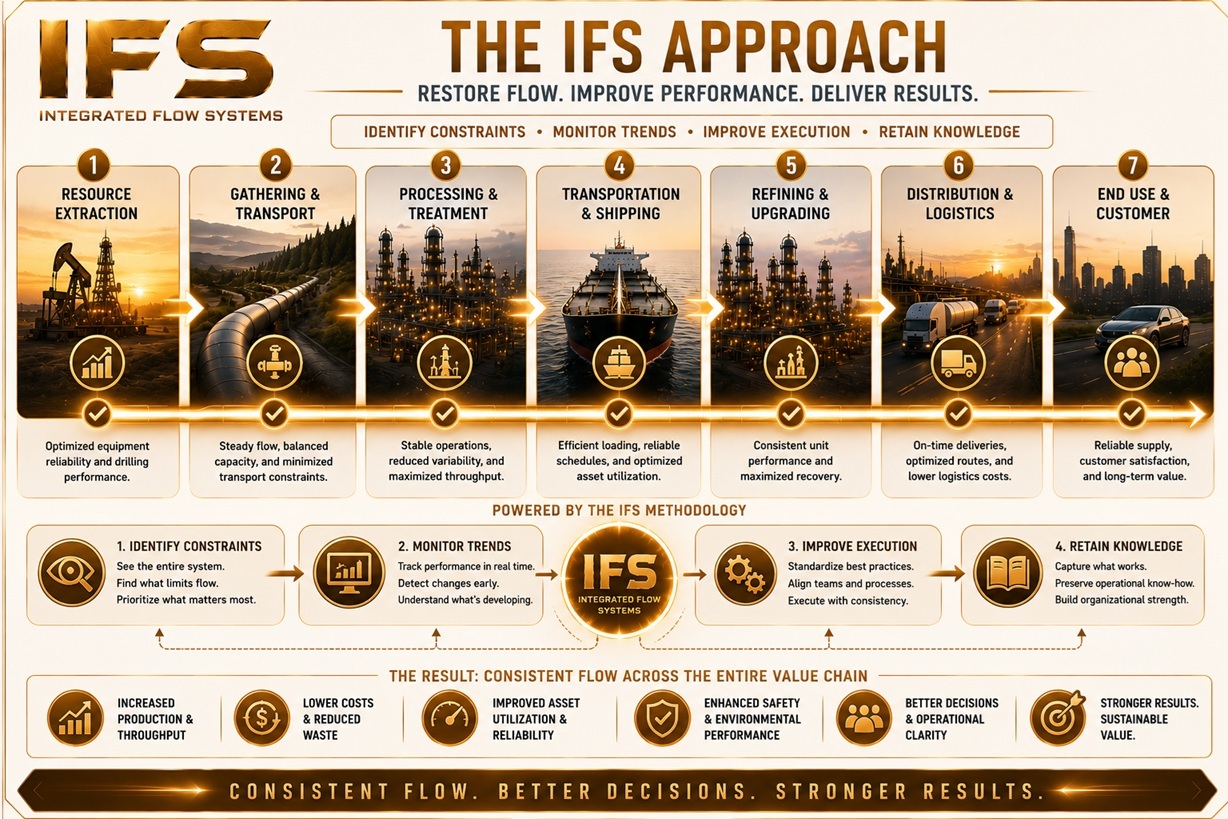
The IFS methodology is built around four core activities: identifying constraints, monitoring trends, improving execution, and retaining knowledge. Together, these create a continuous cycle of observation, action, review, and improvement that can be applied across virtually any operational environment.
By identifying constraints, organizations gain visibility into the factors limiting performance. By monitoring trends, developing issues can be recognized before they become major disruptions. By improving execution, teams achieve greater consistency and alignment across shifts, departments, and operational areas. By retaining knowledge, organizations preserve valuable experience and lessons learned rather than losing them through turnover, retirement, or changing personnel.
The result is not simply increased production or reduced costs. The result is a more resilient operation—one that can adapt, learn, and improve over time while maintaining consistency across people, equipment, information, materials, and decisions.
IFS is not built around reacting to problems after they occur.
It is built around creating the visibility, structure, and operational discipline necessary to prevent many of those problems from developing in the first place.
Consistent Flow. Better Decisions. Stronger Results.
Join us in enhancing efficiency and control.
IFS is a deterministic operational platform designed for structured industrial workflow management.
Through robust architectural design focused on recoverability and structured execution.
Yes, IFS is adaptable and scalable for multiple industrial applications.
IFS minimizes data collection to what is necessary for operational functionality.
IFS is designed to operate independently of live infrastructure integration.
Contact us for a detailed demonstration and consultation.