Integrated Flow Systems (IFS) was founded on a simple principle: every operation is a flow system.
People, equipment, materials, information, resources, and decisions move through interconnected processes every day.
When those flows remain aligned, operations perform efficiently, safely, and consistently. When they become constrained or disconnected, waste increases, performance declines, and opportunities are lost.
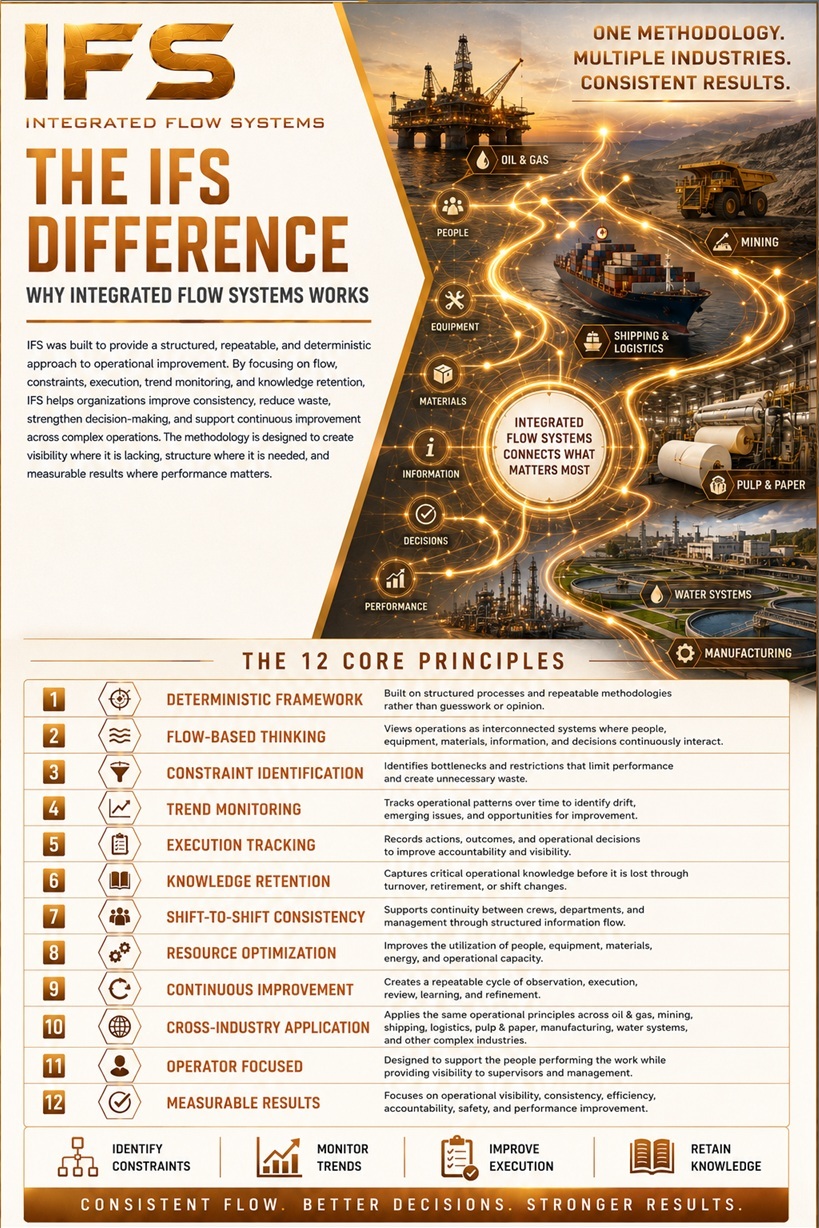
The Integrated Flow Systems (IFS) App is a deterministic operational intelligence platform designed to help operators identify trends, constraints, opportunities, and decision pathways within complex systems.
Unlike traditional AI systems, IFS does not generate recommendations through prediction, inference, or autonomous reasoning. Instead, it follows a structured decision framework built from industry-specific operating procedures, field experience, documented best practices, and predefined decision logic.
Operators enter operational information through structured snapshots of the current system state.
Examples include:
Flow conditions
Pressure conditions
Production conditions
Equipment conditions
Process observations
Operator notes
Before and after transition snapshots
Each snapshot creates a time-stamped operational record.
The Trend Engine compares multiple snapshots over time.
Rather than asking only:
"What is happening right now?"
the system also evaluates:
What direction conditions are moving
Whether conditions are improving or degrading
Whether change is accelerating or stabilizing
Whether recovery patterns are forming
Whether known constraint patterns are emerging
Trend monitoring transforms isolated observations into operational context.
The Constraint Engine evaluates conditions that limit system performance.
Examples include:
Flow restrictions
Bottlenecks
Pressure instability
Resource imbalance
Capacity limitations
Process interruptions
Constraints are tracked over time to determine whether they are:
Forming
Expanding
Stabilizing
Recovering
Eliminated
The Decision Framework applies deterministic rules to current conditions, trend status, and known constraints.
Recommendations are selected from predefined operational pathways stored within the system database.
Examples include:
Maintain current operations
Increase monitoring
Reduce operating rate
Investigate restriction
Escalate review
Execute recovery procedure
Initiate intervention
Every recommendation is traceable to documented operational logic.
After receiving a recommendation, operators record:
Action taken
Modified action
Override decisions
Operational outcomes
Supporting notes
This creates accountability and provides measurable feedback on operational performance.
The System Memory layer records:
Historical conditions
Trend development
Constraint formation
Decisions taken
Outcomes achieved
Over time, the system develops a library of operational patterns that can be referenced during future events.
IFS continuously monitors trends and conditions.
Alerts can be generated for:
Accelerating decline
Constraint growth
Repeated negative outcomes
Process instability
Accelerating improvement
Constraint relief
Recovery formation
Repeated successful outcomes
Alerts are generated using deterministic thresholds rather than prediction models.
Artificial intelligence plays a minimal role within the IFS architecture.
AI is not responsible for:
Operational decisions
Trend determination
Constraint identification
Recommendation generation
Outcome evaluation
These functions are performed by deterministic logic and predefined operational frameworks.
Where AI is utilized, its role is limited to:
Retrieving information from approved databases
Presenting supporting reference material
Assisting users in locating relevant documentation
Translating information into user-friendly language
AI does not replace operator judgment and does not alter the decision framework.
IFS provides a structured operational process:
Flow Monitoring
→ Trend Monitoring
→ Constraint Monitoring
→ Decision Framework
→ Execution Logging
→ System Memory
The result is a transparent, repeatable, and auditable system that helps operators identify developing conditions, evaluate operational choices, and improve outcomes through consistent application of deterministic logic.
Our mission is to help organizations improve operational visibility, identify constraints, strengthen execution, and support continuous improvement through practical, structured flow management. We believe that better decisions come from better information, better visibility, and a clearer understanding of how systems function as a whole.
At IFS, we focus on measurable outcomes rather than theory alone. Our approach combines operational discipline, trend monitoring, execution tracking, and continuous improvement into a repeatable framework that can be applied across multiple industries, including oil and gas, mining, shipping and logistics, pulp and paper, water systems, manufacturing, and other complex operations.
Our values are simple: clarity, accountability, consistency, continuous improvement, and results.
Consistent Flow. Better Decisions. Stronger Results.
We emphasize stability in workflows to ensure reliable operations.
IFS integrates recoverability-first logic in all processes.
Our workflows are designed for clear, structured execution minimizing cognitive load.
Expert in operational management and workflow optimization.