
Systems Architect Consulting

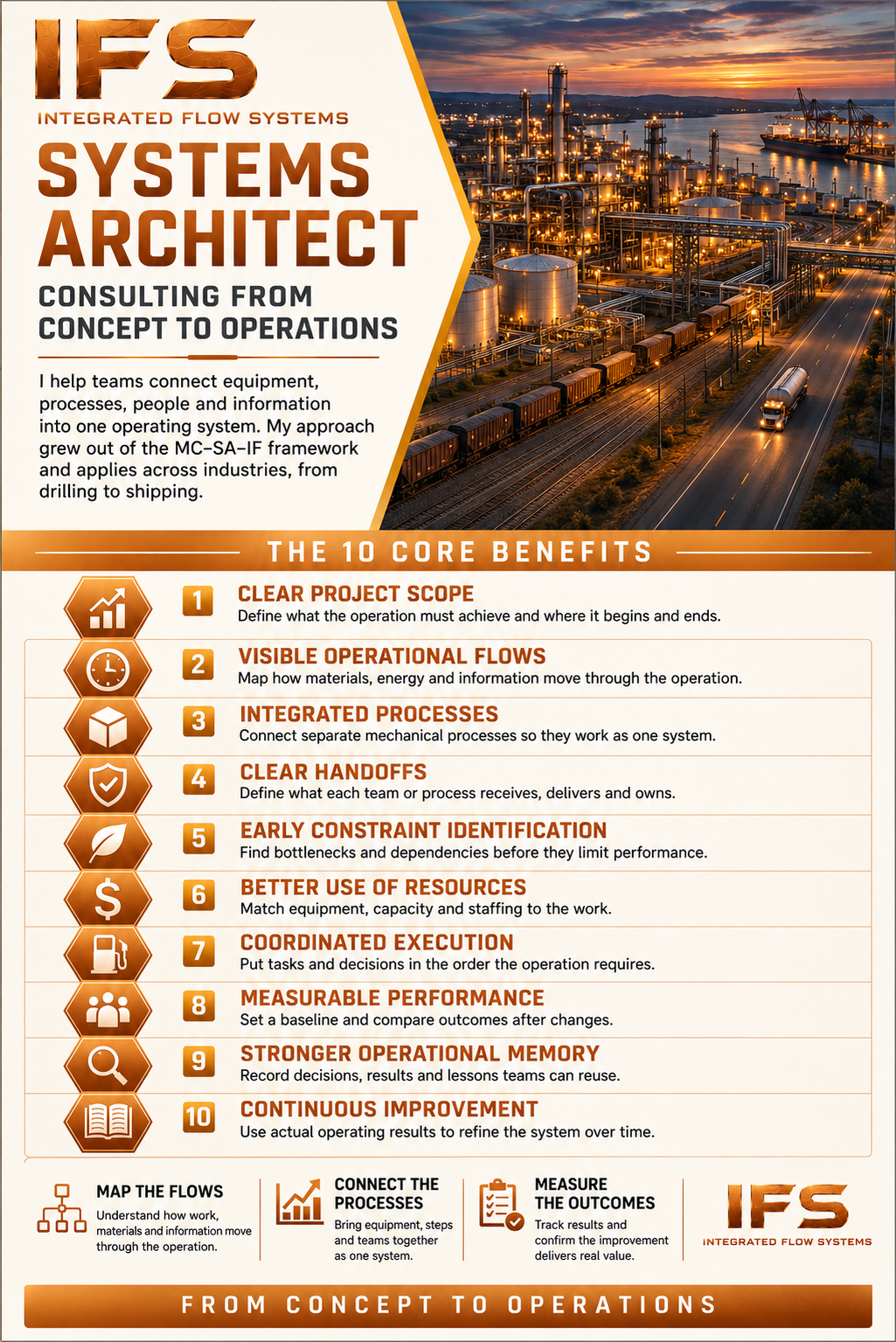
Designing complex operations and integrating separate processes into one working system, from early concept through implementation.

Map the Flows. Connect the Processes. Guide Implementation.

What I Can Help With

I’m Dale Reimer, founder of Integrated Flow Systems.


I help teams work out how equipment, materials, energy, people, and information need to move through an operation. That can mean designing a new operation from the ground up, connecting mechanical processes that were developed separately, or finding where an existing system is getting held up.


I developed this approach through my MC–SA–IF framework. The same method applies whether the project involves oil drilling, shipping and logistics, or integrating agriculture, energy, and fuel production.
PRICING

What I Can Help With

  • Designing a new operation. Turn an early concept into a design that shows how the processes, equipment, resources, and teams will work together.
  • Integrating separate processes. Identify what each process needs and what it produces. Define how materials, energy, and information pass between them, and what each process needs from the one before it.
  • Improving an existing operation. Trace delays, bottlenecks, and recurring problems through the system to see where they start and what else they affect.
  • Supporting implementation. Help your team put the design into practice, decide what to monitor, and use early operating results to refine how the system works.


How I Work

I use the MC–SA–IF framework I developed to understand how an operation works as a whole. The method applies across industries because it starts with the same questions every time. What needs to move? Where does it change or get handed off? What limits the flow? Who needs to act when conditions change?


  1. Define the objective. Establish what the operation needs to deliver and how we’ll tell whether it’s working.
  2. Map the operation. Follow materials, energy, equipment, people, and information through each stage. Document the dependencies and handoffs.
  3. Design how the parts work together. Identify constraints and define the sequence, connections, and decisions the operation depends on.
  4. Carry the design into operation. Work with your team through implementation, review what happens in practice, and document what works so the team can build on it.


Consistent Flow. Better Decisions. Stronger Results.

Ready to Improve Your Operation?

Examples of the Work

These examples show how I apply my MC–SA–IF framework to different systems. The IINs make the operation and its connections visible. The hypothesis breakdowns show how I take a proposed idea, identify what it depends on, and work through what would need to be true for it to succeed.


Industrial and Operational Scenarios

  • Japan Industrial Network — A visual walkthrough of how ports, transportation, energy infrastructure, and manufacturing connect across an industrial network. View IIN (PDF)
  • British Columbia Forestry — A visual walkthrough of forestry operations in British Columbia, showing how the stages of the operation depend on one another. View IIN (PDF)


Hypothesis Breakdown Series

Each breakdown starts with a hypothesis and follows the implications through the system. It identifies the assumptions, dependencies, and constraints that could shape the outcome, along with the questions that would need to be answered before moving forward.

  • Saudi Arabia · View Breakdown (PDF)
  • Oman · View Breakdown (PDF)
  • Texas Gulf Coast · View Breakdown (PDF)
  • Gibraltar · View Breakdown (PDF)