Explore operational insights, industry graphics, reference materials, and practical examples designed to support better decisions and more consistent performance across complex industrial systems.
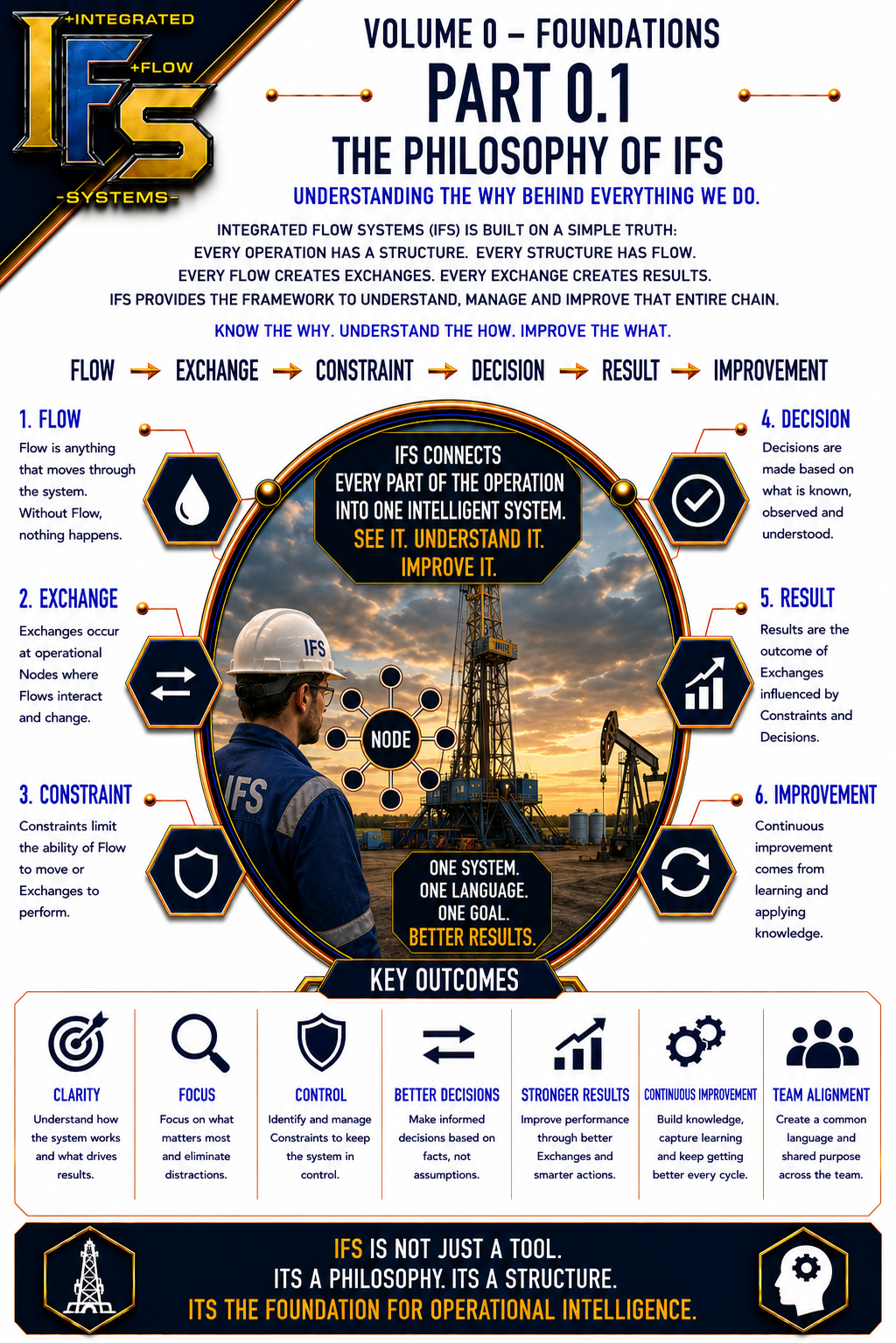
Everything that happens inside an industrial operation happens because something moves.
Fluids move.
Materials move.
Energy moves.
Information moves.
People move.
Equipment changes state.
Decisions create movement.
Nothing happens without flow.
Integrated Flow Systems (IFS) was built around that single observation.
Regardless of industry, every operation consists of flows moving through connected points where something changes.
Those changes create results.
Some create value.
Some create waste.
Some create opportunity.
Some create risk.
IFS exists to understand the difference.
Traditional operations often separate departments into individual responsibilities.
Drilling watches drilling.
Production watches production.
Maintenance watches equipment.
Engineering watches performance.
Logistics watches movement.
Each group becomes highly skilled within its own area.
But the operation itself never separates.
Every action influences another part of the system.
A pressure change becomes a flow change.
A flow change becomes a production change.
A production change becomes a maintenance issue.
A maintenance delay becomes a scheduling problem.
A scheduling problem becomes lost production.
IFS connects those relationships into one operational picture.
Instead of managing isolated equipment, it manages connected systems.
Nothing changes until something moves.
Every pump.
Every pipeline.
Every drilling fluid.
Every conveyor.
Every valve.
Every production stream.
Every shipment.
Every electrical circuit.
Every information transfer.
Every one is a flow.
When that flow reaches another part of the operation, an exchange occurs.
Pressure changes.
Temperature changes.
Velocity changes.
Chemistry changes.
Energy changes.
Production changes.
Every exchange creates the next condition inside the operation.
IFS tracks those exchanges because every future result begins there.
No operation performs without limits.
Equipment capacity.
Formation pressure.
Pump efficiency.
Crew availability.
Weather.
Chemical compatibility.
Pipeline capacity.
Transportation delays.
Maintenance schedules.
Every one of these becomes a constraint on flow.
Most operational problems are not created by catastrophic failures.
They begin as small constraints that slowly reduce system performance.
IFS focuses on recognizing those constraints while they are still manageable.
Small constraints become large problems only when they remain unnoticed.
Operators make decisions every minute.
Increase flow.
Reduce pressure.
Adjust mud weight.
Change pump speed.
Investigate vibration.
Replace equipment.
Continue drilling.
Stop drilling.
Every decision changes the direction of the system.
IFS improves decision quality by replacing assumptions with connected operational understanding.
Instead of asking,
"What is happening?"
IFS asks,
"What caused it?"
"What changed?"
"What else changed with it?"
"What happens next if nothing is done?"
Understanding comes before action.
Every operational result has a cause.
Every cause exists somewhere inside the connected flow system.
Higher production.
Lower production.
Equipment failures.
Improved efficiency.
Lost time.
Reduced costs.
Unexpected gains.
They all begin somewhere upstream.
IFS works backwards through connected flows until the source is identified.
The result is never the beginning of the investigation.
It is the end of a chain of connected events.
Every completed operation creates new operational knowledge.
Every investigation strengthens future decisions.
Every solved problem becomes part of organizational memory.
Every discovered opportunity becomes repeatable.
IFS continuously improves because every operational cycle teaches the next one.
Knowledge accumulates.
Patterns become recognizable.
Decisions become faster.
Performance becomes more consistent.
The operation becomes more predictable.
IFS is more than software.
It is more than monitoring.
It is more than reporting.
It is a structured philosophy for understanding how industrial systems actually operate.
Flows create exchanges.
Exchanges encounter constraints.
Constraints require decisions.
Decisions create results.
Results become knowledge.
Knowledge drives continuous improvement.
That philosophy applies equally to oil and gas, mining, world shipping, desalination, pulp and paper, manufacturing, utilities, logistics, chemical processing, transportation, and every industry built upon connected operational flows.
Because every industry is different.
But every flow system follows the same principles.
Integrated Flow Systems provides one operational language capable of understanding them all.
Every industrial system exists for one purpose.
To perform operations.
Without operations, equipment has no purpose.
Facilities produce nothing.
Resources create no value.
Plans remain ideas.
Operations are where planning becomes action, resources become production, and effort becomes measurable results.
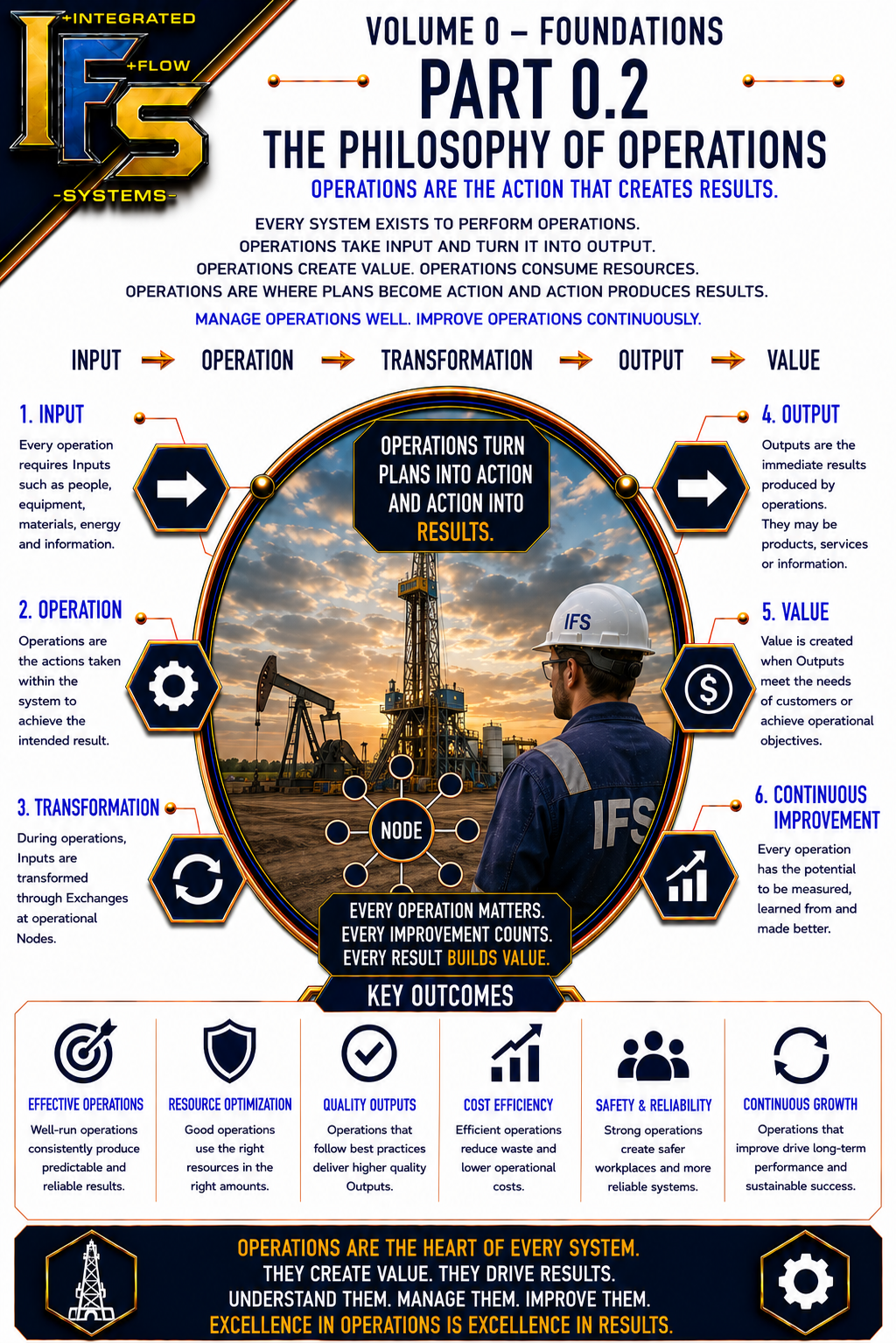
Integrated Flow Systems (IFS) recognizes that every successful operation follows the same fundamental sequence.
Inputs enter the system.
Operations transform those inputs.
Outputs are produced.
Value is created.
Understanding that sequence is the foundation of operational excellence.
Nothing begins without resources.
Every operation requires something to enter the system before anything can be produced.
People bring knowledge and experience.
Equipment provides capability.
Materials become products.
Energy powers movement.
Information guides decisions.
Time coordinates every activity.
These inputs form the starting point of every industrial process.
Whether drilling an oil well, operating a mine, producing fresh water, loading a vessel, manufacturing products, or generating electricity, every operation begins with carefully managed inputs.
The quality of the result can never consistently exceed the quality of the inputs entering the system.
Operations are where work actually happens.
Pumps circulate fluids.
Drill bits remove rock.
Conveyors move material.
Compressors increase pressure.
Heat exchangers transfer energy.
Valves regulate flow.
Operators make decisions.
Automation executes commands.
Every action transforms the condition of the system.
Nothing remains unchanged after an operation.
IFS focuses on understanding exactly how those transformations occur and how each operational step influences every connected process that follows.
No operational change exists in isolation.
Every transformation creates another condition somewhere downstream.
A pressure increase changes flow.
A flow change affects temperature.
A temperature change influences chemistry.
Chemistry alters equipment performance.
Equipment performance changes production.
Production influences scheduling.
Scheduling affects maintenance.
Maintenance changes reliability.
One operational change can influence dozens of connected systems.
IFS follows those relationships across the entire operation instead of examining each department independently.
Because understanding the transformation is often more valuable than simply measuring the output.
Every operation produces an output.
Sometimes that output is a product.
Sometimes it is information.
Sometimes it is improved efficiency.
Sometimes it is simply the next condition required for another process to continue.
Outputs reveal how effectively the operation transformed its available resources.
Consistent outputs indicate consistent operations.
Variable outputs often reveal hidden operational constraints that require further investigation.
IFS continuously compares outputs against operational conditions to understand not only what happened, but why it happened.
Operations consume resources.
Value is created only when those resources produce meaningful results.
Higher production.
Lower operating costs.
Improved quality.
Reduced downtime.
Safer workplaces.
More reliable equipment.
Better environmental performance.
Improved customer satisfaction.
Every organization measures value differently.
IFS does not define value.
It identifies how operational performance creates it.
By understanding where value is created, lost, delayed, or constrained, organizations gain the ability to improve the entire operation instead of optimizing isolated activities.
No industrial operation is ever truly finished.
Every completed task becomes another opportunity to learn.
Every production cycle generates operational knowledge.
Every maintenance activity reveals new information.
Every investigation strengthens future decisions.
Every successful improvement becomes part of organizational capability.
IFS treats continuous improvement as a permanent operational process rather than an occasional initiative.
Small improvements repeated consistently create significant long-term advantages.
One better procedure.
One improved sequence.
One eliminated delay.
One reduced constraint.
Over thousands of operational cycles, these small improvements become measurable competitive advantages.
Operations are the point where every department meets.
Engineering designs them.
Operations execute them.
Maintenance protects them.
Management measures them.
Planning schedules them.
Safety supports them.
Logistics supplies them.
Quality verifies them.
Finance measures their value.
No department operates independently.
Every team contributes to the same operational outcome.
IFS provides a common operational language that allows every department to understand how its decisions influence the entire system.
Integrated Flow Systems views operations as the heart of every industrial system.
Inputs become action.
Action creates transformation.
Transformation produces outputs.
Outputs create value.
Value drives continuous improvement.
This philosophy applies equally to oil and gas, mining, world shipping, desalination, pulp and paper, manufacturing, utilities, power generation, transportation, logistics, chemical processing, agriculture, construction, and every industry where resources are transformed into measurable results.
Because operations are never just tasks.
They are the mechanism through which organizations create value, improve performance, reduce waste, strengthen reliability, and build long-term operational intelligence.
Every successful operation begins with understanding the system.
Every great operation improves the system.
And every improvement begins with understanding how the operation truly works.
Every operation exists because something changes.
Without change, nothing is produced.
Nothing is improved.
Nothing creates value.
Flows simply move from one place to another.
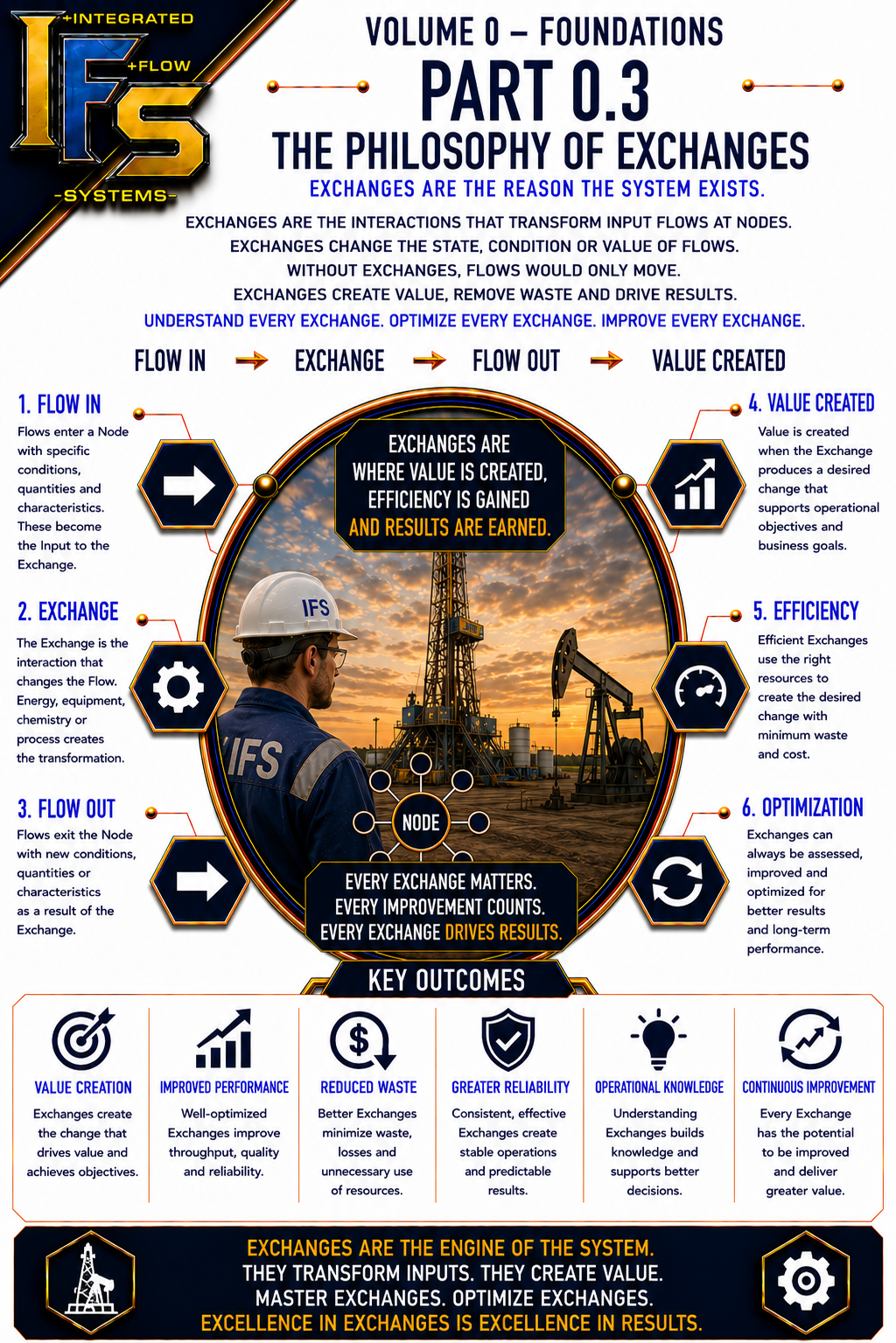
The point where that change occurs is called an Exchange.
Integrated Flow Systems (IFS) recognizes Exchanges as the heart of every industrial operation.
They are where work is performed.
They are where energy is transferred.
They are where chemistry changes.
They are where pressure is increased or reduced.
They are where materials are processed.
They are where value is either created or lost.
If Flow is movement, then Exchange is purpose.
No flow remains the same after passing through an Exchange.
Water enters a pump.
Pressure increases.
Oil enters a separator.
Gas separates.
Steam enters a heat exchanger.
Temperature changes.
Ore enters a crusher.
Particle size decreases.
Raw seawater enters a desalination membrane.
Fresh water leaves.
Every Exchange transforms the condition of the flow.
That transformation becomes the starting point for every operation that follows.
IFS focuses on understanding those transformations because every downstream result depends on them.
Nothing enters an Exchange without characteristics.
Pressure.
Temperature.
Flow rate.
Density.
Composition.
Velocity.
Energy.
Chemical properties.
Every one of these influences what the Exchange can accomplish.
The quality of an Exchange depends heavily on the condition of the incoming flow.
Poor inputs rarely create excellent outputs.
Understanding incoming conditions allows operators to predict how effectively an Exchange will perform before problems develop.
Once transformation occurs, the flow leaves with new characteristics.
Pressure changes.
Temperature changes.
Chemical composition changes.
Moisture changes.
Velocity changes.
Purity changes.
Energy changes.
Sometimes the change is exactly what the operation intended.
Sometimes it reveals an emerging operational constraint.
IFS compares incoming and outgoing conditions continuously to understand how effectively every Exchange performs.
The greater the difference between expected and actual results, the more valuable that Exchange becomes for investigation.
Organizations often think value is created when products are sold.
IFS recognizes that value is created much earlier.
Every efficient Exchange creates value.
Every unnecessary delay destroys value.
Every wasted resource reduces value.
Every optimized process increases value.
A single improved Exchange may reduce energy consumption.
Increase production.
Improve product quality.
Reduce maintenance.
Increase equipment life.
Improve environmental performance.
Lower operating costs.
The operation becomes more valuable because one Exchange performs better than it did yesterday.
Waste rarely appears suddenly.
It develops through inefficient Exchanges.
Excess energy.
Lost pressure.
Unnecessary heat.
Material losses.
Chemical imbalance.
Equipment wear.
Idle time.
Repeated rework.
Every inefficient Exchange consumes resources while producing less value.
IFS identifies where waste begins, allowing organizations to improve the source rather than continuously treating the symptoms.
The best waste reduction strategy is improving the Exchange that created the waste in the first place.
No Exchange remains perfect forever.
Equipment ages.
Operating conditions change.
Production targets increase.
Raw materials vary.
Environmental conditions shift.
Operator experience grows.
Every one of these influences Exchange performance.
Optimization is therefore not a one-time project.
It becomes a continuous operational discipline.
Measure the Exchange.
Understand the Exchange.
Improve the Exchange.
Verify the result.
Then begin again.
Small improvements repeated across hundreds or thousands of Exchanges create enormous operational gains throughout the entire system.
Engineering designs Exchanges.
Operations run them.
Maintenance preserves them.
Quality verifies them.
Safety protects them.
Management measures their performance.
Finance measures the value they create.
No department owns an Exchange.
Every department contributes to its success.
IFS provides one common framework for understanding how each Exchange influences every connected operation throughout the organization.
When everyone understands the Exchange, everyone understands the operation.
Integrated Flow Systems recognizes Exchanges as the engine of every industrial system.
Flows arrive.
Transformations occur.
Outputs are created.
Value is generated.
Knowledge is gained.
Continuous improvement begins.
This philosophy applies equally to oil and gas drilling, production, pipelines, refineries, mining, mineral processing, desalination, chemical manufacturing, pulp and paper, utilities, transportation, logistics, shipping, agriculture, food processing, construction, and every industrial operation where materials, energy, information, or resources are transformed into something more valuable.
Because the quality of every operation is determined by the quality of its Exchanges.
Master the Exchanges.
Understand how they transform the system.
Optimize them continuously.
When Exchanges improve, operations improve.
When operations improve, organizations become stronger.
And when every Exchange creates more value than it did yesterday, continuous operational excellence becomes part of the system itself.
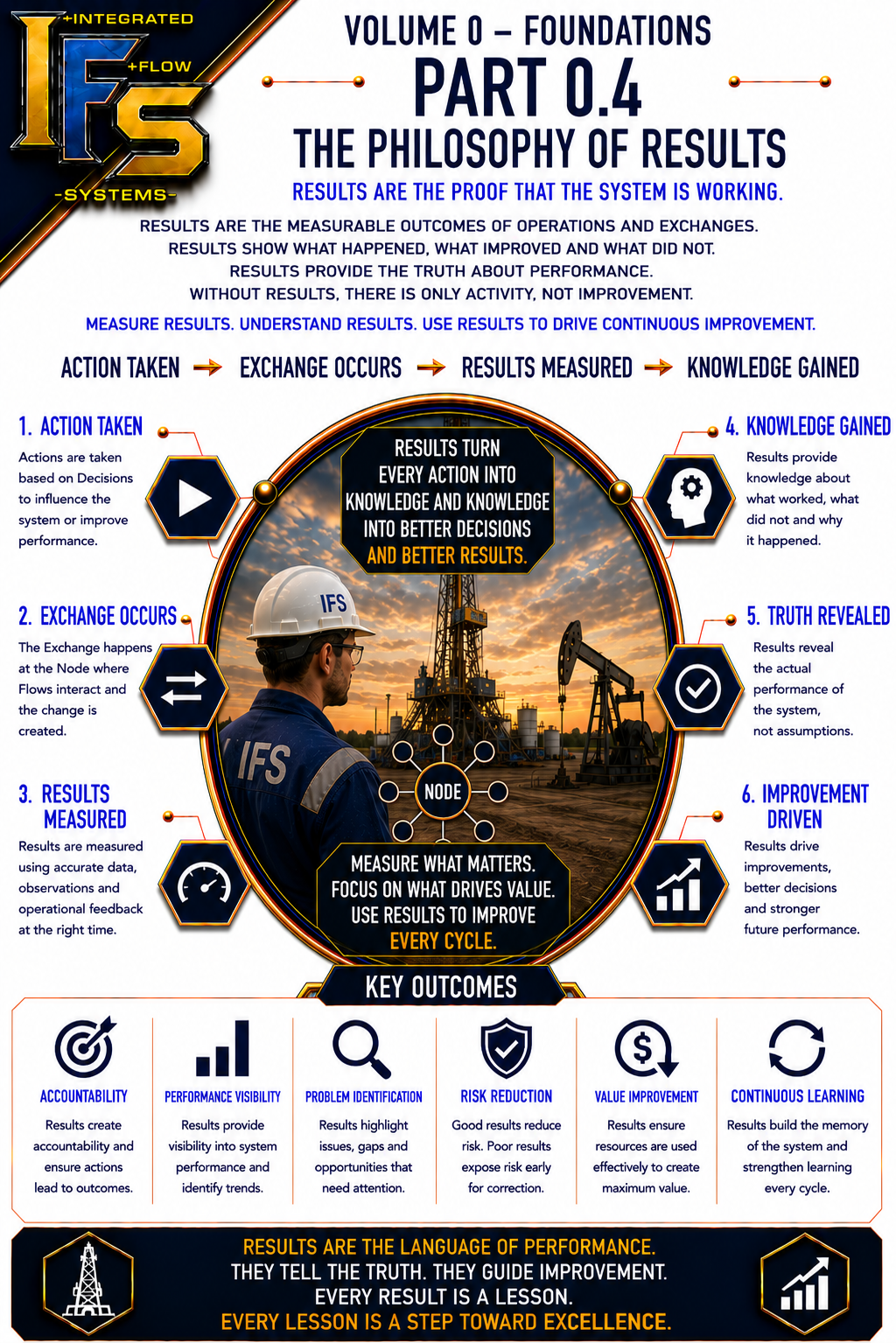
Every operation produces a result.
Whether expected or unexpected.
Successful or unsuccessful.
Profitable or costly.
Every action changes the system, and every change produces an outcome.
Integrated Flow Systems (IFS) recognizes that results are not simply numbers on a report.
They are the evidence of how well the entire system performed.
Results reveal whether decisions were correct.
Whether operations were effective.
Whether Exchanges performed as expected.
Whether Constraints were successfully managed.
Most importantly, results tell the truth.
No result appears without action.
Operators make decisions.
Equipment performs operations.
Flows move through Exchanges.
Conditions change.
Outputs are produced.
Only then does the result become visible.
The result is never the beginning of the story.
It is the final chapter of everything that happened before it.
IFS always works backwards from the result to understand the complete chain of events that produced it.
Because improving future performance requires understanding past performance.
Opinions do not improve operations.
Assumptions do not increase production.
Expectations do not reduce downtime.
Results measure reality.
Production either increased or it did not.
Fuel consumption either improved or it did not.
Pressure remained stable or it changed.
Equipment reliability increased or declined.
The system either became more efficient or less efficient.
Results remove uncertainty.
They replace assumptions with measurable operational truth.
A successful result teaches just as much as an unsuccessful one.
When production exceeds expectations, something caused it.
When maintenance costs increase, something caused it.
When quality improves, something caused it.
When downtime decreases, something caused it.
Every measured result contains operational knowledge waiting to be discovered.
IFS treats every result as an opportunity to strengthen understanding of the system.
Instead of asking,
"Was the result good?"
IFS asks,
"Why did this result occur?"
"What created it?"
"Can it be repeated?"
"Can it be improved?"
Every answer strengthens future operations.
Many operations appear successful until results are examined carefully.
Equipment may remain operational while efficiency quietly declines.
Production may remain acceptable while operating costs steadily increase.
Maintenance may appear effective while equipment life slowly decreases.
Only results reveal the complete operational picture.
IFS measures performance across connected systems rather than isolated activities.
Because excellent individual departments do not always create excellent operational performance.
Only the final results reveal how effectively the entire system worked together.
Consistently strong results rarely happen by accident.
They usually indicate stable operations.
Reliable equipment.
Controlled processes.
Effective decision making.
Well-managed constraints.
Healthy operational flows.
Poor results often reveal developing risks long before failures occur.
Small reductions in performance frequently become the earliest indicators of larger operational problems.
IFS monitors results continuously because trends in performance often become visible before equipment alarms or operational failures occur.
Results become one of the earliest warning systems available.
Value is not created only by producing more.
It is also created by producing smarter.
Reducing waste.
Improving quality.
Increasing consistency.
Extending equipment life.
Reducing maintenance.
Improving safety.
Lowering operating costs.
Increasing production reliability.
Every positive operational result strengthens organizational value.
Every improvement compounds over time.
One better decision today becomes hundreds of better decisions tomorrow.
No operation is ever perfect.
Every completed task creates another opportunity to learn.
Every production report reveals another pattern.
Every maintenance record tells another story.
Every investigation strengthens operational memory.
Results become the learning engine of the organization.
IFS captures those lessons so they become permanent knowledge rather than temporary experience.
Organizations improve fastest when they remember what worked, understand why it worked, and apply those lessons consistently across future operations.
Integrated Flow Systems recognizes results as the language of operational performance.
Actions create Exchanges.
Exchanges produce results.
Results generate knowledge.
Knowledge improves decisions.
Better decisions create better operations.
The cycle never ends.
This philosophy applies equally to oil and gas, mining, desalination, world shipping, pulp and paper, manufacturing, chemical processing, utilities, logistics, transportation, construction, agriculture, and every industrial operation where performance can be measured, understood, and continuously improved.
Because results are never simply numbers.
They are the evidence of how the entire system performed.
Measure them accurately.
Understand them completely.
Learn from them continuously.
Because every result tells a story.
And every story contains the knowledge needed to build the next improvement.
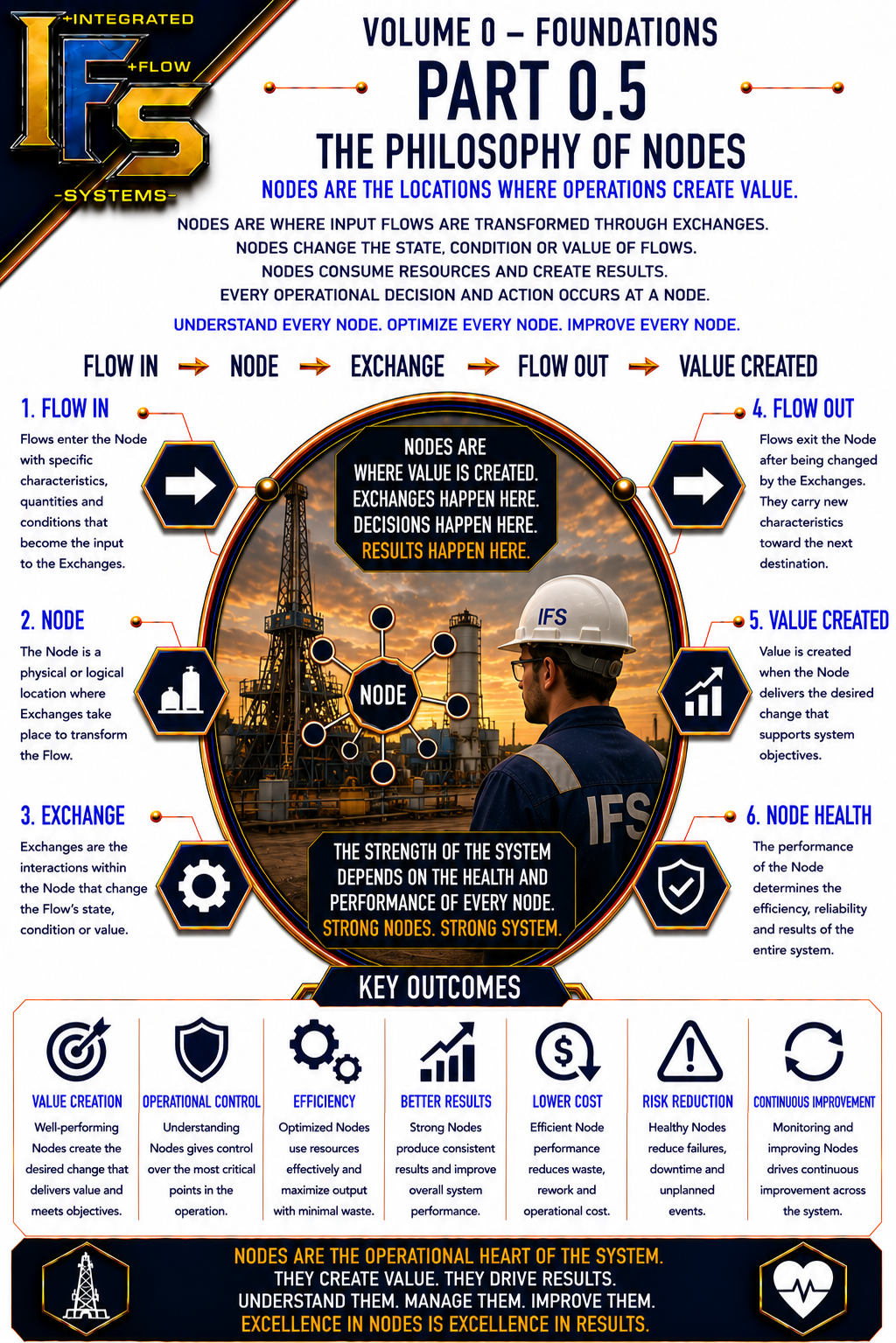
Every operation happens somewhere.
Every decision is made somewhere.
Every transformation occurs somewhere.
Every improvement begins somewhere.
Integrated Flow Systems (IFS) identifies these locations as Nodes.
A Node is the point where flows arrive, Exchanges occur, resources are consumed, decisions are applied, and measurable value is created.
Nodes are where operational performance is built.
Understanding the health of every Node means understanding the health of the entire operation.
Nothing in an industrial system simply moves from beginning to end without interaction.
Crude oil passes through separators.
Water passes through treatment equipment.
Ore passes through crushers and mills.
Logs pass through debarkers and digesters.
Containers pass through ports and terminals.
Chemicals pass through reactors.
Materials pass through assembly stations.
Information passes through operators, software, and control systems.
Each of these locations is a Node.
Every Node changes something.
Every Node contributes to the final result.
A Flow has potential.
A Node unlocks that potential.
Raw materials become finished products.
Pressure becomes energy.
Water becomes potable.
Ore becomes concentrate.
Logs become pulp.
Data becomes operational intelligence.
Every increase in value occurs because something meaningful happened at a Node.
Without Nodes, there are no Exchanges.
Without Exchanges, there are no Results.
Without Results, there is no value.
Operators do not make decisions in empty space.
They make them while standing at a pump.
Monitoring a drilling rig.
Adjusting a valve.
Changing a conveyor speed.
Starting a compressor.
Managing a ship's propulsion.
Operating a desalination membrane.
Inspecting a paper machine.
Supervising an automated production line.
Every decision influences the performance of a specific Node.
Improving decision quality improves Node performance.
Improving Node performance improves the entire system.
Operational problems rarely affect an entire facility all at once.
They begin at individual Nodes.
A single pump begins losing efficiency.
One separator starts carrying over liquids.
A crusher develops excessive vibration.
A heat exchanger begins fouling.
A transfer station develops congestion.
A loading berth creates vessel delays.
A compressor gradually loses capacity.
A drilling process becomes less consistent.
Small changes at one Node eventually influence every connected Flow downstream.
Strong Nodes create stable systems.
Weak Nodes create expanding Constraints.
IFS continuously monitors Node performance because improving one critical Node often improves the performance of every connected operation.
Every Node has measurable characteristics.
Flow rate.
Pressure.
Temperature.
Quality.
Efficiency.
Cycle time.
Reliability.
Energy consumption.
Equipment condition.
Operator interaction.
Resource utilization.
When these measurements remain stable, the Node performs predictably.
When trends begin changing, the Node often becomes the earliest indicator of future operational problems.
Instead of waiting for equipment failure, IFS watches for declining Node health.
Small changes become early opportunities for investigation.
Industrial operations never function as isolated equipment.
Every Node connects to another.
A drilling rig connects to mud systems.
Mud systems connect to solids control.
Solids control connects to waste management.
Processing plants connect to storage.
Storage connects to transportation.
Transportation connects to customers.
Each Node depends on the performance of every connected Node.
One poorly performing location can create Constraints throughout the entire operation.
One improved Node can increase performance across multiple systems.
This is why IFS maps operational relationships instead of isolated equipment.
Understanding connections is often more valuable than understanding individual machines.
Every time a Node is measured, inspected, adjusted, or improved, new operational knowledge is created.
IFS stores this knowledge through Snapshot Memory.
Over time, every Node develops its own operational history.
Which adjustments worked.
Which conditions produced the best results.
Which operating ranges created the highest efficiency.
Which warning signs appeared before failures.
Which improvements consistently delivered better performance.
Instead of starting from experience alone, future operators begin with verified operational knowledge.
Every successful Node becomes smarter over time.
Integrated Flow Systems recognizes Nodes as the operational heart of every industrial system.
Flows arrive.
Exchanges occur.
Resources are consumed.
Decisions are applied.
Results are created.
Knowledge is captured.
Value is produced.
This philosophy applies equally to oil and gas, mining, desalination, world shipping, manufacturing, pulp and paper, chemical processing, logistics, utilities, construction, agriculture, and every industrial environment where materials, energy, equipment, information, or people interact to create measurable outcomes.
Because every improvement begins at a Node.
Every Constraint begins at a Node.
Every opportunity begins at a Node.
Understand every Node.
Measure every Node.
Strengthen every Node.
Because stronger Nodes create stronger systems, better decisions, greater reliability, lower operating costs, continuous operational improvement, and sustainable value across the entire operation.
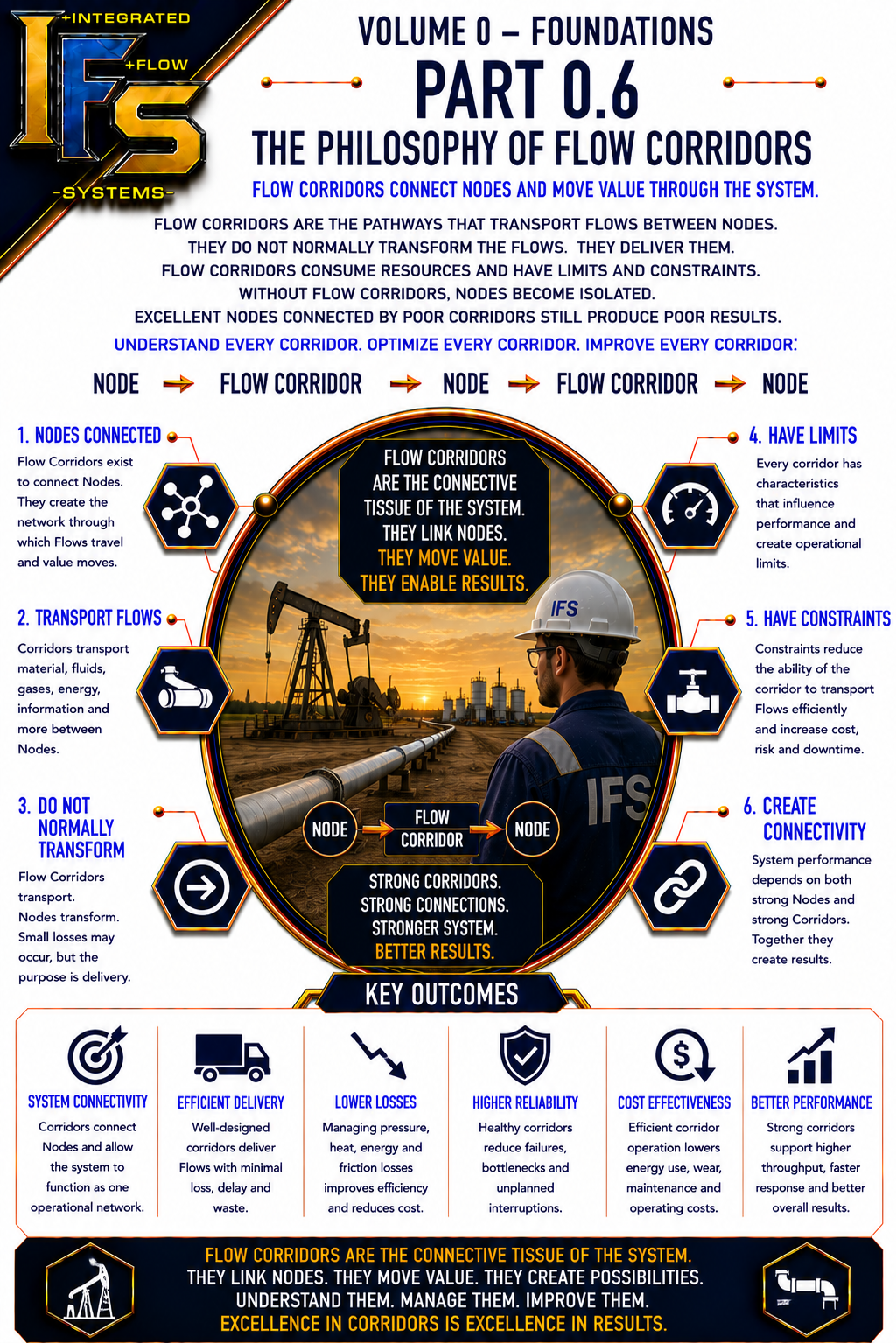
Nothing moves through an industrial operation by accident.
Every material, every fluid, every piece of information, every unit of energy, and every product travels along a defined path.
Integrated Flow Systems (IFS) calls these paths Flow Corridors.
Flow Corridors connect Nodes, transport value, and allow an entire operation to function as one integrated system rather than a collection of independent assets.
Without Corridors, Nodes become isolated.
Without connectivity, value cannot move.
Every industrial process is a network.
Oil moves through gathering lines.
Natural gas travels through pipelines.
Water flows through treatment systems.
Ore moves on conveyors.
Steam travels through headers.
Electricity flows through transmission systems.
Products move through warehouses.
Containers travel through ports and shipping lanes.
Information moves through communication networks.
Each of these is a Flow Corridor.
Their purpose is simple.
Move value from one Node to the next safely, efficiently, and reliably.
Unlike Nodes, Flow Corridors usually do not transform what they carry.
Their primary responsibility is transportation.
Pipelines deliver crude oil.
Conveyors transport ore.
Roads move equipment.
Shipping lanes connect continents.
Electrical cables transmit energy.
Fiber networks carry information.
Although small changes may occur during transport through pressure loss, heat loss, friction, delay, or degradation, the objective of the Corridor is delivery—not transformation.
Its success is measured by how effectively it connects one Node to another.
Every Flow Corridor operates within measurable boundaries.
Pressure limits.
Flow capacity.
Temperature ratings.
Velocity.
Distance.
Energy loss.
Transit time.
Storage capacity.
Traffic density.
Communication bandwidth.
These limits define how much value the Corridor can transport without creating Constraints.
When these limits are exceeded, the Corridor begins reducing the performance of every connected Node.
Understanding Corridor capacity is essential for maintaining overall system stability.
Most operational bottlenecks do not begin where value is created.
They begin while value is moving.
Pipelines become restricted.
Conveyors overload.
Ports become congested.
Road networks delay deliveries.
Power distribution reaches capacity.
Communication networks slow.
Storage facilities become full.
Shipping schedules slip.
These Constraints reduce throughput long before equipment actually fails.
IFS continuously evaluates Corridor performance because small transportation inefficiencies often become large operational losses downstream.
A perfectly operating Node cannot compensate for a poor connection.
An efficient drilling operation still suffers if materials arrive late.
A refinery cannot process crude that never arrives.
A mill cannot produce without raw material delivery.
A manufacturing plant cannot assemble products without component logistics.
A desalination plant cannot distribute clean water without reliable pipelines.
Excellent Nodes connected by weak Corridors still produce poor results.
Strong Corridors amplify the value created by every connected Node.
The entire system becomes faster, smoother, and more reliable.
Flow Corridors do more than transport resources.
They reveal operational intelligence.
Changes in travel time.
Pressure loss.
Energy consumption.
Traffic patterns.
Inventory movement.
Queue formation.
Delivery consistency.
Transit reliability.
These trends often identify opportunities long before production numbers begin changing.
Improving a single Corridor can increase throughput across dozens of connected Nodes without adding new equipment.
Sometimes the greatest improvement is not creating more capacity.
It is allowing existing capacity to move more efficiently.
IFS views every industrial operation as a connected network.
Nodes perform work.
Flow Corridors connect that work.
Together they create operational continuity.
Every Corridor influences upstream performance.
Every Corridor influences downstream performance.
Every Corridor affects cost, reliability, responsiveness, efficiency, safety, and value creation.
When the relationships between Corridors are understood, operators gain visibility far beyond individual equipment.
They begin understanding the behavior of the entire operational network.
Integrated Flow Systems recognizes Flow Corridors as the connective tissue of every industrial operation.
They connect Nodes.
They move materials.
They transport energy.
They carry information.
They enable production.
They support decision-making.
They sustain operational continuity.
This philosophy applies equally across oil and gas, mining, desalination, pulp and paper, manufacturing, shipping, logistics, utilities, agriculture, chemical processing, transportation, construction, and every industry where value moves between operational locations.
Because strong Corridors create connected systems.
Connected systems create reliable operations.
Reliable operations create measurable value.
Understand every Corridor.
Measure every Corridor.
Strengthen every Corridor.
Because excellence in Flow Corridors creates higher throughput, lower losses, greater reliability, stronger operational resilience, improved system performance, and continuous improvement across the entire industrial network.

Industrial operations do not improve through assumptions.
They improve through understanding.
Every decision, every action, every adjustment, and every result should be based on observable facts rather than opinion, habit, or intuition alone.
Integrated Flow Systems (IFS) is built on the principle of Deterministic Operational Intelligence.
Deterministic means every conclusion is supported by measurable evidence, logical relationships, verified observations, and repeatable operational knowledge.
Instead of asking operators to guess what might be happening, IFS helps them understand what is happening, why it is happening, and what should happen next.
Every improvement begins with observation.
Operators observe equipment.
Instrumentation observes pressure.
Sensors observe temperature.
Control systems observe flow.
Operators observe behavior.
Maintenance observes wear.
Inspection observes condition.
Nothing meaningful can be improved until it is first observed.
IFS treats observation as the beginning of operational intelligence.
The better the observations, the stronger the decisions that follow.
Observation alone is not enough.
Operational intelligence requires measurement.
Pressure.
Flow rate.
Temperature.
Production.
Torque.
Vibration.
Energy consumption.
Cycle time.
Quality.
Resource utilization.
These measurements transform observations into objective operational facts.
IFS emphasizes measuring the variables that influence system performance rather than collecting unnecessary data.
Better measurements create better understanding.
Individual readings rarely explain complex operations.
One pressure value means very little.
One production number tells only part of the story.
One temperature reading captures only a moment.
IFS analyzes relationships between measurements.
How one Flow influences another.
How one Node affects downstream performance.
How one Constraint expands through connected systems.
How trends develop over time.
Operational intelligence comes from connecting observations, not simply collecting them.
This transforms raw operational data into meaningful knowledge.
Good decisions are not based on assumptions.
They are based on verified operational evidence.
IFS supports deterministic decision-making by following a repeatable process.
Observe.
Measure.
Analyze.
Identify the relationships.
Understand the cause.
Evaluate the available options.
Choose the action that best supports the operational objective.
Every recommendation can be traced back to measurable evidence.
Nothing is hidden behind algorithms that operators cannot understand.
Every conclusion remains explainable.
Knowledge without action changes nothing.
Operational intelligence exists to improve operations.
Adjust operating parameters.
Modify procedures.
Schedule maintenance.
Increase monitoring.
Remove Constraints.
Capture opportunities.
Protect assets.
Improve efficiency.
Every action changes the system.
IFS ensures those actions are based on facts instead of assumptions, increasing confidence while reducing operational uncertainty.
Every operational event becomes future knowledge.
What was observed.
What changed.
What action was taken.
What improved.
What failed.
What produced the best outcome.
IFS records this information through Snapshot Memory, allowing every completed investigation to strengthen future decision-making.
Operational intelligence grows stronger every time the system learns from verified experience.
Industrial systems never remain static.
Equipment ages.
Production changes.
Demand shifts.
Operating conditions evolve.
New opportunities appear.
New Constraints develop.
Deterministic Operational Intelligence supports continuous improvement because every operational cycle generates additional knowledge.
Observe.
Measure.
Analyze.
Improve.
Repeat.
Each cycle increases operational understanding while reducing uncertainty.
Knowledge compounds over time.
One of the defining principles of IFS is transparency.
Operators should understand why a recommendation exists.
Managers should understand why a decision was made.
Engineers should understand why a trend developed.
Executives should understand why performance improved.
Every conclusion should be traceable to observable operational evidence.
Operational intelligence is valuable only when people can understand and trust it.
IFS produces explainable intelligence rather than unexplained answers.
Integrated Flow Systems applies Deterministic Operational Intelligence across every industrial environment where operational decisions influence performance.
Oil and gas.
Mining.
Desalination.
Shipping.
Manufacturing.
Pulp and paper.
Utilities.
Chemical processing.
Construction.
Agriculture.
Transportation.
Logistics.
Every industry depends upon observing accurately, measuring consistently, analyzing logically, deciding confidently, acting effectively, recording knowledge, and continuously improving performance.
Deterministic Operational Intelligence transforms observations into understanding, understanding into decisions, decisions into action, and actions into measurable operational improvement.
Because operational excellence is never created by guesswork.
It is created by facts.
Understand the system.
Measure the system.
Analyze the system.
Improve the system.
Because facts create clarity.
Clarity creates confidence.
Confidence creates better decisions.
Better decisions create better operations, stronger organizations, lower operational risk, greater efficiency, and continuous measurable improvement across every connected industrial system.
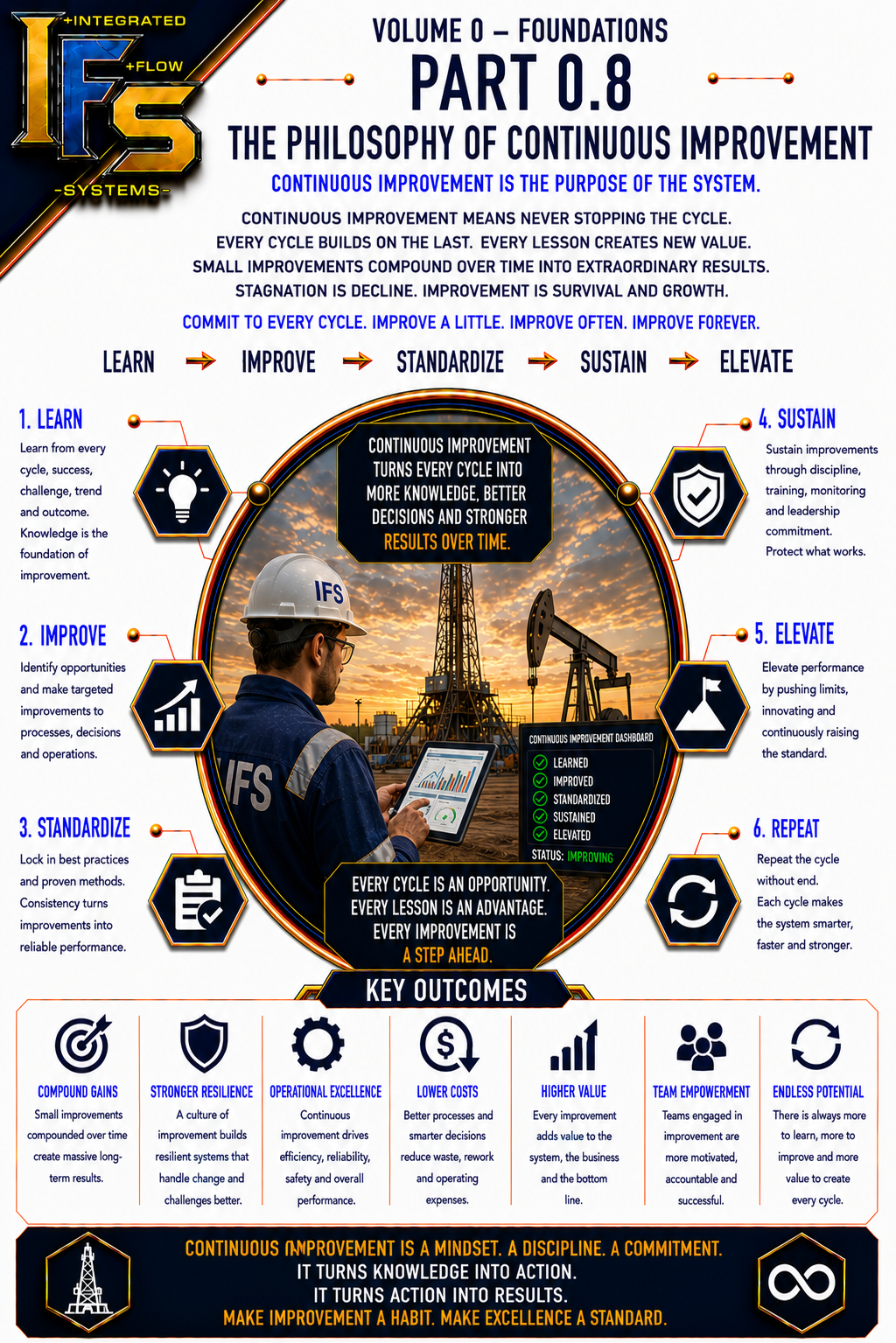
No industrial system is ever truly finished.
Markets change.
Equipment ages.
Processes evolve.
Technology advances.
Customer expectations increase.
Operating conditions shift.
Organizations that stop improving eventually begin falling behind.
Integrated Flow Systems (IFS) recognizes Continuous Improvement as the purpose of operational intelligence.
Every operational cycle creates new knowledge.
Every lesson creates an opportunity.
Every improvement strengthens the entire system.
Every operation produces results.
Every result teaches something.
A successful production run demonstrates what works.
A failure reveals what needs attention.
An unexpected trend exposes hidden Constraints.
An Opportunity Alert uncovers previously unseen potential.
IFS captures every operational cycle because each one adds to the organization's growing body of operational knowledge.
Improvement begins by learning from what the system has already experienced.
Continuous Improvement is rarely built through one dramatic breakthrough.
It is built through hundreds of small improvements.
Reducing connection time by thirty seconds.
Improving pump efficiency by two percent.
Eliminating one recurring shutdown.
Reducing unnecessary fuel consumption.
Increasing production consistency.
Removing one operational bottleneck.
Improving communication during shift changes.
Each improvement appears small by itself.
Over weeks, months, and years, those gains compound into substantial competitive advantages.
Small improvements become extraordinary results.
Finding a better way has little value if it disappears with the next shift.
Successful improvements must become repeatable.
IFS records proven operating methods, verified procedures, successful interventions, and effective operational practices through Snapshot Memory.
Once an improvement consistently produces better results, it becomes the new operational standard.
Standardization transforms individual success into organizational capability.
Knowledge becomes permanent rather than temporary.
Improvement is not simply discovering better methods.
It is protecting them.
Organizations often improve briefly before returning to old habits.
IFS monitors operational performance continuously to ensure successful improvements remain effective over time.
Performance is verified.
Procedures are reinforced.
Operators remain aligned.
Results continue to improve.
Sustaining improvement is just as important as creating it.
Every improvement increases the capability of the operation.
Higher efficiency.
Greater reliability.
Lower operating costs.
Reduced waste.
Improved safety.
Higher production quality.
Stronger environmental performance.
Better decision-making.
Greater operational resilience.
IFS encourages organizations to continually raise operational standards rather than simply maintain existing performance.
Today's best practice becomes tomorrow's baseline.
Continuous Improvement never ends.
Every completed cycle begins another.
Observe.
Measure.
Analyze.
Improve.
Verify.
Standardize.
Repeat.
Each cycle increases operational intelligence.
Each cycle strengthens organizational knowledge.
Each cycle creates new opportunities that were previously invisible.
The system becomes smarter because the organization becomes smarter.
One improved Node strengthens connected Flow Corridors.
Improved Corridors increase system throughput.
Better Exchanges increase value creation.
Improved Results strengthen future Decisions.
Better Decisions create stronger operational performance.
Knowledge flows throughout the organization.
One improvement made in one facility can improve dozens of others.
One solved problem can prevent hundreds of future failures.
One Opportunity Alert can establish a new operating standard across an entire company.
Continuous Improvement becomes organizational growth.
Integrated Flow Systems treats Continuous Improvement as the natural outcome of operational understanding.
Observe operations.
Capture knowledge.
Identify opportunities.
Remove Constraints.
Strengthen performance.
Record success.
Share knowledge.
Repeat forever.
This philosophy applies equally across oil and gas, mining, desalination, shipping, manufacturing, pulp and paper, chemical processing, utilities, logistics, transportation, agriculture, construction, and every industrial environment where better decisions create better results.
Continuous Improvement is not a project.
It is not an initiative.
It is not a department.
It is the operating philosophy of organizations that continue getting stronger while others remain unchanged.
Improve every cycle.
Capture every lesson.
Strengthen every decision.
Because every improvement creates value.
Every lesson builds knowledge.
Every cycle makes the system smarter.
And organizations that continuously improve continuously outperform.
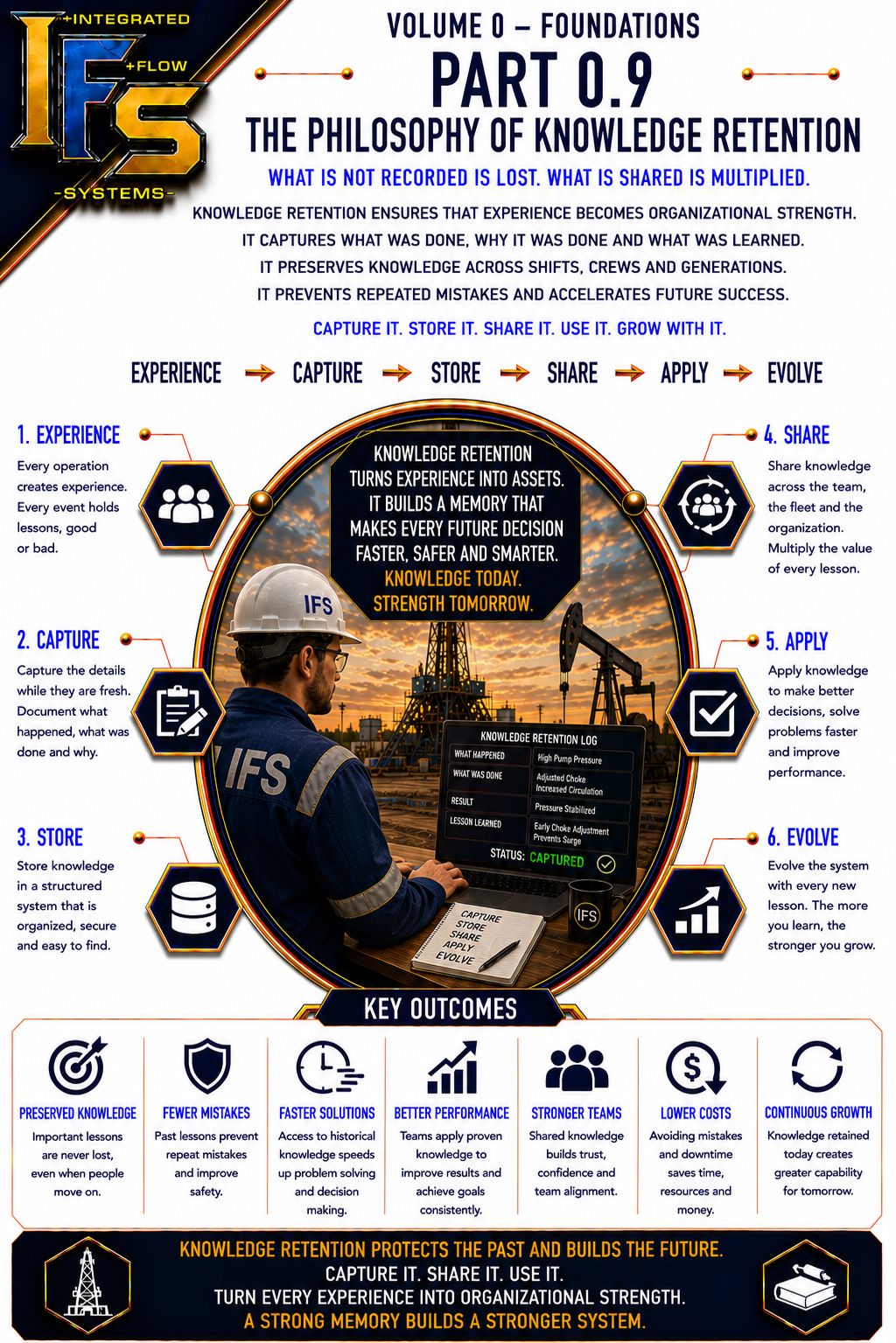
Every industrial operation creates knowledge.
Every shift uncovers experience.
Every investigation reveals new understanding.
Every success demonstrates what works.
Every failure exposes what does not.
The question is not whether knowledge is created.
The question is whether that knowledge survives.
Integrated Flow Systems (IFS) is built on the philosophy that Knowledge Retention transforms operational experience into permanent organizational intelligence.
Knowledge that is not captured disappears.
Knowledge that is retained strengthens every future decision.
No two operating days are exactly alike.
Equipment behaves differently.
Weather changes.
Production fluctuates.
Operators respond to unexpected events.
Maintenance teams solve new problems.
Engineers discover better methods.
Every one of these experiences contains operational value.
Left undocumented, those lessons often disappear when the shift ends.
IFS treats every operation as an opportunity to expand organizational knowledge.
The most valuable operational knowledge is often created during the event itself.
What changed?
What was observed?
What action was taken?
Why was that decision made?
What happened afterward?
IFS encourages operators to document these observations immediately through Snapshot Memory.
Capturing knowledge while events are fresh preserves details that would otherwise be forgotten.
Accurate memories create accurate operational history.
Information scattered across notebooks, emails, spreadsheets, or personal memory is difficult to retrieve when it matters most.
Knowledge must be organized.
IFS stores operational knowledge within a structured framework.
Snapshots.
Events.
Investigations.
Trend histories.
Corrective actions.
Opportunities.
Lessons learned.
Verified outcomes.
Because every record follows the same logical structure, operators can quickly locate relevant knowledge whenever similar situations occur again.
Knowledge becomes searchable instead of forgotten.
Experience should never remain isolated with one individual.
One operator's discovery can benefit an entire company.
One maintenance solution can prevent dozens of future failures.
One successful drilling adjustment can improve an entire field.
One shipping optimization can improve fleet-wide efficiency.
IFS encourages knowledge sharing across crews, departments, facilities, regions, fleets, and business units.
As knowledge spreads, organizational capability expands.
Individual experience becomes collective intelligence.
Retaining knowledge has no value unless it influences future decisions.
Operational history becomes useful when it answers questions such as:
Have we seen this before?
What caused it?
What action worked?
What failed?
How long did recovery take?
Can this solution be repeated?
IFS brings historical knowledge directly into operational decision-making.
Instead of starting every investigation from zero, organizations begin with everything they have already learned.
Past experience accelerates future performance.
Knowledge Retention is not static.
Every new event expands the organization's understanding.
Every verified solution increases confidence.
Every completed investigation improves future recognition.
Every Opportunity Alert creates new best practices.
Every avoided failure strengthens operational resilience.
Organizational Memory grows continuously because Snapshot Memory never stops learning from verified operational experience.
The system becomes more valuable with every operational cycle.
One of the greatest costs in industry is solving the same problem repeatedly.
Organizations often lose knowledge through retirements.
Staff turnover.
Shift changes.
Contract transitions.
Business growth.
Facility expansion.
Critical operational experience disappears because it was never formally retained.
IFS prevents this loss by transforming operational knowledge into permanent organizational assets.
The lesson remains even when the individual moves on.
The organization keeps improving instead of repeatedly relearning old lessons.
Integrated Flow Systems views Knowledge Retention as the foundation of sustainable operational excellence.
Experience creates knowledge.
Knowledge becomes memory.
Memory improves decisions.
Better decisions improve operations.
Improved operations create stronger results.
Stronger results generate even greater knowledge.
This philosophy applies equally across oil and gas, mining, desalination, shipping, manufacturing, pulp and paper, utilities, logistics, chemical processing, construction, agriculture, transportation, and every industrial environment where operational experience creates long-term value.
Knowledge is one of the few organizational assets that becomes more valuable every time it is shared.
Capture every lesson.
Record every improvement.
Preserve every discovery.
Share every success.
Because organizations that retain knowledge solve problems faster, avoid repeated mistakes, train new personnel more effectively, improve operational consistency, strengthen organizational resilience, reduce operational risk, and continuously increase performance through permanent operational intelligence.
Integrated Flow Systems (IFS) transforms operational experience into permanent organizational knowledge through Snapshot Memory, deterministic operational intelligence, structured learning, and continuous knowledge retention—ensuring every lesson strengthens every future decision across the entire industrial operation.

Operational Excellence is not achieved through one decision.
It is built through thousands of disciplined decisions made consistently over time.
Every process.
Every operator.
Every asset.
Every shift.
Every improvement.
Integrated Flow Systems (IFS) recognizes Operational Excellence as the natural result of applying every foundational principle together.
Strong Flows.
Healthy Nodes.
Efficient Exchanges.
Reliable Flow Corridors.
Deterministic Decisions.
Continuous Improvement.
Knowledge Retention.
When every part of the system improves together, operational excellence becomes the standard rather than the exception.
Every successful operation begins before work starts.
Objectives are defined.
Constraints are identified.
Resources are allocated.
Risks are evaluated.
Responsibilities are assigned.
Success is rarely accidental.
Planning creates clarity.
Clear plans reduce uncertainty, eliminate unnecessary variation, and prepare the operation for predictable execution.
IFS helps organizations understand the complete operational system before action begins.
Plans only create value when they are executed consistently.
Operators perform procedures.
Maintenance completes inspections.
Production follows established processes.
Supervisors monitor performance.
Engineers verify system behavior.
Discipline creates consistency.
Consistency creates reliability.
IFS supports disciplined execution by providing operators with structured operational intelligence instead of assumptions or guesswork.
Every action contributes toward the operational objective.
Operations cannot improve unless they remain under control.
Control means continuously understanding what is happening throughout the system.
Flow rates.
Pressure.
Temperature.
Production.
Equipment condition.
Energy consumption.
Resource utilization.
Operational Constraints.
IFS maintains visibility across connected operations through Snapshot Memory and deterministic monitoring.
When operators remain aware of changing conditions, they maintain control before problems become failures.
Control creates confidence.
Confidence creates stability.
Optimization is the continual process of making the system better.
Reduce unnecessary movement.
Improve resource utilization.
Increase throughput.
Lower operating costs.
Reduce energy consumption.
Improve reliability.
Remove Constraints.
Strengthen Flow Corridors.
Improve Node performance.
IFS identifies optimization opportunities by connecting operational trends across the entire system rather than focusing on isolated equipment.
The greatest improvements often come from understanding how the entire operation works together.
Outstanding performance is rarely dramatic.
It is usually consistent.
Operations that repeatedly achieve predictable results build trust.
Customers trust reliable organizations.
Operators trust proven systems.
Management trusts accurate information.
Investors trust consistent performance.
Communities trust responsible operations.
IFS promotes repeatable operational excellence through measurable standards rather than temporary improvements.
Consistency becomes a competitive advantage.
Operational Excellence is never permanent.
Organizations either improve or decline.
Equipment changes.
Technology evolves.
Markets shift.
Customer expectations increase.
IFS ensures operational excellence continues by continually learning from experience.
Every investigation.
Every Opportunity Alert.
Every Risk Alert.
Every improvement.
Every operational cycle strengthens organizational knowledge.
Excellence is sustained because learning never stops.
Many organizations attempt to improve isolated processes.
IFS improves the entire operational network.
Flows become more efficient.
Nodes become healthier.
Exchanges become more effective.
Flow Corridors become stronger.
Knowledge becomes permanent.
Decisions become smarter.
Operators become more confident.
Performance improves naturally because every component supports every other component.
Operational Excellence is created through system integration rather than isolated optimization.
Integrated Flow Systems views Operational Excellence as the practical application of every foundational principle working together.
Observe accurately.
Measure consistently.
Understand relationships.
Remove Constraints.
Capture knowledge.
Strengthen decisions.
Improve continuously.
Protect value.
Repeat every operational cycle.
This philosophy applies equally across oil and gas, mining, desalination, world shipping, manufacturing, logistics, utilities, pulp and paper, chemical processing, agriculture, construction, transportation, and every industrial organization seeking safer operations, greater efficiency, stronger reliability, higher profitability, and sustainable long-term performance.
Operational Excellence is not a destination.
It is the way an organization chooses to operate every day.
Build stronger Flows.
Build stronger Nodes.
Build stronger Corridors.
Build stronger Decisions.
Build stronger Knowledge.
Because organizations built on strong operational foundations consistently outperform those built on isolated improvements.
Integrated Flow Systems (IFS) provides a deterministic framework for Operational Excellence by integrating Flow Systems Management, Snapshot Memory, operational intelligence, continuous improvement, knowledge retention, and measurable decision-making into one connected operational philosophy that helps organizations achieve safer operations, higher efficiency, stronger reliability, lower costs, greater profitability, and continuous operational improvement across every industrial sector.
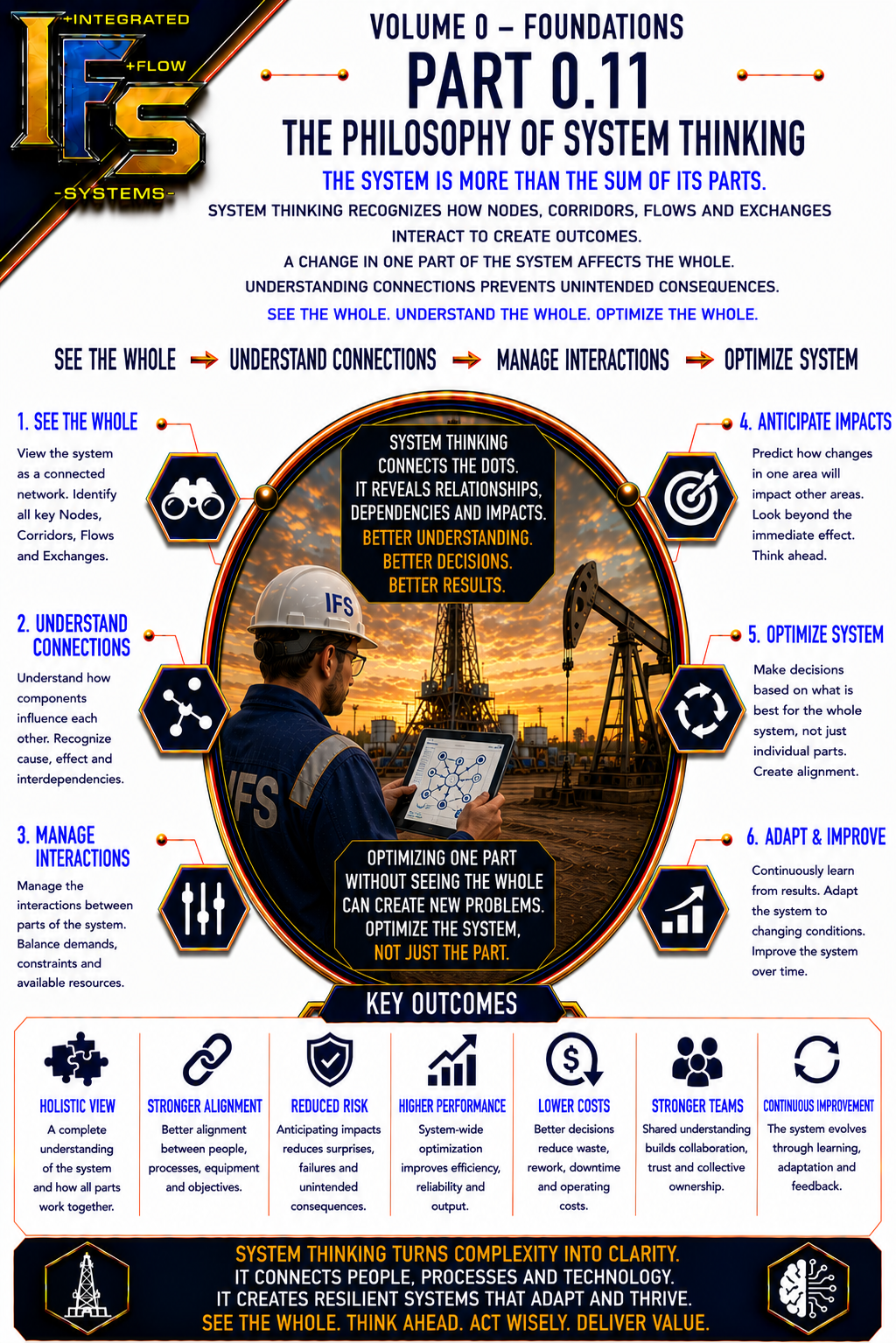
Every industrial operation is a system.
Not a collection of independent assets.
Not isolated departments.
Not individual pieces of equipment.
A true operational system is a network of connected Flows, Nodes, Exchanges, Flow Corridors, Constraints, Decisions, and Results that continuously influence one another.
Integrated Flow Systems (IFS) is built on the principle that understanding individual components is valuable—but understanding how those components interact is where operational intelligence is created.
The greatest opportunities and the greatest risks rarely exist within a single component.
They exist in the relationships between them.
Every operation is larger than any one machine, process, or department.
A drilling rig is more than drilling equipment.
A mine is more than haul trucks.
A refinery is more than process units.
A shipping fleet is more than vessels.
A desalination plant is more than membranes and pumps.
Each operation is a living network of interconnected activities.
When one Flow changes, other Flows respond.
When one Node becomes constrained, downstream performance changes.
When one operational decision is made, dozens of secondary effects may follow.
IFS begins by helping operators see the complete operational picture rather than isolated snapshots.
Understanding the whole system provides context that individual measurements cannot.
No operational event happens alone.
Pressure influences flow.
Flow influences production.
Production influences storage.
Storage influences transportation.
Transportation influences customers.
Maintenance influences reliability.
Reliability influences profitability.
Everything connects.
IFS maps these relationships so operators understand not only what is happening, but why it is happening and what else may be affected.
Understanding relationships transforms data into operational knowledge.
Operations are defined by interaction.
People interact with equipment.
Equipment interacts with materials.
Materials interact with chemistry.
Chemistry interacts with temperature.
Temperature influences pressure.
Pressure affects production.
Every interaction creates consequences.
Managing one variable without understanding its interaction with the rest of the system often shifts problems rather than solving them.
IFS helps organizations manage operational interactions instead of chasing isolated symptoms.
The objective is system balance rather than localized optimization.
Every decision creates future effects.
Some appear immediately.
Others emerge hours, days, weeks, or months later.
Increasing production may overload downstream processing.
Reducing maintenance may increase equipment failures.
Changing one operating parameter may improve one area while unintentionally reducing performance somewhere else.
System Thinking allows operators to anticipate these secondary effects before they become operational problems.
IFS continuously evaluates how changes propagate throughout the operational network, helping organizations make decisions that strengthen the whole system rather than one department.
One of the most common mistakes in industrial operations is optimizing individual components while reducing total system performance.
A pump may become more efficient while creating downstream bottlenecks.
A production increase may overwhelm transportation capacity.
A faster drilling process may create additional completion challenges.
A refinery may improve throughput while increasing maintenance demands.
Local optimization is not always system optimization.
IFS evaluates improvements across the complete operational network, ensuring gains in one area do not create larger Constraints elsewhere.
The objective is always total system performance.
No system remains static.
Operating conditions change.
Equipment ages.
Markets evolve.
Environmental conditions shift.
New technologies emerge.
Operational intelligence must evolve with the system.
IFS combines System Thinking with Snapshot Memory, allowing every completed cycle, investigation, Opportunity Alert, Risk Alert, operational improvement, and verified solution to strengthen future decision making.
The operational network becomes progressively smarter because every lesson becomes permanent organizational knowledge.
Integrated Flow Systems teaches organizations to think beyond individual assets and individual events.
See the complete Flow.
Understand every relationship.
Recognize operational dependencies.
Manage interactions.
Anticipate consequences.
Optimize the entire system.
Learn continuously.
Improve continuously.
This philosophy applies equally across oil and gas, mining, desalination, world shipping, manufacturing, logistics, utilities, pulp and paper, chemical processing, transportation, agriculture, construction, municipal infrastructure, and every complex industrial operation where connected systems determine operational success.
The strongest organizations are not those with the best individual equipment.
They are the organizations that understand how every part works together.
Because operational excellence is never created by improving one component alone.
It is created by improving the entire connected system.
Integrated Flow Systems (IFS) applies deterministic System Thinking to industrial operations by connecting Flows, Nodes, Exchanges, Flow Corridors, Constraints, Snapshot Memory, operational intelligence, and continuous improvement into one unified operational framework that helps organizations improve reliability, reduce operational risk, optimize total system performance, strengthen decision-making, increase profitability, and achieve sustainable operational excellence across every industrial sector.

Every successful operation is built on discipline.
Every world-class operation is sustained by consistency.
Technology can improve performance.
Knowledge can improve decisions.
Experience can improve judgment.
But none of these produce reliable results unless the right actions are performed consistently, every shift, every crew, and every operating cycle.
Integrated Flow Systems (IFS) recognizes that operational excellence is not created by occasional success.
It is created by disciplined execution repeated so consistently that excellence becomes the normal operating condition.
Every operation begins with a decision.
A decision to follow procedures.
A decision to perform inspections.
A decision to collect accurate data.
A decision to communicate clearly.
A decision to complete every task correctly.
Discipline begins before the first Flow moves through the system.
It begins with commitment.
IFS establishes repeatable operational standards that allow every crew member to understand exactly what success looks like before work begins.
Consistency starts with shared expectations.
Complex industrial systems generate enormous amounts of information.
Not every measurement deserves equal attention.
Not every event requires immediate intervention.
Discipline means focusing on the variables that truly drive system performance.
Pressure.
Flow.
Temperature.
Production.
Energy.
Equipment condition.
Safety.
Operational Constraints.
Snapshot Memory helps operators distinguish meaningful changes from normal operational variation so attention remains focused on the variables that create the greatest operational value.
Focused attention reduces distractions, improves decision quality, and prevents important signals from being overlooked.
Many operational failures do not begin because the wrong decision was made.
They begin because the correct decision was only partially implemented.
Procedures are skipped.
Measurements are delayed.
Inspections are incomplete.
Documentation is postponed.
Small shortcuts accumulate into larger operational risks.
IFS encourages disciplined execution from beginning to end.
Observe.
Measure.
Record.
Verify.
Review.
Complete every step.
Consistency is created when every operational cycle is finished with the same level of attention that it began.
Consistency is repetition with purpose.
When the same proven process is repeated over hundreds or thousands of operational cycles, it becomes organizational culture.
Culture cannot be installed.
It is built.
One disciplined action at a time.
Every completed checklist.
Every accurate Snapshot.
Every verified investigation.
Every documented lesson.
Every standardized procedure strengthens organizational reliability.
Reliable organizations are simply disciplined organizations operating consistently over time.
Operational excellence rarely comes from extraordinary actions.
It comes from mastering ordinary actions.
Taking accurate measurements.
Following established procedures.
Communicating effectively.
Learning from results.
Improving processes.
Protecting safety.
Maintaining equipment.
Managing Constraints.
Organizations that consistently master the fundamentals outperform organizations that constantly search for shortcuts.
IFS reinforces these fundamentals by providing a structured operational framework that supports disciplined execution every day.
Improvement only creates value if it lasts.
Temporary gains disappear when discipline fades.
Consistency protects progress.
Standardized operating procedures.
Continuous monitoring.
Snapshot Memory.
Knowledge Retention.
Trend Analysis.
Performance Reviews.
These systems ensure that improvements become permanent operational capabilities rather than temporary successes.
Every completed cycle strengthens the next one.
Every lesson improves future performance.
Every disciplined action compounds into long-term operational excellence.
Integrated Flow Systems recognizes that systems do not become exceptional because they occasionally perform well.
They become exceptional because they perform well consistently.
Discipline transforms intention into action.
Consistency transforms action into habit.
Habits create culture.
Culture creates reliability.
Reliability creates trust.
Trust creates operational excellence.
This philosophy applies across every industrial environment, including oil and gas, mining, desalination, manufacturing, world shipping, logistics, utilities, construction, chemical processing, agriculture, transportation, municipal infrastructure, and every complex operation where repeatable performance determines long-term success.
The strongest systems are not built on perfect days.
They are built on disciplined days repeated over years.
Because operational excellence is never accidental.
It is practiced until it becomes permanent.
Integrated Flow Systems (IFS) strengthens industrial performance by combining deterministic operational intelligence, standardized workflows, Snapshot Memory, Knowledge Retention, disciplined execution, and continuous improvement into a repeatable operational framework that reduces variability, improves reliability, increases safety, lowers operating costs, strengthens decision-making, and builds a culture of operational excellence across every industrial sector.
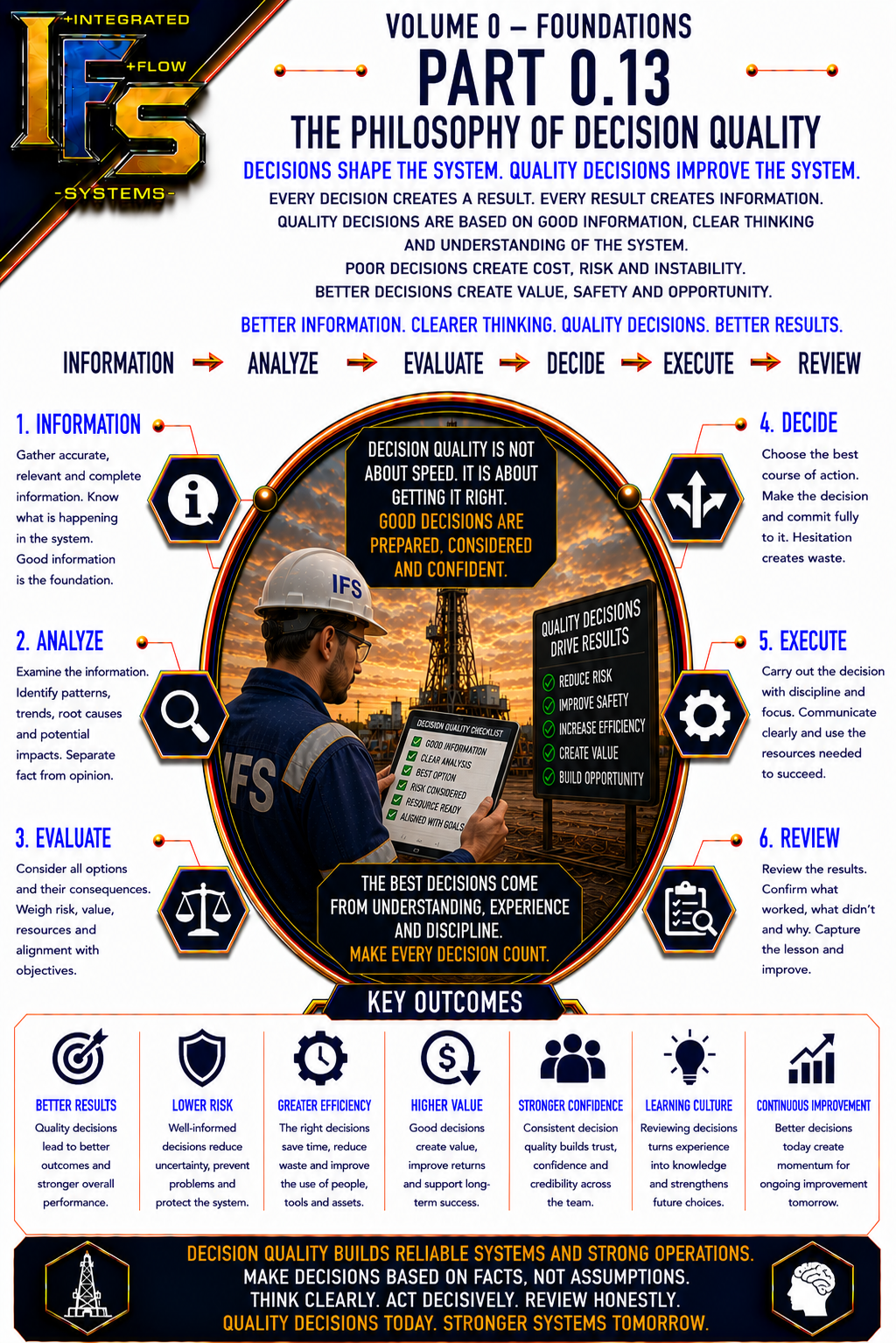
Every industrial operation is shaped by decisions.
Every adjustment to a valve.
Every maintenance schedule.
Every production target.
Every drilling parameter.
Every routing choice.
Every safety response.
Every operational improvement begins with a decision.
Some decisions create value.
Others create waste.
The difference is rarely luck.
It is the quality of the information, the clarity of the thinking, and the discipline used before the decision is made.
Integrated Flow Systems (IFS) exists to improve decision quality by ensuring that every important operational decision is based on facts, relationships, verified trends, and deterministic operational intelligence rather than assumptions or guesswork.
Good decisions begin long before anyone chooses a course of action.
They begin with accurate information.
Incomplete data creates uncertainty.
Poor measurements create poor conclusions.
Missing context creates unnecessary risk.
IFS starts by gathering operational information from across the system.
Flows.
Nodes.
Exchanges.
Equipment conditions.
Production trends.
Historical performance.
Snapshot Memory.
Operator observations.
Constraint development.
The objective is simple.
Understand what is actually happening before deciding what to do.
Reliable information is the foundation of reliable operations.
Information alone does not improve performance.
It must be understood.
Analysis identifies relationships that raw data cannot reveal.
Patterns.
Trends.
Dependencies.
Operational interactions.
Emerging Constraints.
Opportunity formation.
Root causes.
Instead of reacting to isolated measurements, IFS analyzes how the complete operational system behaves over time.
This transforms information into operational understanding.
Good analysis prevents expensive assumptions.
Most operational situations have more than one possible response.
Increase production.
Reduce production.
Adjust pressure.
Modify chemistry.
Change scheduling.
Monitor longer.
Investigate further.
Intervene immediately.
Each option carries different costs, risks, benefits and long-term consequences.
IFS evaluates decisions against the complete operational picture.
How will this affect upstream operations?
What changes downstream?
Does it reduce Constraints?
Does it create new ones?
Will today's solution become tomorrow's problem?
System Thinking ensures every option is evaluated within the context of the entire operation.
Decision quality is not measured by speed.
It is measured by correctness.
Fast decisions based on poor information often create expensive problems.
Delayed decisions during developing operational events create different risks.
IFS provides deterministic operational intelligence that allows operators to make timely, confident decisions supported by verified observations rather than intuition alone.
Confidence comes from understanding.
Not guessing.
Every decision should be explainable, repeatable, and supported by evidence.
Even the best decision has no value if it is poorly executed.
Execution requires communication.
Coordination.
Resources.
Verification.
Accountability.
IFS connects operational decisions directly to execution by documenting what was decided, why it was chosen, what actions were taken, and how the system responded afterward.
Every execution becomes measurable.
Every action becomes traceable.
Every outcome becomes part of organizational knowledge.
No decision is complete until its results are understood.
Did it solve the original problem?
Did it improve performance?
Did it create unexpected consequences?
Should the response become standard practice?
Should it never be repeated?
IFS closes every decision cycle through structured review.
Results are compared against expectations.
Lessons are captured.
Snapshot Memory records both successful and unsuccessful outcomes.
Every completed review improves the quality of future decisions.
The organization becomes progressively smarter because every decision contributes to permanent operational knowledge.
Integrated Flow Systems recognizes that organizations do not improve simply by collecting more information.
They improve by making better decisions.
Gather accurate information.
Analyze the system.
Evaluate the options.
Decide with confidence.
Execute with discipline.
Review honestly.
Learn continuously.
Repeat every cycle.
This philosophy applies across oil and gas, mining, world shipping, desalination, manufacturing, utilities, logistics, chemical processing, construction, agriculture, transportation, municipal infrastructure, and every industrial environment where operational decisions influence safety, reliability, efficiency, profitability, and long-term success.
The strongest organizations are not those that make the most decisions.
They are the organizations that consistently make the best decisions.
Because every decision shapes the future of the system.
And better decisions create better systems.
Integrated Flow Systems (IFS) improves industrial decision quality by combining deterministic operational intelligence, Snapshot Memory, System Thinking, operational analysis, Knowledge Retention, trend recognition, and continuous improvement into a structured decision framework that reduces uncertainty, lowers operational risk, strengthens safety, improves productivity, increases profitability, and helps organizations consistently make better operational decisions across every industrial sector.
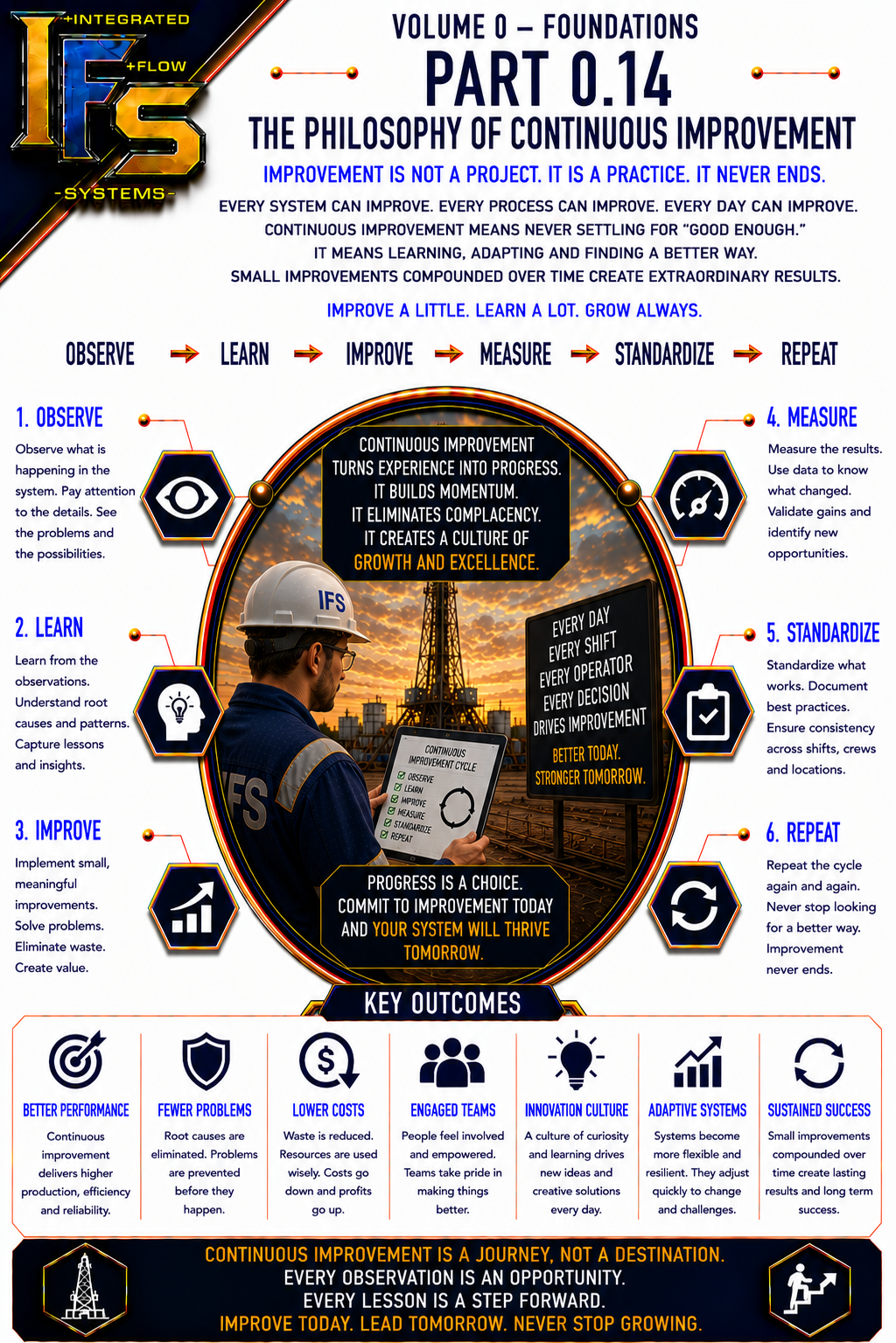
No industrial system is ever finished.
No operation is ever perfect.
No process reaches a point where it can no longer improve.
Every system has opportunities that have not yet been discovered.
Every shift creates new experience.
Every decision produces new knowledge.
Every completed operational cycle offers another opportunity to make the next one stronger.
Integrated Flow Systems (IFS) is founded on the belief that continuous improvement is not a separate program or occasional initiative.
It is the natural operating cycle of every successful organization.
Improvement is not something performed once.
It is something practiced every day.
Every improvement begins with observation.
Operators see changes.
Instrumentation detects trends.
Snapshot Memory identifies patterns.
Knowledge Retention preserves experience.
Results expose opportunities.
IFS encourages organizations to observe the system objectively rather than relying on assumptions.
Small operational changes often appear long before larger problems or opportunities become obvious.
The organizations that improve fastest are those that learn to recognize these early signals.
Observation creates awareness.
Awareness creates opportunity.
Every operational cycle teaches something.
Successful production runs reveal best practices.
Equipment failures reveal hidden weaknesses.
Operator observations expose practical improvements.
Near misses improve safety.
Opportunity Alerts reveal untapped potential.
Risk Alerts expose developing Constraints.
IFS captures these lessons through deterministic operational intelligence and Snapshot Memory so valuable experience is never lost when shifts change, projects finish, or personnel retire.
Knowledge compounds.
Every lesson becomes an asset.
Improvement should never be random.
It should target the areas that create the greatest operational value.
Reducing bottlenecks.
Improving throughput.
Increasing reliability.
Reducing energy consumption.
Improving product quality.
Increasing equipment life.
Reducing downtime.
Improving safety.
Strengthening decision quality.
IFS prioritizes improvements by understanding how each change affects the complete operational system.
The objective is sustainable operational progress, not isolated optimization.
Improvement without measurement is opinion.
Operational excellence requires evidence.
Did production increase?
Did downtime decrease?
Did reliability improve?
Did maintenance costs decline?
Did safety improve?
Did energy efficiency increase?
Did Constraints become smaller?
IFS continuously measures operational results so organizations know exactly which improvements are creating measurable value and which require additional refinement.
Facts replace assumptions.
Performance becomes visible.
An improvement only creates lasting value when it becomes standard practice.
Successful operating procedures should not remain isolated to one crew or one location.
They should become part of organizational knowledge.
IFS transforms verified improvements into repeatable operational standards.
Documented procedures.
Knowledge Retention.
Snapshot Memory.
Operational playbooks.
Historical comparisons.
Standardization ensures that every future operator benefits from every previous success.
Organizational intelligence grows continuously.
Continuous improvement is exactly that.
Continuous.
The cycle never finishes.
Observe.
Learn.
Improve.
Measure.
Standardize.
Repeat.
Every completed cycle strengthens the next.
Every improvement creates new opportunities.
Every lesson increases operational intelligence.
Organizations that continuously improve rarely experience sudden breakthroughs.
Instead, they experience thousands of small improvements that compound into extraordinary long-term performance.
Integrated Flow Systems recognizes that operational excellence is not created through occasional innovation alone.
It is created through relentless improvement.
Observe carefully.
Learn continuously.
Improve deliberately.
Measure honestly.
Standardize success.
Repeat forever.
This philosophy applies across oil and gas, mining, world shipping, desalination, manufacturing, logistics, utilities, chemical processing, construction, agriculture, transportation, municipal infrastructure, and every industrial operation where performance is built one operational cycle at a time.
The strongest organizations never believe they have finished improving.
They understand that every system can become more reliable.
Every process can become more efficient.
Every decision can become smarter.
Every operator can become more capable.
Because improvement is not the destination.
Improvement is the operating system.
Integrated Flow Systems (IFS) transforms continuous improvement into a structured operational process by combining deterministic operational intelligence, Snapshot Memory, Knowledge Retention, trend analysis, System Thinking, measurable performance data, standardized best practices, and continuous learning to help industrial organizations improve reliability, increase efficiency, reduce costs, strengthen safety, optimize operational performance, and build a permanent culture of operational excellence across every industry.

Knowledge is one of the few resources that becomes more valuable every time it is used.
Unlike fuel, materials, or equipment, knowledge does not diminish through application.
It grows.
Every solved problem.
Every completed project.
Every operational improvement.
Every successful decision.
Every failure investigated.
Every lesson learned strengthens the organization—provided it is captured, preserved, and shared.
Integrated Flow Systems (IFS) transforms operational experience into organizational intelligence through structured Knowledge Retention and Snapshot Memory.
Experience alone creates expertise.
Shared experience creates operational excellence.
Every shift produces experience.
Operators observe changing conditions.
Technicians solve unexpected problems.
Supervisors make difficult decisions.
Engineers optimize performance.
Maintenance teams identify failure patterns.
These experiences contain operational value that often disappears when they remain only in human memory.
IFS begins by recognizing that every operational event is a learning opportunity.
Good outcomes reveal best practices.
Poor outcomes reveal opportunities for improvement.
Every experience has something to teach.
The greatest operational lessons are often forgotten because they are never documented.
An experienced operator retires.
A project ends.
A contractor leaves.
A shift changes.
The knowledge disappears.
IFS captures operational knowledge while it is still fresh.
What happened?
Why did it happen?
What decision was made?
What action was taken?
What was the result?
Would the same solution work again?
Every investigation becomes permanent operational memory.
Every lesson becomes searchable organizational knowledge.
Knowledge has little value if it cannot be found.
Scattered notebooks.
Individual spreadsheets.
Personal experience.
Disconnected reports.
These create isolated pockets of information.
IFS organizes knowledge into structured operational memory linked directly to Flows, Nodes, Equipment, Constraints, Snapshot History, Decisions, and Results.
Instead of searching through years of reports, operators can immediately retrieve similar operational situations and verified historical solutions.
Knowledge becomes available exactly when it is needed.
Knowledge becomes exponentially more valuable when it is shared.
One successful solution should never benefit only one crew.
One important lesson should never remain isolated to one facility.
IFS allows verified operational knowledge to flow throughout the organization.
Across shifts.
Across departments.
Across facilities.
Across fleets.
Across industries.
As operational memory expands, every operator begins each day with the accumulated experience of everyone who came before.
Organizations stop repeating solved problems.
They begin building upon previous success.
Knowledge only creates value when it influences decisions.
Historical memory should not exist simply as documentation.
It should actively improve operations.
IFS integrates Knowledge Retention directly into operational decision-making.
When similar conditions appear, Snapshot Memory compares current operational patterns with verified historical events.
Successful responses become recommendations.
Failed approaches become warnings.
Past experience actively improves present performance.
Knowledge becomes operational intelligence.
Organizations evolve one lesson at a time.
Every completed investigation strengthens future decisions.
Every Opportunity Alert expands organizational capability.
Every Risk Alert improves prevention.
Every standardized improvement increases consistency.
Every operational cycle contributes to a stronger system.
IFS ensures that operational intelligence grows continuously because knowledge never stops accumulating.
The organization becomes progressively more capable without losing what it has already learned.
Integrated Flow Systems recognizes that knowledge is one of the most valuable assets any organization possesses.
Experience creates knowledge.
Knowledge builds memory.
Memory improves decisions.
Better decisions improve operations.
Better operations create new knowledge.
The cycle never ends.
Capture every lesson.
Protect every insight.
Share every success.
Apply every improvement.
Build upon every experience.
This philosophy applies across oil and gas, mining, desalination, world shipping, manufacturing, logistics, utilities, chemical processing, agriculture, transportation, municipal infrastructure, construction, and every industrial environment where operational knowledge creates competitive advantage.
Organizations do not become exceptional because they avoid mistakes.
They become exceptional because they remember them.
And because they ensure those lessons are never learned twice.
Integrated Flow Systems (IFS) transforms operational experience into permanent organizational intelligence by combining Knowledge Retention, Snapshot Memory, deterministic operational analysis, historical pattern recognition, System Thinking, continuous improvement, and structured operational learning to help industrial organizations preserve expertise, improve decision quality, reduce repeated failures, strengthen workforce capability, accelerate operational excellence, and build a continuously expanding knowledge system across every industrial sector.
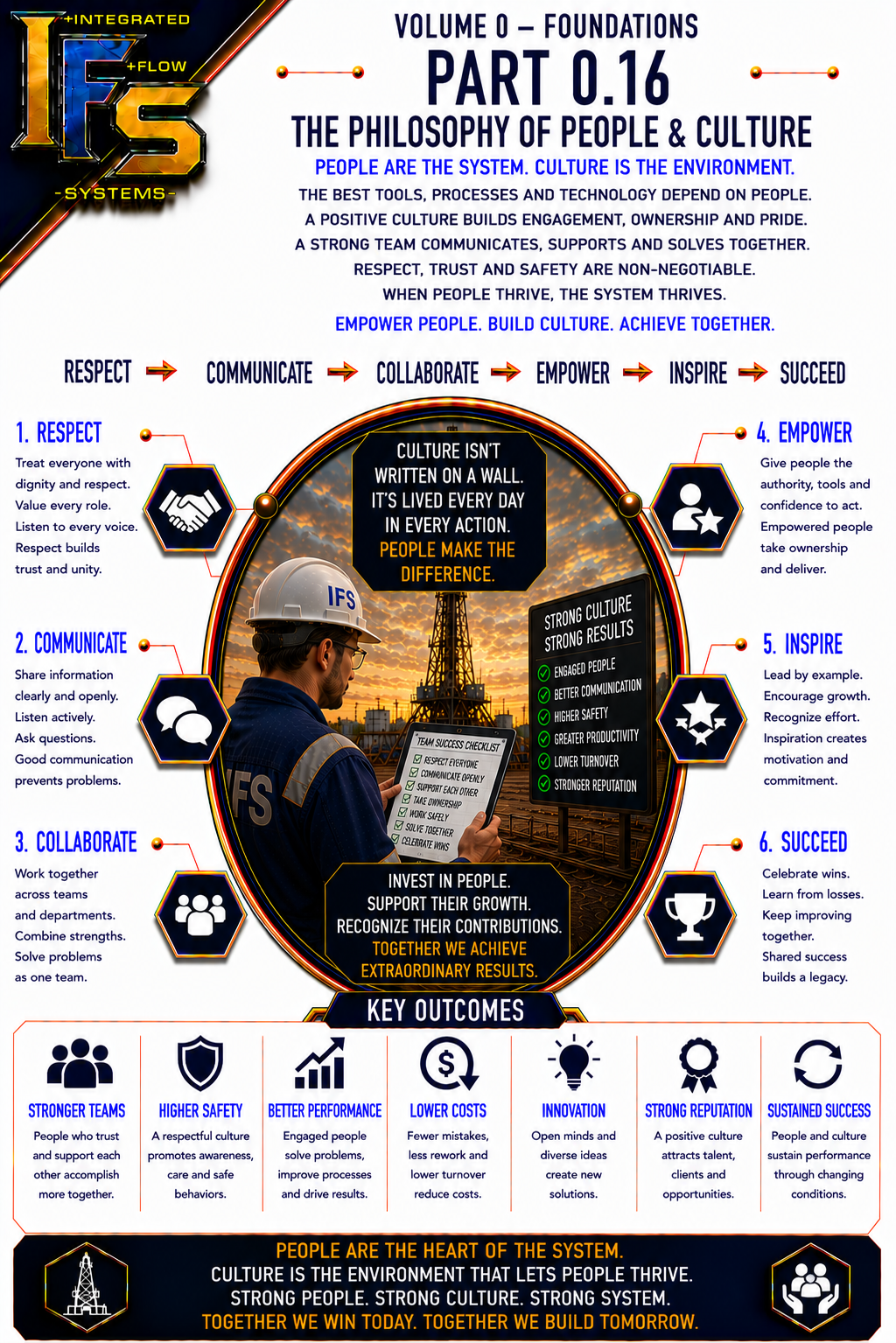
Technology can improve an operation.
Processes can standardize an operation.
Equipment can increase capacity.
But people determine whether any of it succeeds.
Integrated Flow Systems (IFS) recognizes that every industrial system ultimately depends on the people who operate it. Equipment may move materials, fluids, energy and information, but people make the decisions that determine whether those movements create value or create problems.
Culture is not a motivational slogan.
It is the collection of daily behaviors, decisions, communication, accountability and leadership that determine how consistently an organization performs.
Strong systems require strong people.
Strong people thrive within strong cultures.
Every successful operation begins with mutual respect.
Respect for experience.
Respect for knowledge.
Respect for safety.
Respect for procedures.
Respect for every role within the operation.
From field operators and maintenance technicians to engineers, supervisors and executives, every individual contributes to the performance of the larger system.
IFS treats operational knowledge as valuable regardless of where it originates.
Good ideas are not defined by job title.
They are defined by results.
Organizations that respect people encourage observation, reporting and continuous improvement without fear of blame.
Many operational problems do not begin as mechanical failures.
They begin as communication failures.
Incomplete shift handovers.
Missing information.
Assumptions.
Poor documentation.
Unreported observations.
Delayed decisions.
IFS strengthens communication by providing every operator with a common operational language built around Flows, Nodes, Exchanges, Constraints, Trends, Decisions and Results.
Instead of opinions competing with opinions, teams discuss measurable system behavior.
Everyone sees the same operational picture.
Everyone works from the same operational memory.
Industrial operations are rarely isolated.
Maintenance affects production.
Production affects logistics.
Engineering affects operations.
Operations affect safety.
Planning affects every department.
IFS encourages cross-functional collaboration because every decision influences multiple parts of the system.
System Thinking allows specialists to contribute their expertise while understanding how their decisions affect the larger operation.
When departments collaborate instead of competing, the entire organization performs more effectively.
People perform best when they understand why they are doing something, not simply what they are told to do.
IFS gives operators visibility into system behavior.
Snapshot Memory provides historical context.
Knowledge Retention preserves previous experience.
Trend Monitoring explains operational direction.
Deterministic Operational Intelligence supports objective decision-making.
Rather than replacing human judgment, IFS strengthens it.
Confident operators make better decisions.
Better decisions create stronger operations.
Culture is established through leadership.
Leaders influence what is rewarded.
What is tolerated.
What is expected.
What becomes normal.
Organizations committed to continuous improvement encourage curiosity, accountability, professionalism and learning.
Mistakes become opportunities to improve rather than reasons to assign blame.
Successes become lessons that strengthen the entire organization.
Leaders who invest in people create organizations capable of sustained excellence.
Individual performance matters.
Team performance determines organizational success.
Strong teams share knowledge.
Support each other.
Communicate openly.
Solve problems together.
Learn continuously.
Celebrate improvement.
IFS helps create this environment by giving every team member access to the same operational framework, allowing knowledge to move throughout the organization instead of remaining isolated within individuals or departments.
Success becomes repeatable because the organization improves together.
Integrated Flow Systems recognizes that people remain the most important component of every operational system.
Processes matter.
Technology matters.
Equipment matters.
But people connect all of them.
A culture built on respect, communication, collaboration, accountability and continuous learning creates organizations capable of sustained operational excellence.
When people understand the system, they improve the system.
When they trust each other, they strengthen the system.
When they share knowledge, the system evolves.
Strong people.
Strong culture.
Strong operations.
Strong organizations.
This philosophy applies equally across oil and gas, mining, desalination, shipping, manufacturing, utilities, transportation, logistics, chemical processing, agriculture, municipal infrastructure, construction and every industry where people work together to manage complex operational systems.
Because operational excellence is never created by technology alone.
It is created by people who understand the system, trust one another, continuously improve, and work together toward a common purpose.
Integrated Flow Systems (IFS) strengthens industrial organizations by combining structured operational knowledge, Snapshot Memory, deterministic decision support, Knowledge Retention, System Thinking, continuous improvement, and a shared operational language that empowers people, builds collaborative cultures, improves communication, supports safer decisions, increases operational reliability, and creates long-term organizational excellence across every industrial sector.

Every industrial system depends on people making decisions, performing actions and accepting responsibility for the outcomes.
Equipment cannot hold itself accountable.
Processes cannot admit mistakes.
Technology cannot build trust.
Only people can.
Integrated Flow Systems (IFS) recognizes accountability as one of the fundamental characteristics of operational excellence. It transforms procedures into reliable execution, decisions into measurable results, and individuals into trusted members of a high-performing organization.
Accountability is not about assigning blame after something goes wrong.
It is about taking ownership before problems grow.
Every person within an operation owns something.
An operator owns observations.
A technician owns maintenance quality.
A supervisor owns leadership.
An engineer owns design decisions.
Management owns organizational direction.
No role is disconnected from the larger system.
IFS encourages every individual to understand how their decisions influence downstream operations, safety, productivity and long-term performance.
Ownership means accepting responsibility for both successes and failures.
Not because someone is watching.
Because the system depends on it.
Plans only create value when people follow them.
Procedures only improve performance when they are consistently executed.
Standards only matter when they become daily habits.
IFS reinforces operational commitment through structured processes, Snapshot Memory, standardized decision pathways and Knowledge Retention.
Teams know what is expected.
They know why it matters.
They understand how their work connects to the entire operational system.
Reliability is not created by chance.
It is built through consistent commitment.
Knowing what should be done is only the beginning.
Operational excellence requires action.
Correct inspections.
Accurate reporting.
Timely maintenance.
Disciplined execution.
Continuous monitoring.
Effective intervention.
IFS encourages decisive action based on measurable evidence rather than assumptions.
Every completed action becomes another verified data point that strengthens operational knowledge.
Responsibility without action produces no improvement.
Action transforms accountability into measurable results.
Hidden problems become larger problems.
Delayed reporting increases operational risk.
Incomplete information creates poor decisions.
Transparent reporting allows organizations to recognize developing trends before they become operational failures.
IFS encourages factual reporting.
Not blame.
Not opinion.
Not politics.
Operators record what happened.
Snapshot Memory preserves the evidence.
Decision makers work from facts rather than assumptions.
Transparency protects both people and assets.
Every outcome provides information.
Successful decisions demonstrate effective practices.
Failures reveal opportunities for improvement.
Near misses expose hidden risks before major incidents occur.
IFS captures these lessons through Knowledge Retention so that every investigation strengthens future operations.
Organizations that learn continuously require fewer repeated investigations because previous experience remains available to every future decision maker.
Every lesson strengthens accountability across the organization.
Accountability is never static.
Every completed task creates an opportunity to improve.
Processes become more efficient.
Communication becomes clearer.
Training becomes more effective.
Standards become stronger.
Teams become more capable.
IFS transforms accountability into a continuous improvement cycle where every observation, decision, action and result contributes to a stronger operational system.
Small improvements repeated consistently create extraordinary long-term performance.
Integrated Flow Systems views accountability as the foundation of professional operations.
It creates trust.
It strengthens communication.
It improves decision quality.
It protects safety.
It preserves operational knowledge.
It reduces risk.
Most importantly, it builds organizations where every individual understands both their responsibility and their contribution to the success of the entire system.
When people own their work, systems become more reliable.
When teams report honestly, decisions become more accurate.
When organizations learn from every outcome, excellence becomes repeatable.
Accountability is not about finding someone to blame.
It is about creating an organization where everyone contributes to making the system stronger than it was yesterday.
This philosophy applies across oil and gas, mining, shipping, desalination, manufacturing, utilities, logistics, transportation, chemical processing, construction, municipal infrastructure and every complex industrial operation where safety, reliability and performance depend on disciplined execution and responsible decision-making.
Because operational excellence is built one accountable decision at a time.
And every accountable decision strengthens the entire system.
Integrated Flow Systems (IFS) strengthens industrial organizations by combining accountability, deterministic operational intelligence, Snapshot Memory, Knowledge Retention, structured decision support, transparent reporting, continuous improvement, and system-wide operational visibility to help teams reduce risk, improve safety, strengthen reliability, enhance decision quality, and build a culture of ownership across every industrial sector.
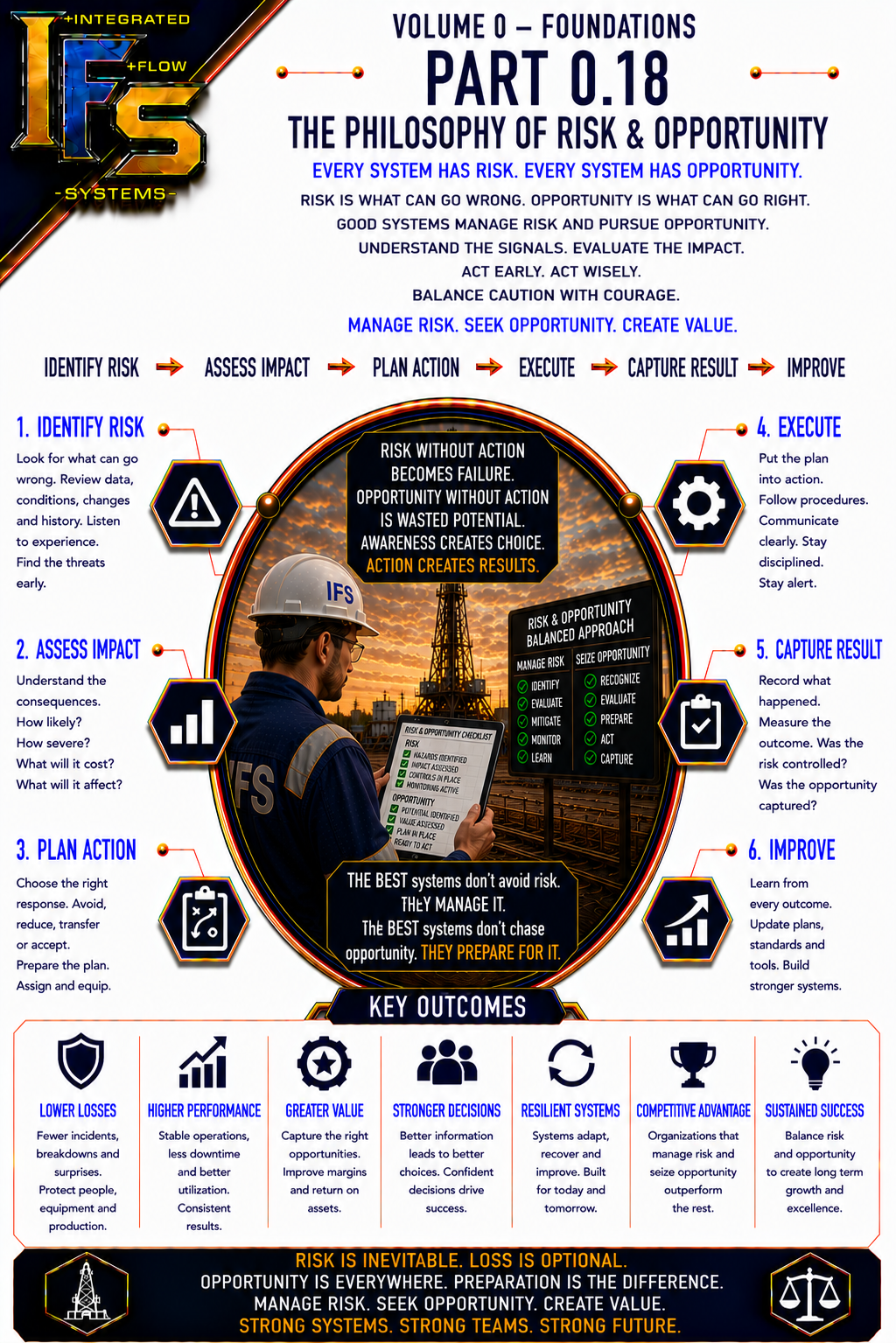
Every industrial system is built on equipment, processes, technology and information.
But none of those can accept responsibility.
Only people can.
Integrated Flow Systems (IFS) recognizes that accountability is one of the primary forces that determines whether an organization consistently performs at a high level or gradually drifts toward increasing risk, declining performance and preventable failures.
Accountability is not about assigning blame.
It is about creating ownership.
Ownership of observations.
Ownership of decisions.
Ownership of actions.
Ownership of results.
When every person accepts responsibility for the part of the system they influence, the entire system becomes stronger.
Every operation depends upon thousands of individual decisions made every day.
An operator notices an abnormal pressure trend.
A mechanic identifies unusual equipment wear.
A supervisor verifies a procedure.
An engineer approves a design change.
A manager allocates resources.
Each decision influences every downstream operation.
IFS teaches that accountability begins by understanding exactly what belongs to you.
Your equipment.
Your procedures.
Your inspections.
Your reports.
Your decisions.
When every person owns their responsibilities, accountability becomes part of the operating culture rather than simply another policy.
Good intentions never improve performance.
Consistent execution does.
Operational standards only produce value when people commit to following them every shift, every day, under every operating condition.
IFS promotes disciplined execution by creating clear operational expectations supported by deterministic processes, Snapshot Memory and measurable system feedback.
Commitment means completing inspections correctly.
Following procedures completely.
Recording observations honestly.
Finishing corrective actions.
Doing what was agreed upon.
Reliability is simply accountability repeated consistently over time.
Knowledge without action changes nothing.
Every improvement requires someone to act.
A valve must be adjusted.
A pump must be inspected.
A process must be corrected.
A report must be completed.
A decision must be implemented.
IFS connects observations directly to operational decisions, ensuring accountability does not stop at recognizing a problem.
The system encourages timely action before small issues become large operational failures.
Every completed action becomes another measurable improvement.
Industrial systems become dangerous when information is hidden.
Unreported equipment problems.
Incomplete shift handovers.
Delayed maintenance reporting.
Ignored warning signs.
Assumptions replacing measurements.
These create uncertainty throughout the operation.
IFS encourages complete transparency through factual reporting, Snapshot Memory and permanent Knowledge Retention.
The objective is never to assign blame.
The objective is to reveal operational truth.
Truth allows better decisions.
Better decisions reduce risk.
Every completed operation produces experience.
Every success demonstrates effective practice.
Every failure identifies an opportunity to improve.
IFS captures these lessons permanently so organizations never lose valuable operational knowledge.
Accountability does not end when the task is completed.
It continues by asking:
What happened?
Why did it happen?
What worked?
What did not?
What should be improved next time?
Organizations that consistently answer these questions become stronger after every operational cycle.
Ownership.
Commitment.
Action.
Transparency.
Learning.
Improvement.
These are not independent activities.
They form a continuous operational cycle.
Every improvement raises expectations.
Higher expectations produce stronger performance.
Stronger performance builds greater trust.
Greater trust strengthens accountability throughout the organization.
IFS ensures that accountability becomes part of the operating system itself rather than depending solely upon individual personalities.
The result is consistent operational excellence.
Integrated Flow Systems views accountability as the operational discipline that protects every other part of the system.
It protects safety.
It protects quality.
It protects production.
It protects equipment.
It protects operational knowledge.
It protects organizational trust.
Most importantly, accountability transforms individual responsibility into collective operational performance.
When people own their work, systems become reliable.
When teams communicate honestly, decisions improve.
When organizations learn continuously, performance compounds year after year.
This philosophy applies equally across oil and gas, mining, world shipping, desalination, manufacturing, chemical processing, utilities, transportation, logistics, construction, municipal infrastructure and every industry where reliable operations depend upon people consistently doing the right things for the right reasons.
Because accountability is never simply about one person.
It is about building an organization where everyone strengthens the system through ownership, transparency, disciplined execution and continuous improvement.
Integrated Flow Systems (IFS) builds accountable industrial organizations through deterministic operational intelligence, Snapshot Memory, Knowledge Retention, transparent reporting, structured decision support, continuous improvement, and system-wide operational visibility, helping teams improve safety, strengthen reliability, reduce operational risk, increase trust, protect asset value, and create consistently higher performance across every industrial sector.

Every industrial operation contains two forces that exist at the same time.
Risk.
Opportunity.
Most organizations spend the majority of their time looking for what might fail.
Far fewer spend the same effort looking for what might perform better than expected.
Integrated Flow Systems (IFS) treats both as equally important.
Every trend moving in the wrong direction is a developing risk.
Every trend moving in the right direction is a developing opportunity.
Both deserve investigation.
Both create value.
The only difference is the direction they are moving.
Risk is a natural part of every operation.
Equipment wears.
Processes drift.
Materials change.
Conditions evolve.
People make mistakes.
External factors introduce uncertainty.
The objective is not to eliminate all risk.
That is impossible.
The objective is to recognize developing risk while there is still time to make good decisions.
IFS continuously monitors operational behavior through Snapshot Memory, Trend Analysis and Deterministic Operational Intelligence to identify small changes before they become large operational failures.
Small deviations become early warnings.
Early warnings become informed decisions.
Informed decisions prevent expensive consequences.
Opportunity is often much harder to recognize than risk.
Failure usually attracts immediate attention.
Success often goes unnoticed.
One well consistently drills faster.
One production line produces slightly higher output.
One ship consistently burns less fuel.
One desalination train uses slightly less energy.
One maintenance crew finishes earlier than expected.
Most organizations simply accept the improved result.
IFS asks a different question.
Why?
Opportunity is simply positive variation that has not yet been understood.
Once understood, it becomes repeatable.
Repeatable improvement becomes organizational value.
Not every risk requires immediate intervention.
Not every opportunity deserves investment.
IFS evaluates both using measurable evidence.
How large is the trend?
How consistent is it?
Is it accelerating?
How many systems are affected?
What is the operational value?
What is the financial impact?
What is the safety implication?
What resources are required?
By evaluating impact before acting, organizations focus effort where it creates the greatest operational return.
Recognition alone changes nothing.
The best observations still require action.
A developing risk may require increased monitoring.
A process adjustment.
Equipment inspection.
Operational intervention.
An identified opportunity may require investigation.
Documentation.
Standardization.
Replication.
Knowledge sharing.
IFS connects recognition directly to structured decision-making so organizations respond deliberately rather than emotionally.
Action transforms information into measurable improvement.
Every intervention creates new knowledge.
Every prevented failure strengthens organizational confidence.
Every successful improvement creates another proven operating practice.
IFS permanently captures both successful risk mitigation and verified opportunity discoveries through Snapshot Memory and Knowledge Retention.
Future operators no longer begin from zero.
They begin with experience.
The organization becomes progressively smarter with every operational cycle.
Managing risk is not a one-time exercise.
Finding opportunity is not a one-time event.
Every completed investigation creates another opportunity to improve operational understanding.
Today's solution becomes tomorrow's standard.
Tomorrow's standard becomes the starting point for the next improvement.
Organizations that consistently manage both risk and opportunity evolve faster than those focused only on avoiding failure.
The greatest competitive advantage belongs to organizations that continuously learn.
Integrated Flow Systems recognizes that operational excellence depends upon balancing caution with curiosity.
Risk protects value.
Opportunity creates value.
Both require disciplined observation.
Both require structured investigation.
Both require deterministic decision-making.
IFS treats declining trends as opportunities to prevent loss.
It treats improving trends as opportunities to multiply success.
Neither is ignored.
Both become organizational knowledge.
This philosophy applies equally across oil and gas, mining, world shipping, desalination, manufacturing, utilities, logistics, transportation, chemical processing, municipal infrastructure, construction and every industrial operation where recognizing change before everyone else creates safer operations, stronger performance and lasting competitive advantage.
Because the strongest organizations do not simply react to risk.
They recognize it early.
They do not simply celebrate success.
They understand it.
And by understanding both risk and opportunity, they continuously strengthen the entire operational system.
Integrated Flow Systems (IFS) combines deterministic operational intelligence, Snapshot Memory, trend recognition, Knowledge Retention, structured decision support, system-wide monitoring and continuous improvement to help industrial organizations identify operational risk earlier, discover hidden opportunities, improve safety, reduce downtime, increase efficiency, protect asset value, capture repeatable success and create measurable competitive advantage across every industrial sector.
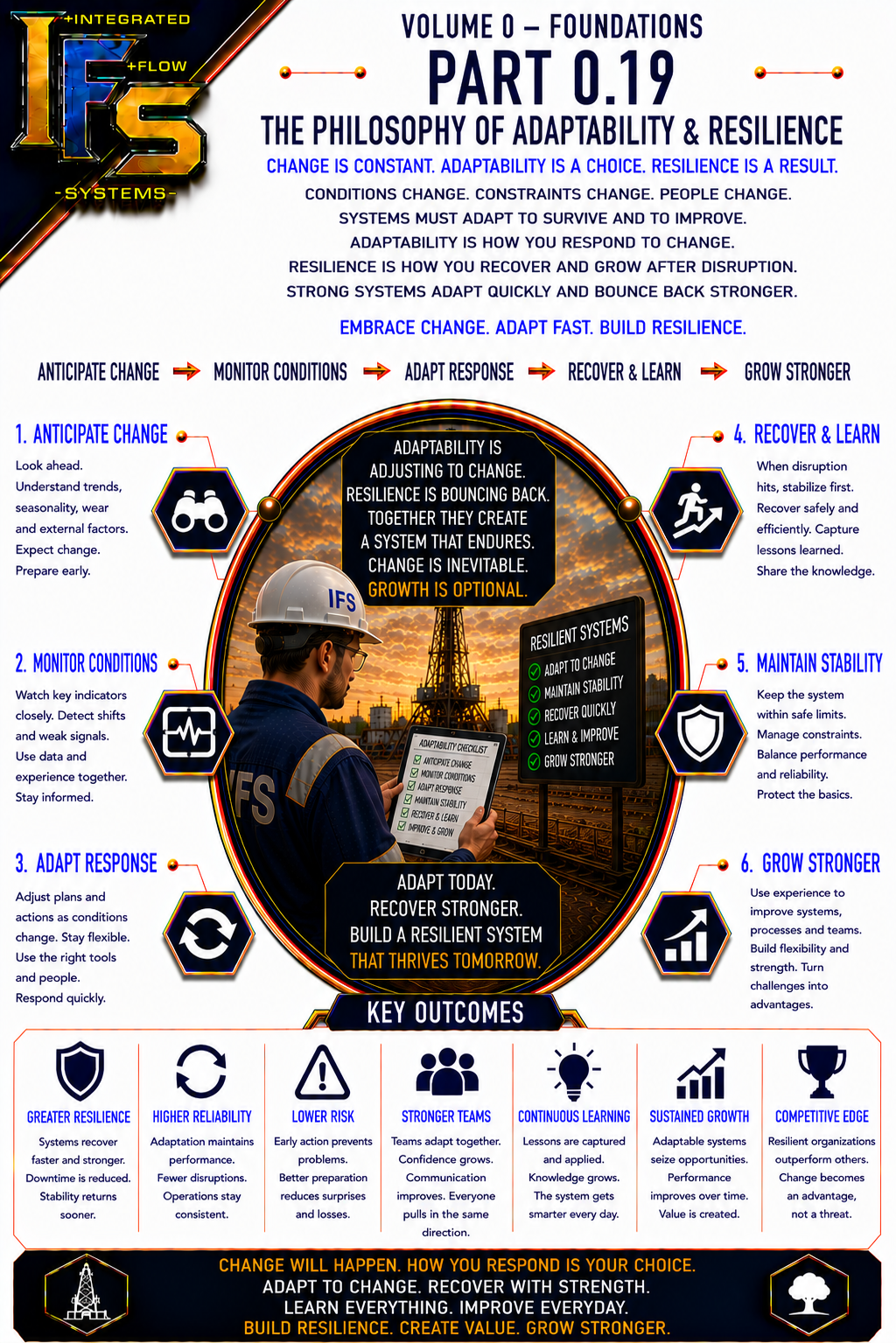
Every industrial operation exists within a changing environment.
Reservoir pressures change.
Weather changes.
Equipment ages.
Production targets shift.
Supply chains fluctuate.
Regulations evolve.
Markets respond.
Technology advances.
Organizations that expect operations to remain static eventually struggle.
Organizations that learn to adapt continue improving.
Integrated Flow Systems (IFS) recognizes that adaptability is not reacting to change after it happens.
It is recognizing change early enough to respond intelligently.
Resilience is the result of that preparation.
Every system experiences change.
Some changes occur slowly over years.
Others happen within seconds.
A pressure trend begins to drift.
Equipment efficiency slowly declines.
Raw material quality varies.
Customer demand changes.
Environmental conditions shift.
Every change influences the larger operational system.
IFS continuously monitors operational trends using Snapshot Memory, deterministic analysis and historical knowledge to identify changing conditions before they become operational disruptions.
The earlier change is recognized, the more options remain available.
Adaptability begins with awareness.
Organizations cannot respond to changes they never recognize.
IFS continuously monitors operational conditions through Flows, Nodes, Exchanges, Constraints, Trend Analysis and Snapshot Memory.
Rather than evaluating isolated events, the system evaluates operational direction.
Is performance improving?
Is stability declining?
Is equipment behavior changing?
Are constraints increasing?
Are opportunities emerging?
Continuous monitoring transforms uncertainty into measurable operational awareness.
Recognizing change is only the beginning.
The value comes from responding correctly.
Not every operational change requires immediate intervention.
Some require observation.
Others require adjustment.
Some require complete operational redesign.
IFS provides deterministic decision support by connecting current observations with previous operational knowledge.
Instead of reacting emotionally or relying on assumptions, operators evaluate measurable evidence before selecting the appropriate response.
Adaptability becomes structured rather than improvised.
Even the best organizations experience disruption.
Equipment fails.
Unexpected conditions develop.
External events interrupt operations.
Recovery is not measured by how quickly work resumes.
It is measured by how effectively the organization restores safe, reliable performance while learning from the event.
IFS preserves every investigation through Knowledge Retention and Snapshot Memory, ensuring recovery creates permanent organizational improvement instead of temporary correction.
Each disruption becomes another opportunity to strengthen future operations.
Adaptability should never create chaos.
The purpose of adaptation is to restore stability.
Operators require confidence.
Management requires predictability.
Customers require reliability.
IFS balances flexibility with operational discipline by maintaining clear procedures, measurable decision pathways and continuous system visibility.
Organizations remain stable even while adapting to changing conditions.
This balance creates resilient operations capable of maintaining performance under uncertainty.
Resilient organizations do more than recover.
They improve because of the experience.
Every operational challenge reveals information.
Every solved problem expands organizational knowledge.
Every improvement strengthens future decision-making.
IFS ensures that lessons learned from one operation become available across future operations, projects, crews and facilities.
The organization evolves continuously because its operational memory continues expanding.
Growth becomes systematic rather than accidental.
Integrated Flow Systems views adaptability and resilience as essential characteristics of every successful industrial organization.
Change cannot be prevented.
Uncertainty cannot be eliminated.
Disruptions cannot always be avoided.
What can be controlled is how quickly an organization recognizes change, understands its significance, responds intelligently and captures the lessons for future improvement.
Adaptability allows organizations to respond.
Resilience allows organizations to recover.
Knowledge allows organizations to improve.
Together they create operational systems capable of performing consistently under changing conditions while becoming stronger after every challenge.
This philosophy applies equally across oil and gas, mining, world shipping, desalination, manufacturing, chemical processing, utilities, transportation, logistics, municipal infrastructure, construction and every industrial operation where changing conditions demand disciplined observation, intelligent adaptation and continuous operational learning.
Because the strongest systems are not the ones that never face change.
They are the ones that recognize change early, adapt with confidence, recover intelligently and emerge stronger than before.
Integrated Flow Systems (IFS) combines deterministic operational intelligence, Snapshot Memory, continuous trend monitoring, Knowledge Retention, structured decision support, adaptive operational workflows and system-wide visibility to help industrial organizations anticipate change, respond intelligently, recover efficiently, strengthen resilience, improve reliability, reduce operational risk, and create long-term competitive advantage across every industrial sector.
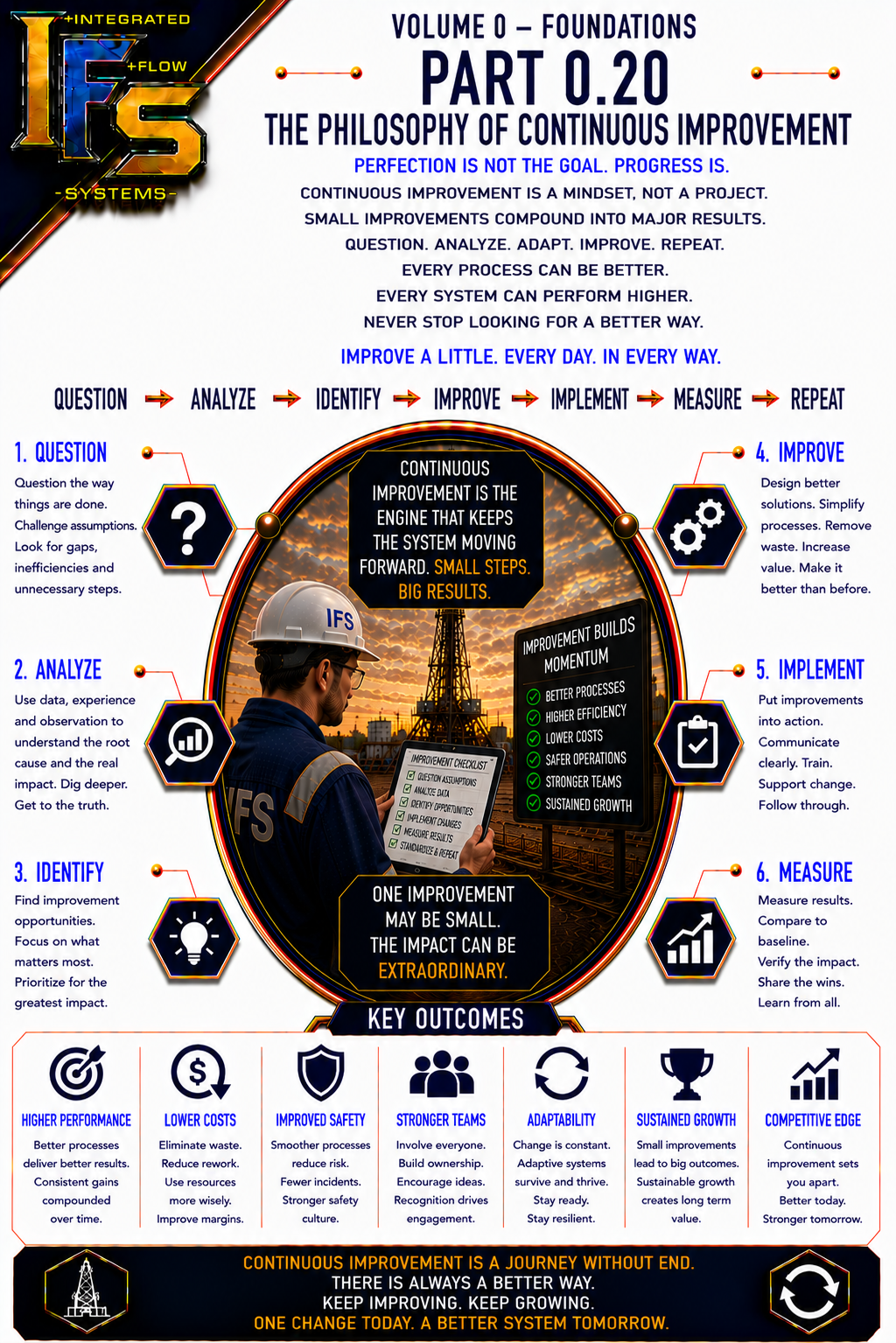
No industrial system is ever truly finished.
No process is beyond improvement.
No operation reaches a point where learning should stop.
Integrated Flow Systems (IFS) is founded on the belief that operational excellence is not achieved through one major breakthrough, but through thousands of small improvements made consistently over time.
Every observation creates an opportunity.
Every lesson creates knowledge.
Every improvement strengthens the system.
Progress is not built in leaps.
It is built in cycles.
Continuous improvement begins with curiosity.
Why is this process performed this way?
Can this task be completed more safely?
Can downtime be reduced?
Can waste be eliminated?
Can production become more consistent?
Can operators make better decisions with better information?
IFS encourages organizations to challenge assumptions rather than protect tradition.
Procedures should exist because they produce measurable value, not simply because they have always existed.
The best improvements often begin with a simple question.
Not every problem has an obvious solution.
Effective improvement requires understanding the true cause before attempting correction.
IFS uses deterministic operational intelligence, Snapshot Memory and historical operational knowledge to analyze trends across Flows, Nodes, Exchanges and Constraints.
Instead of treating symptoms, organizations identify root causes.
Instead of reacting to isolated events, they understand long-term operational behavior.
Good analysis prevents poor improvements.
Better understanding produces better decisions.
Improvement resources are limited.
Time is limited.
Budgets are limited.
Personnel are limited.
IFS helps organizations focus on the changes that deliver the greatest operational value.
Sometimes the largest improvement comes from removing a major bottleneck.
Sometimes it comes from reducing maintenance frequency.
Sometimes it comes from improving communication between crews.
Sometimes it comes from recognizing a positive operational pattern that others overlook.
Continuous improvement is not about changing everything.
It is about improving what matters most.
Every improvement should solve a measurable problem or create measurable value.
Reduce waste.
Improve safety.
Increase reliability.
Lower operating costs.
Increase production.
Improve product quality.
Reduce downtime.
Strengthen decision-making.
IFS provides a structured framework for implementing improvements through measurable objectives, operational monitoring and continuous verification.
Improvement without measurement is simply optimism.
Measured improvement becomes operational knowledge.
A good idea has little value until it becomes standard practice.
Successful improvements must be documented.
Shared.
Taught.
Repeated.
Verified.
IFS transforms successful operational changes into organizational knowledge through Snapshot Memory and Knowledge Retention.
Once proven, improvements become part of the operating system.
Future crews begin where previous crews finished.
The organization never loses what it has learned.
Every completed improvement begins another cycle.
Measure the results.
Compare performance.
Evaluate unexpected consequences.
Capture lessons learned.
Identify the next opportunity.
Repeat.
Continuous improvement is not a destination.
It is the operating rhythm of organizations committed to long-term excellence.
Each cycle builds upon the previous one.
Performance compounds.
Knowledge compounds.
Competitive advantage compounds.
Integrated Flow Systems views continuous improvement as the operating engine that keeps industrial organizations moving forward.
It transforms operational knowledge into operational progress.
It transforms experience into higher performance.
It transforms individual improvements into organizational capability.
Every cycle strengthens the next.
Every lesson improves future decisions.
Every success becomes repeatable.
Every challenge becomes another opportunity to learn.
This philosophy applies equally across oil and gas, mining, world shipping, desalination, manufacturing, chemical processing, utilities, transportation, logistics, construction, municipal infrastructure and every industrial operation where long-term success depends upon disciplined learning, structured improvement and measurable operational excellence.
Because perfection is not the objective.
Progress is.
And organizations that improve a little every day eventually outperform those waiting for the perfect solution.
Integrated Flow Systems (IFS) combines deterministic operational intelligence, Snapshot Memory, continuous trend analysis, Knowledge Retention, structured decision support, system-wide monitoring and continuous improvement methodologies to help industrial organizations eliminate waste, reduce downtime, improve safety, increase efficiency, strengthen operational reliability, capture organizational knowledge and build sustainable competitive advantage across every industrial sector.
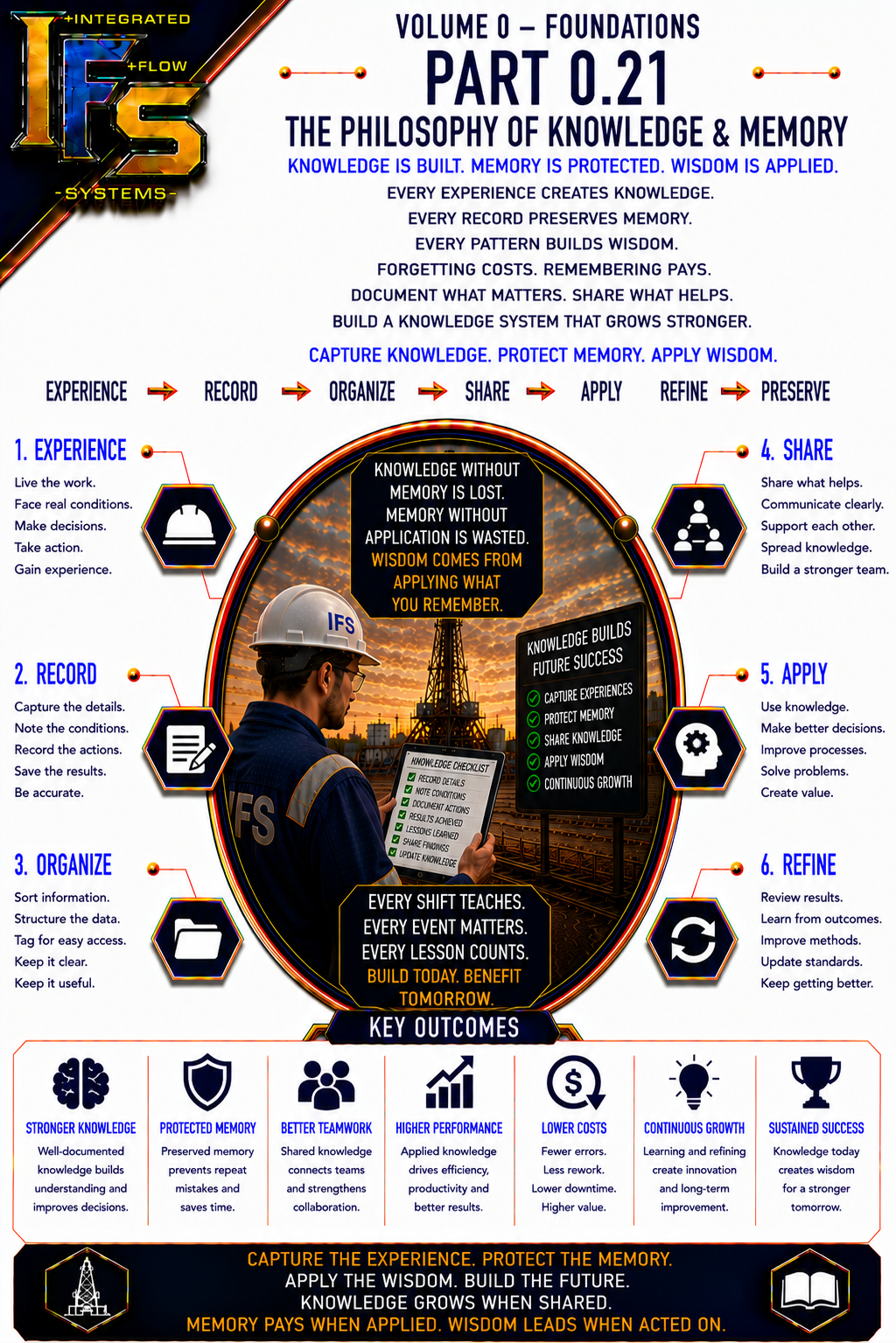
Industrial systems do not become stronger simply by operating longer.
They become stronger by remembering what they have learned.
Every shift generates knowledge.
Every maintenance activity reveals information.
Every operational upset exposes weaknesses.
Every successful recovery uncovers better methods.
Unless those lessons are captured, organized and applied, they disappear the moment the shift ends.
Integrated Flow Systems (IFS) treats operational knowledge as one of the most valuable assets an organization possesses. Knowledge grows through experience, memory preserves that knowledge, and wisdom applies it to future decisions.
Every action produces information.
Operators witness equipment behavior.
Technicians discover better repair methods.
Engineers observe changing process conditions.
Supervisors recognize recurring operational patterns.
These experiences become the raw material of organizational intelligence.
Experience cannot be purchased.
It must be earned through operation.
IFS ensures those experiences are never wasted.
Memory begins with accurate records.
Not every event deserves documentation, but every event that changes operational understanding should be captured.
What happened?
Why did it happen?
What actions were taken?
What was the outcome?
What improved?
What failed?
What should be done differently next time?
IFS transforms these observations into structured operational records that can be searched, compared and reused throughout the organization.
Accurate records prevent valuable experience from becoming forgotten experience.
Information without organization quickly becomes unusable.
Thousands of reports mean little if no one can find the right one when needed.
IFS organizes operational knowledge by:
Equipment
Process
Flow
Node
Exchange
Constraint
Failure Mode
Opportunity
Operational Condition
Root Cause
Corrective Action
Outcome
This structured approach allows organizations to retrieve relevant operational experience within seconds rather than searching through years of disconnected reports.
Knowledge becomes operational infrastructure.
Knowledge creates its greatest value when it moves beyond the individual.
One operator's discovery should become every operator's advantage.
One successful maintenance strategy should benefit every facility.
One solved problem should never require solving again elsewhere.
IFS promotes organizational learning by allowing verified operational knowledge to move across shifts, departments, facilities and industries while maintaining complete operational context.
Shared knowledge multiplies organizational capability.
Remembering information is only the beginning.
Knowledge creates value only when it influences future decisions.
Operators recognize warning signs earlier.
Supervisors choose better corrective actions.
Engineers improve designs.
Maintenance teams reduce recurring failures.
Management allocates resources more effectively.
Every lesson applied strengthens the next operational cycle.
IFS transforms stored information into practical operational intelligence.
Knowledge becomes action.
Action becomes improvement.
Improvement becomes organizational capability.
Operational knowledge is never complete.
Every new experience updates previous understanding.
Old assumptions may become obsolete.
Improved procedures replace older methods.
New technologies introduce new operating conditions.
Changing environments require updated responses.
IFS treats knowledge as a living operational resource that continuously evolves alongside the system itself.
Every operational cycle expands the organization's understanding.
Every lesson improves future performance.
Integrated Flow Systems recognizes that competitive advantage is not created only by equipment, technology or capital.
It is created by organizations that learn faster than their competitors.
Knowledge without memory disappears.
Memory without application creates no value.
Application without continuous refinement eventually becomes outdated.
True operational wisdom combines all three.
Experience.
Memory.
Application.
By capturing operational knowledge, protecting organizational memory and continuously applying proven lessons, IFS builds industrial systems that become more intelligent, more reliable and more valuable with every shift, every project and every operating cycle.
Whether operating in oil and gas, mining, shipping, desalination, manufacturing, utilities, logistics, chemical processing or any other industrial environment, organizations that preserve knowledge avoid repeating mistakes, accelerate improvement, reduce downtime, improve safety and strengthen operational performance year after year.
Because every lesson has value.
Every experience teaches.
Every memory protects the future.
And every piece of knowledge applied today becomes tomorrow's competitive advantage.
Integrated Flow Systems (IFS) combines deterministic operational intelligence, structured Knowledge Retention, Snapshot Memory, trend analysis, operational history, decision support and continuous learning into a unified operational framework that transforms experience into lasting organizational intelligence, allowing industrial organizations to continuously improve safety, reliability, efficiency, productivity and long-term operational excellence.

Every industrial system exists for one reason.
To create value.
Pipelines do not exist simply to move product.
Refineries do not exist simply to process crude.
Mines do not exist simply to move rock.
Ships do not exist simply to transport cargo.
Desalination plants do not exist simply to produce water.
Every operation exists to transform resources into something more valuable than what entered the system.
Purpose defines why the system exists.
Value determines whether it succeeds.
Integrated Flow Systems (IFS) begins every analysis by asking two simple questions:
What is the purpose?
Where is the value created?
Every decision, every exchange, every node and every improvement must ultimately support those answers.
Purpose establishes direction.
Without a clearly defined purpose, organizations become busy instead of productive.
Equipment may operate.
People may work.
Processes may continue.
But activity without purpose often creates waste rather than value.
IFS ensures every system begins with clearly defined objectives that guide decisions at every level.
When everyone understands the purpose, priorities become clearer, decisions become faster and resources are used more effectively.
Once the purpose is understood, every action should support it.
Departments should not compete against one another.
Maintenance should support Operations.
Engineering should support Maintenance.
Planning should support Production.
Logistics should support Delivery.
Management should support the entire operational system.
IFS continually evaluates whether daily activities remain aligned with organizational objectives.
Misaligned actions consume resources while creating little value.
Aligned actions multiply results.
Value is created whenever a flow leaves a node in a better condition than it entered.
Sometimes that value is obvious.
More production.
Higher quality.
Lower cost.
Greater reliability.
Sometimes value is less visible.
Improved safety.
Reduced environmental impact.
Operator knowledge.
Equipment life.
Risk reduction.
Customer confidence.
IFS measures value across the entire operational system rather than focusing on production alone.
Because true operational excellence improves multiple forms of value simultaneously.
Purpose becomes meaningful only when it produces measurable results.
Good intentions do not improve operations.
Execution does.
IFS emphasizes disciplined execution supported by clear procedures, operational knowledge, continuous monitoring and measurable performance.
Consistent execution transforms planning into performance.
Results validate whether the system is fulfilling its intended purpose.
Every improvement should demonstrate measurable impact.
Did production increase?
Did downtime decrease?
Were operating costs reduced?
Was safety improved?
Did equipment reliability increase?
Did operators spend less time solving recurring problems?
IFS measures operational improvements against the original purpose of the system.
If an improvement does not increase value, it should be questioned.
If it consistently creates value, it becomes part of organizational knowledge.
Purpose without action is only intention.
Action without value becomes unnecessary work.
Real success occurs when purpose, execution and measurable value remain aligned over time.
Organizations create lasting competitive advantage when every employee understands not only what they do, but why it matters.
IFS encourages organizations to celebrate improvements, recognize meaningful contributions, share successful practices and continually reinvest operational knowledge back into the system.
This creates a culture where value is not accidental.
It becomes intentional.
Integrated Flow Systems recognizes that every industrial operation is part of a larger value system.
Every node should create value.
Every exchange should increase value.
Every corridor should protect value.
Every decision should strengthen value.
Every improvement should expand value.
Purpose provides direction.
Measurement provides feedback.
Knowledge provides improvement.
Value provides meaning.
When all four work together, organizations become more than efficient.
They become resilient, adaptable and continuously improving systems capable of delivering long-term operational excellence.
Whether operating in oil and gas, mining, shipping, manufacturing, desalination, logistics, utilities or any complex industrial environment, IFS ensures that every action can be traced back to its purpose, every decision can be measured by its value, and every improvement contributes to stronger operational performance.
Because systems are not remembered for how busy they were.
They are remembered for the value they created.
Integrated Flow Systems (IFS) unifies purpose, operational intelligence, flow management, deterministic decision-making, knowledge retention, continuous improvement and measurable value creation into a single operational framework that helps organizations align people, processes, equipment and decisions around what matters most—creating safer operations, stronger performance, lower costs and sustainable long-term value.
Whether you're looking to reduce downtime, improve efficiency, preserve equipment, or better understand your operational data, we're ready to help.
Complete the form below and we'll discuss how Integrated Flow Systems can be applied to your operation.
Let's start the conversation.