Explore operational insights, industry graphics, reference materials, and practical examples designed to support better decisions and more consistent performance across complex industrial systems.
Every industrial operation generates enormous amounts of information.
Pressures fluctuate.
Temperatures change.
Equipment wears.
Flows increase and decrease.
Operators make adjustments.
Maintenance repairs equipment.
Production rises and falls.
Every day, thousands of events occur throughout an operation.
The challenge has never been collecting information.
The challenge has always been organizing it into something that consistently improves operational performance.
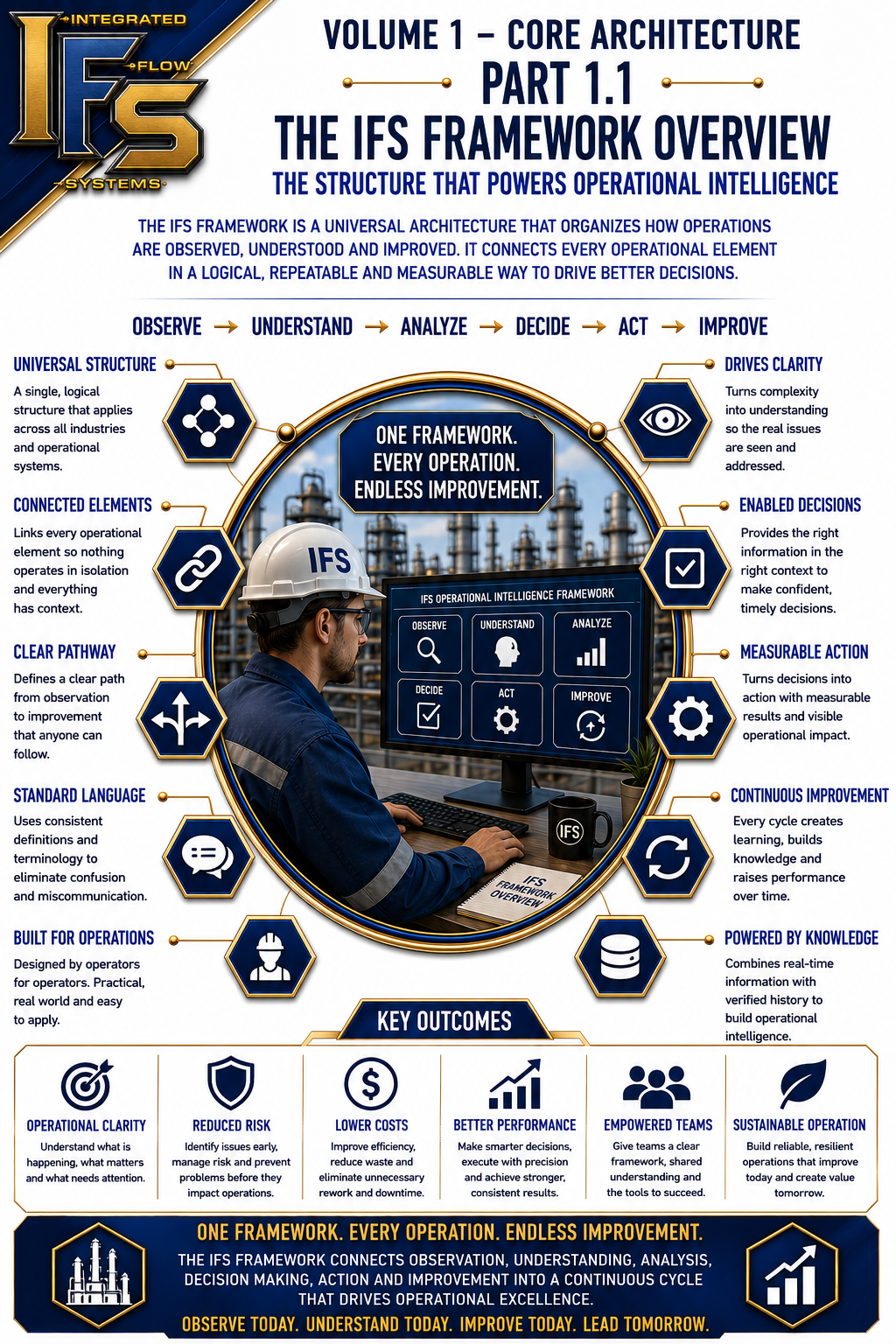
That is the purpose of the Integrated Flow Systems (IFS) Framework.
IFS provides a universal operational architecture that transforms scattered observations into structured understanding, informed decisions and continuous improvement. Rather than treating operations as disconnected departments or isolated pieces of equipment, the framework connects every operational element into a single, repeatable system.
Regardless of industry, the framework remains the same.
Observe.
Understand.
Analyze.
Decide.
Act.
Improve.
This cycle forms the operational heartbeat of every IFS implementation.
Everything begins with observation.
An operation cannot improve what it cannot see.
Observation includes far more than instrument readings.
Operators observe abnormal sounds.
Technicians notice changing vibration.
Production identifies declining throughput.
Maintenance records equipment condition.
Quality control measures product consistency.
Environmental systems monitor emissions.
Supervisors document operational events.
Every observation becomes a potential source of operational intelligence.
IFS captures observations from across the operation and places them into a structured framework where they become meaningful rather than isolated pieces of information.
Observation transforms unknown conditions into visible conditions.
Raw information has little value without context.
Understanding explains what the information actually means.
A pressure increase may indicate normal production.
Or it may indicate a restriction developing downstream.
A temperature change may be expected during startup.
Or it may signal equipment failure.
IFS connects every observation to its operational context.
Where did it occur?
Which flow changed?
Which Node was involved?
What Exchanges occurred?
What Constraints existed?
Understanding transforms isolated data into operational awareness.
Once the operational context is understood, analysis begins.
IFS examines relationships rather than isolated values.
It identifies:
Cause and effect
Patterns
Trends
Constraints
Dependencies
Opportunities
Risk development
Performance changes
Instead of reacting to symptoms, operators begin identifying the mechanisms creating those symptoms.
Analysis moves the organization from reactive operation toward predictive understanding.
Every operation eventually reaches a decision point.
Continue operating.
Increase monitoring.
Adjust the process.
Investigate further.
Perform maintenance.
Reduce production.
Intervene immediately.
IFS supports deterministic decision-making by ensuring decisions are based on observable evidence, operational history, verified knowledge and measurable system conditions.
Every recommendation follows a logical path that can be explained, reviewed and continuously improved.
Decisions become consistent because the framework remains consistent.
Decisions create value only when executed.
Execution transforms planning into operational reality.
Whether adjusting equipment, changing procedures, dispatching maintenance or modifying production, actions should directly support operational objectives.
IFS emphasizes disciplined execution supported by standardized procedures, clear communication and measurable expectations.
Every action becomes another source of operational knowledge.
Improvement completes the operational cycle.
After every action, the system asks:
What changed?
Did it work?
Did performance improve?
What was learned?
Should this become standard practice?
IFS captures these lessons inside organizational Memory where they strengthen future operations.
Improvement is never considered complete.
Every cycle creates additional knowledge that improves the next cycle.
This continuous learning process allows organizations to become progressively more intelligent over time.
The strength of the IFS Framework lies in its ability to organize complexity without oversimplifying operations.
Rather than replacing existing operational expertise, it provides a common architecture that allows every discipline to communicate using the same operational language.
Operations understand production.
Maintenance understands equipment.
Engineering understands process behavior.
Management understands performance.
Safety understands risk.
Reliability understands trends.
Everyone understands how their decisions affect the larger system.
Instead of isolated departments solving isolated problems, the organization begins operating as one integrated system.
IFS is not software first.
It is not artificial intelligence first.
It is not data collection first.
It is an operational thinking framework.
Technology supports the framework.
It does not define it.
The framework organizes operational knowledge into a structure that people can understand, improve and continuously expand.
Because the architecture remains consistent, organizations gain repeatability, clarity and long-term operational stability regardless of industry or process complexity.
Integrated Flow Systems recognizes that operational excellence does not result from isolated improvements.
It emerges when every observation contributes to understanding.
Every understanding improves analysis.
Every analysis strengthens decisions.
Every decision guides effective action.
Every action generates new knowledge.
Every lesson improves the next operational cycle.
This repeating sequence forms a self-improving operational system that becomes stronger with every shift, every project and every decision.
Whether applied to oil and gas, mining, shipping, manufacturing, desalination, utilities, logistics or any other complex operation, the IFS Framework provides one universal architecture for organizing operational intelligence, managing complexity and driving continuous improvement.
Because every great operation begins the same way.
Observe clearly.
Understand completely.
Analyze objectively.
Decide confidently.
Act deliberately.
Improve continuously.
That is the framework.
That is Integrated Flow Systems.
Every industry appears different on the surface.
An offshore drilling platform bears little resemblance to a container ship crossing the Pacific. A desalination plant operates differently from a coal mine. A paper mill, refinery, chemical plant, manufacturing facility and municipal water treatment plant all use different equipment, different terminology and different operating procedures.
Yet beneath those differences lies a remarkably consistent structure.
Every operational system moves something of value.
Every operational system changes that flow.
Every operational system measures performance.
Every operational system makes decisions.
Every operational system learns from experience.
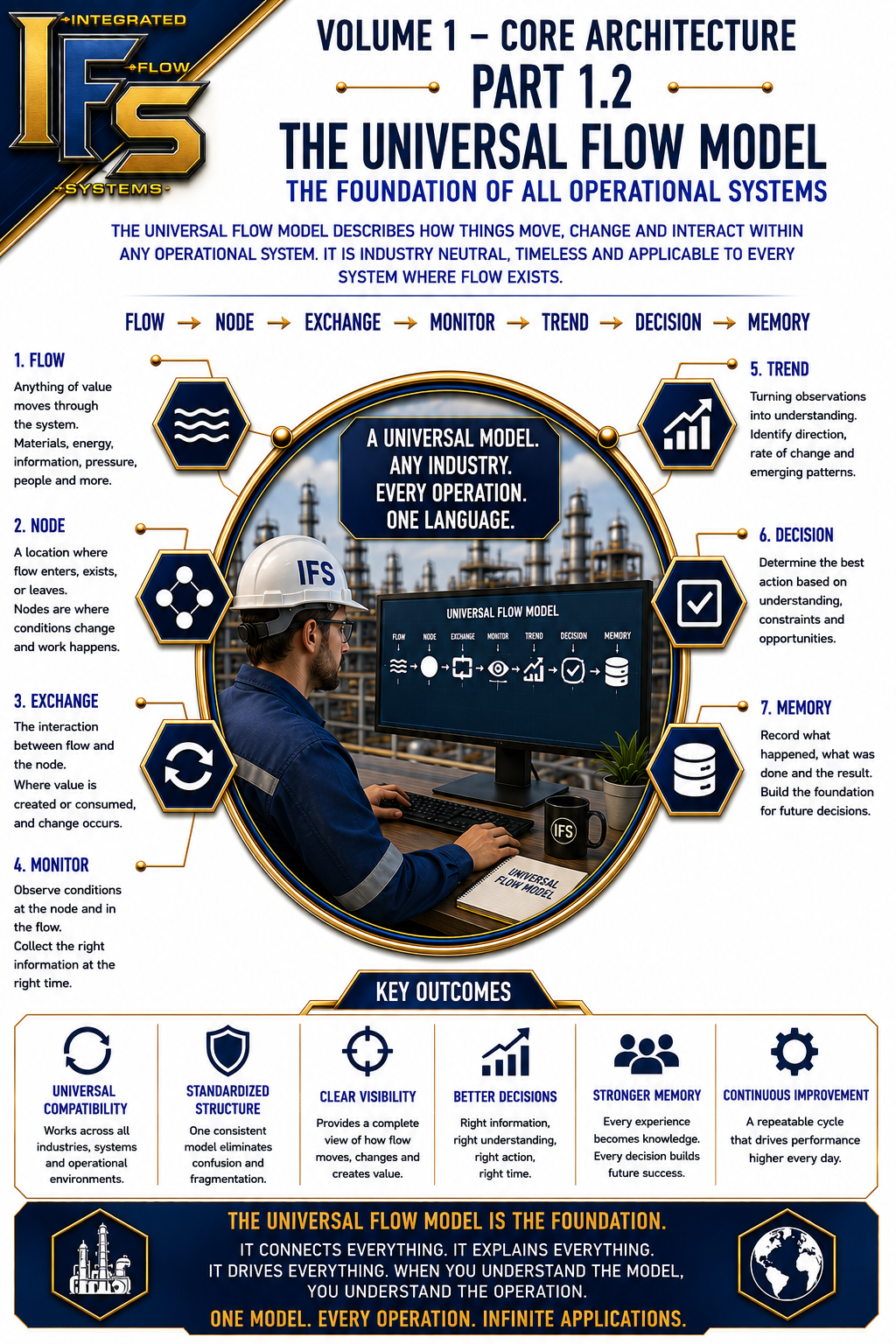
This is the foundation of the Universal Flow Model.
Integrated Flow Systems (IFS) was built upon the understanding that all operational systems share the same underlying architecture, regardless of industry. Once this architecture is understood, the same analytical framework can be applied almost anywhere.
The language changes.
The equipment changes.
The products change.
The model does not.
Everything begins with flow.
Flow represents anything of value moving through a system.
Depending on the operation, flow may consist of:
Liquids
Gases
Solids
Energy
Heat
Electricity
Pressure
Information
Products
Raw materials
Waste streams
People
Financial value
Without movement, there is no operation.
Flow is the lifeblood of every industrial system.
Understanding the behavior of that flow is the first step toward understanding the operation itself.
Flows always arrive somewhere.
These locations are Nodes.
Nodes are where work occurs.
A Node may be:
A separator
A drilling rig
A heat exchanger
A valve station
A conveyor transfer point
A pump
A reactor
A loading terminal
A warehouse
A processing vessel
A maintenance activity
A decision point
Nodes are where conditions change.
They consume resources.
They create value.
They also create constraints.
Every operation is ultimately a network of interconnected Nodes.
When a flow enters a Node, something happens.
Pressure changes.
Temperature changes.
Chemical composition changes.
Velocity changes.
Ownership changes.
Location changes.
Information changes.
These transformations are called Exchanges.
Exchanges determine whether value is created or destroyed.
Poor exchanges create waste.
Efficient exchanges increase value.
Every improvement within IFS ultimately improves one or more Exchanges.
Operations cannot improve what they cannot observe.
Monitoring captures the current condition of both the flow and the Node.
Measurements may include:
Pressure
Temperature
Flow rate
Composition
Production
Vibration
Torque
Fuel consumption
Energy use
Equipment health
Product quality
Operator observations
Monitoring transforms operations from assumption into measurable reality.
IFS emphasizes collecting the right information at the right location and at the right time.
Individual measurements provide snapshots.
Trends provide understanding.
One pressure reading has limited meaning.
Twenty pressure readings reveal behavior.
IFS converts observations into Trends that identify:
Direction
Rate of change
Stability
Acceleration
Recovery
Deterioration
Cycles
Emerging constraints
Emerging opportunities
Trend recognition allows organizations to act before problems become failures and before opportunities disappear.
Knowledge exists to improve decisions.
Every operational decision influences future system behavior.
Adjust flow.
Maintain equipment.
Increase monitoring.
Reduce production.
Investigate further.
Continue operating.
Intervene immediately.
IFS uses deterministic operational intelligence to transform monitored conditions and observed trends into repeatable, explainable decision support.
Every recommendation follows observable evidence.
No guesswork.
No assumptions.
No hidden reasoning.
The final stage completes the operational learning cycle.
Every decision creates an outcome.
Every outcome creates knowledge.
Every lesson strengthens future performance.
IFS records:
What happened
What conditions existed
What decision was made
What action occurred
What result followed
Whether the decision succeeded
Over time, Memory becomes one of the organization's most valuable operational assets.
Knowledge compounds.
Experience becomes searchable.
Successful solutions become repeatable.
Mistakes become less frequent.
The system continuously improves.
The strength of the Universal Flow Model is its simplicity.
Every operational problem can be described using the same sequence:
Flow → Node → Exchange → Monitor → Trend → Decision → Memory
This creates a common language between:
Operations
Engineering
Maintenance
Management
Safety
Environmental teams
Production planning
Reliability groups
Executive leadership
Everyone sees the same operational structure, regardless of discipline or industry.
Communication improves because the system itself becomes the common reference point.
Integrated Flow Systems is not built around drilling.
It is not built around mining.
It is not built around shipping.
It is not built around desalination.
It is built around operations.
The Universal Flow Model recognizes that every industrial process follows the same fundamental architecture.
Something moves.
Something changes.
Something is measured.
Something is learned.
Something improves.
Once an organization understands this model, every operation becomes easier to understand, compare and optimize.
The equipment may differ.
The terminology may differ.
The products may differ.
But the operational language remains universal.
That is what allows IFS to function across industries while maintaining one consistent, deterministic framework for operational intelligence, continuous improvement and long-term organizational learning.
Because when you understand the flow, you understand the system.
And when you understand the system, you understand where value is created.
Operational intelligence does not appear the moment a sensor records a value.
It is not created by a single operator observation.
It is not produced by a computer algorithm.
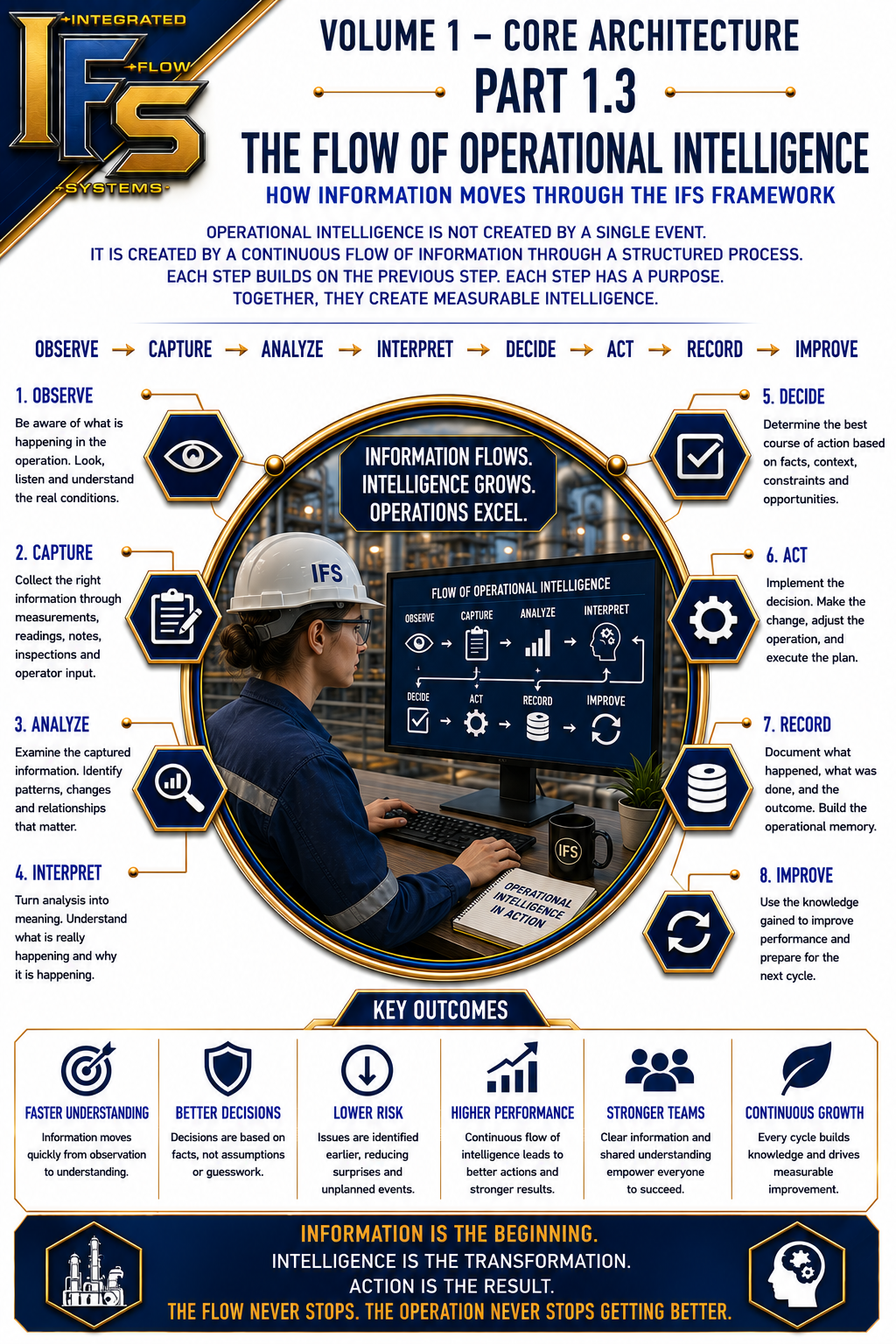
Operational intelligence is created through a structured flow of information.
Every observation becomes information.
Information becomes understanding.
Understanding becomes decisions.
Decisions become actions.
Actions produce results.
Results become knowledge.
Knowledge improves the next operational cycle.
This continuous movement transforms raw operational data into measurable operational intelligence.
That transformation is the foundation of Integrated Flow Systems (IFS).
Everything begins with observation.
Operations are constantly communicating.
Pressure changes.
Flow rates fluctuate.
Equipment vibrates.
Temperatures increase.
Operators notice unusual sounds.
Maintenance identifies abnormal wear.
Quality control measures product variation.
Every operation produces thousands of signals every day.
Most organizations collect enormous amounts of information.
Few organize it into operational intelligence.
IFS begins by ensuring the right observations are made at the right locations and at the right time.
Without observation, nothing else can occur.
Observation must immediately become structured information.
Memory alone is unreliable.
People change.
Shifts change.
Time passes.
Important details disappear.
IFS captures information through multiple sources, including:
Instrument readings
Operator observations
Inspection reports
Maintenance findings
Laboratory results
Production records
Automated monitoring systems
Manual operational input
Everything becomes part of the operational record.
Captured information preserves reality before assumptions replace facts.
Captured information has little value until relationships are identified.
Analysis searches for meaning.
How are variables changing?
What relationships exist?
Which Node is affected?
Which Flow changed?
What Exchange created the difference?
Is the change isolated or spreading?
Are constraints increasing?
Are opportunities developing?
IFS analyzes operations as interconnected systems rather than isolated measurements.
Patterns begin to emerge.
Cause becomes distinguishable from symptom.
Analysis identifies relationships.
Interpretation explains what those relationships mean.
A rising pressure may indicate a restriction.
A temperature increase may indicate fouling.
A production decline may indicate equipment degradation.
A stable trend may indicate successful intervention.
Interpretation transforms technical information into operational understanding.
Operators move beyond knowing what changed.
They begin understanding why it changed.
That understanding is where intelligence begins.
Operational understanding exists to improve decisions.
Every industrial operation continuously faces choices.
Continue operating.
Increase monitoring.
Adjust equipment.
Investigate further.
Reduce throughput.
Perform maintenance.
Modify procedures.
IFS supports deterministic decision-making by ensuring every recommendation follows observable evidence, operational knowledge and measurable conditions.
Decisions become consistent because they are based on repeatable operational logic.
Confidence replaces uncertainty.
Decisions create value only when implemented.
Action is where operational intelligence influences the physical system.
Adjust a valve.
Replace equipment.
Modify operating parameters.
Schedule maintenance.
Reduce production.
Increase inspections.
Improve procedures.
Each action changes the operational environment.
IFS ensures actions remain connected to the information that produced them, allowing every intervention to be evaluated objectively.
Every action produces a result.
That result becomes organizational knowledge.
IFS records:
Original conditions
Observations
Analysis
Decisions
Actions performed
Operational outcome
Lessons learned
This operational memory allows future decisions to benefit from previous experience.
Knowledge compounds over time.
Organizations become progressively more intelligent.
The operational cycle never ends.
Each completed cycle strengthens the next.
Successful interventions become standard practices.
Recurring failures become easier to recognize.
Operator confidence increases.
Decision quality improves.
Maintenance becomes more proactive.
Production becomes more stable.
Risk decreases.
Value increases.
Continuous improvement is not a separate activity.
It is the natural outcome of a system that learns from every operational cycle.
Many organizations treat operational intelligence as a report.
IFS treats it as movement.
Information flows continuously.
Knowledge grows continuously.
Decisions improve continuously.
Operational intelligence is not something that is stored.
It is something that moves through the organization every day.
Just as product flows through equipment, information flows through people, systems and decisions.
When that flow becomes interrupted, intelligence declines.
When it flows efficiently, operational excellence becomes sustainable.
Integrated Flow Systems recognizes that every industrial organization already possesses enormous amounts of information.
The challenge is rarely obtaining more data.
The challenge is moving that information through a structured process that consistently produces better understanding and better decisions.
Observation creates awareness.
Capture preserves reality.
Analysis discovers relationships.
Interpretation creates understanding.
Decision guides action.
Action changes the system.
Recording preserves knowledge.
Improvement strengthens the next cycle.
This continuous movement transforms information into operational intelligence and operational intelligence into measurable operational performance.
Whether applied to oil and gas, mining, shipping, desalination, manufacturing, utilities or any other complex industrial environment, the flow of operational intelligence remains universal.
Information is never the destination.
It is the beginning.
The objective is understanding.
The outcome is better decisions.
The result is a continuously improving operation where every cycle produces greater knowledge, greater reliability, lower risk and higher long-term value.
Because in Integrated Flow Systems, intelligence is not collected.
It flows.

Every operational system is built around movement.
Materials move.
Energy moves.
Information moves.
People move.
Equipment moves.
Value moves.
But nothing important happens while something is simply moving.
Value is created when flow reaches a point where work is performed.
In Integrated Flow Systems (IFS), these locations are called Nodes.
Nodes are the work points of every operational system.
They are where flow changes direction, changes condition, changes ownership, changes value or changes purpose.
If Flow represents movement, then Nodes represent action.
Understanding Nodes is one of the most important principles within the IFS architecture because every improvement, every constraint, every opportunity and nearly every operational decision originates at a Node.
A Node is any location where operational activity occurs.
It may be physical.
It may be mechanical.
It may be chemical.
It may be informational.
It may even be human.
If work is performed, a Node exists.
Examples include:
Pumps
Compressors
Heat exchangers
Valves
Reactors
Separators
Storage tanks
Conveyor transfer points
Crushers
Filters
Mixers
Packaging stations
Loading terminals
Operator inspections
Maintenance activities
Quality control checkpoints
Data collection systems
Across every industry, the equipment changes.
The principle does not.
Nodes are universal.
Flow never exists by itself.
Flow always moves between Nodes.
Raw material enters a processing vessel.
Water enters a filtration system.
Coal enters a crusher.
Oil enters a separator.
Ships enter a port.
Electricity enters a transformer.
Information enters an operator's decision.
Every Flow begins at one Node and eventually arrives at another.
This simple relationship creates the entire operational architecture.
Flow connects.
Nodes perform work.
Movement alone creates very little value.
Nodes transform.
Pressure changes.
Temperature changes.
Velocity changes.
Composition changes.
Ownership changes.
Location changes.
Quality changes.
Inventory changes.
Information changes.
Every meaningful operational change occurs at a Node.
IFS focuses attention where conditions actually change rather than where flow simply continues unchanged.
Every Node has a purpose.
Some separate.
Some combine.
Some filter.
Some heat.
Some cool.
Some compress.
Some pump.
Some transport.
Some inspect.
Some measure.
Some store.
Some control.
Some simply verify that nothing has changed.
Regardless of complexity, every Node performs work that contributes to the overall operation.
Without Nodes, flow has no direction.
Without work, value cannot be created.
Every Node affects value.
Some increase value dramatically.
Others consume energy, labor or materials.
Some reduce waste.
Others create waste.
Some improve quality.
Others introduce variability.
Every operational decision should consider how each Node influences overall system value.
IFS evaluates Nodes not only by what they do, but by what value they create, preserve or consume.
Nodes produce the information that operators need.
Pressure readings.
Temperatures.
Vibration.
Flow rates.
Chemical composition.
Energy consumption.
Equipment condition.
Operator observations.
Maintenance findings.
Production rates.
Every important operational measurement originates at a Node.
When Nodes are monitored consistently, the operation becomes understandable.
When Node information is ignored, uncertainty increases.
Operational intelligence begins at the Node.
Node conditions affect everything upstream and downstream.
A restriction at one pump changes flow throughout the system.
A fouled heat exchanger increases energy consumption elsewhere.
A delayed shipment affects downstream manufacturing.
An overloaded conveyor impacts every subsequent processing stage.
One Node can influence dozens of connected Nodes.
IFS encourages operators to evaluate decisions based upon system-wide Node relationships rather than isolated equipment performance.
Constraints rarely appear randomly.
They develop where work is performed.
Equipment wears.
Filters clog.
Pumps cavitate.
Heat exchangers foul.
Bearings deteriorate.
Storage reaches capacity.
Processing slows.
Operators become overloaded.
Every one of these begins at a Node.
Identifying Node constraints early allows intervention before the problem propagates through the Flow Corridors and affects the remainder of the operation.
This is why Node monitoring is central to IFS.
The same location where problems develop is often where opportunities emerge.
A process optimization.
A reduced cycle time.
Improved equipment settings.
Better maintenance scheduling.
Higher recovery efficiency.
Reduced energy consumption.
Improved product quality.
Increased throughput.
Opportunities are discovered by understanding how each Node performs over time.
Improvement begins by asking a simple question:
Can this Node perform better?
IFS is designed to answer that question using operational evidence rather than assumptions.
No Node exists independently.
Each one connects to many others through Flow Corridors.
Together they form an operational network.
A change at one Node influences connected Nodes.
Those Nodes influence others.
Eventually, the entire operation responds.
This network perspective separates Integrated Flow Systems from equipment-centered management.
Rather than optimizing individual machines independently, IFS seeks to optimize how Nodes interact across the complete operation.
The objective is not better equipment.
The objective is a better system.
Every industrial operation, regardless of industry, is fundamentally a network of interconnected Nodes linked by Flow Corridors.
The Flow moves.
The Nodes work.
Conditions change.
Value is created.
Information is generated.
Decisions are made.
Memory is preserved.
Improvement becomes possible.
The organizations that understand their Nodes understand where value is created, where constraints develop, where opportunities emerge and where operational intelligence begins.
Master the Nodes and the Flow becomes understandable.
Master the Flow and the operation becomes controllable.
Master both, and continuous operational improvement becomes a repeatable process rather than an occasional success.
Because in Integrated Flow Systems, Nodes are not simply pieces of equipment.
They are the heartbeat of the entire operational system.

Nothing in an operational system creates value simply by moving.
Flow alone transports materials, energy, information and products from one location to another.
Value is created when something changes.
In Integrated Flow Systems (IFS), these moments of change are called Exchanges.
Exchanges are where flows interact, transform, transfer energy or information, and produce measurable operational outcomes.
Every operational system is ultimately a collection of Exchanges linked together by Flow Corridors and Nodes.
Understanding Exchanges allows operators to understand not only where work occurs, but exactly how value is created, preserved, transferred or lost.
An Exchange is the point where one or more flows interact and produce change.
That change may be physical.
Chemical.
Mechanical.
Thermal.
Electrical.
Informational.
Financial.
Human.
Whenever something enters an operation differently than it leaves, an Exchange has occurred.
Without Exchanges there is no processing.
Without processing there is no value creation.
Every Exchange changes something.
Pressure increases or decreases.
Temperature rises or falls.
Liquids separate.
Gases compress.
Chemicals react.
Information is analyzed.
Products are assembled.
Energy transfers.
Materials mix.
Waste is removed.
Knowledge is shared.
Each transformation changes the condition of the flow.
IFS focuses on understanding these transformations because they determine operational performance.
Every successful operation exists to create value.
That value is generated through Exchanges.
A refinery increases fuel value.
A desalination plant converts seawater into fresh water.
A pulp mill converts wood into paper products.
A mine separates valuable ore from waste.
A shipping terminal transfers cargo between transportation systems.
An inspection converts observations into operational knowledge.
Every one of these is an Exchange.
Every Exchange either creates, preserves or destroys value.
Not every Exchange improves the system.
Every Exchange contains resistance.
Pressure losses.
Heat losses.
Friction.
Wear.
Energy consumption.
Time delays.
Material losses.
Information errors.
Human mistakes.
Each one reduces operational efficiency.
IFS does not assume Exchanges are perfect.
Instead, it measures their performance continuously.
The objective is not simply understanding Exchanges.
The objective is improving them.
Energy rarely disappears.
It changes form.
Mechanical energy becomes heat.
Electrical energy becomes motion.
Pressure becomes velocity.
Velocity becomes turbulence.
Heat becomes evaporation.
Chemical energy becomes usable work.
Tracking these transfers allows operators to identify hidden inefficiencies that traditional monitoring often overlooks.
IFS evaluates where energy creates value and where it is simply lost.
Physical materials are not the only things exchanged.
Information moves through every operation.
Measurements.
Operator observations.
Maintenance reports.
Control system data.
Inspection results.
Production history.
Shift handovers.
Lessons learned.
Every decision depends upon informational Exchanges.
Poor information creates poor decisions.
Accurate Exchanges create operational intelligence.
Every Exchange leaves evidence.
Pressure changes.
Temperature differences.
Flow rates.
Power consumption.
Product quality.
Cycle times.
Equipment loading.
Chemical composition.
Operator observations.
These measurements tell operators whether an Exchange is performing as intended.
IFS transforms these observations into operational understanding.
If an Exchange cannot be measured, it cannot be confidently improved.
Constraints often originate within Exchanges.
Heat exchangers foul.
Filters clog.
Separators lose efficiency.
Mixing becomes inconsistent.
Control systems drift.
Reaction times increase.
Pressure losses grow.
Quality begins to decline.
These problems develop gradually before becoming operational failures.
Monitoring Exchanges allows organizations to detect degradation while corrective action remains inexpensive.
The same Exchange that creates problems may also create improvements.
Better operating temperatures.
Reduced pressure losses.
Improved mixing.
Higher recovery.
Lower energy consumption.
Better scheduling.
Improved equipment settings.
Higher product quality.
Reduced waste.
Small Exchange improvements often compound into significant operational gains because every downstream process receives improved input conditions.
IFS seeks opportunities at the Exchange level before they become visible in overall production statistics.
Every Exchange can be optimized.
Equipment design.
Operating procedures.
Automation.
Instrumentation.
Maintenance.
Operator training.
Flow balancing.
Scheduling.
Control strategies.
Each improvement increases the efficiency of the Exchange itself while strengthening every connected part of the system.
This systems approach prevents localized optimization that unintentionally creates downstream problems.
No Exchange operates independently.
Every output becomes the input for another Exchange.
Every improvement affects downstream performance.
Every loss compounds across subsequent processes.
This interconnected structure is why IFS evaluates Exchanges as part of the complete operational network rather than isolated pieces of equipment.
Understanding individual Exchanges is valuable.
Understanding how Exchanges influence one another creates operational intelligence.
Operations do not create value because materials move.
They create value because materials, energy, information and people interact through well-designed Exchanges.
Every Exchange transforms something.
Every transformation creates consequences.
Some increase value.
Some reduce value.
Some create opportunity.
Some introduce risk.
The organizations that consistently outperform others understand their Exchanges better than their competitors.
They know where value is created.
They know where losses originate.
They know which Exchanges deserve attention first.
Integrated Flow Systems places Exchanges at the center of operational understanding because every improvement begins with understanding how transformation occurs.
Master the Exchanges and you master how value is created.
Master value creation, and you master the operation itself.

An operation cannot be controlled if it cannot be seen.
Every industrial process is constantly changing. Pressures fluctuate. Temperatures rise and fall. Flow rates shift. Equipment wears. Product quality varies. Operators respond to changing conditions every minute of every shift.
Without continuous awareness of those changes, decisions become reactive instead of proactive.
Integrated Flow Systems (IFS) places Monitoring at the center of operational intelligence because monitoring transforms an operation from something that is merely running into something that is truly understood.
Monitoring is not simply watching numbers on a screen.
It is the disciplined process of observing, measuring, validating and understanding the condition of an entire operational system.
Monitoring is the continuous observation of Nodes, Exchanges and Flow Corridors to determine the current condition of the operation.
Its purpose is not simply collecting data.
Its purpose is understanding.
Monitoring answers questions such as:
What is happening?
Where is it happening?
When did it begin?
How quickly is it changing?
Why is it changing?
What happens if nothing is done?
Only after these questions are answered can quality operational decisions be made.
Every improvement starts by paying attention.
Operators observe:
Equipment behavior.
Process stability.
Material movement.
Environmental conditions.
Operator activities.
System alarms.
Production quality.
Maintenance conditions.
Visual inspections.
Unexpected events.
Many operational problems first appear as subtle observations long before they become measurable failures.
Experienced operators often recognize these early indicators before instruments detect them.
IFS values both human observation and instrument measurement equally because both contribute to operational intelligence.
Not everything should be measured.
The most effective operations identify the measurements that truly define system performance.
Examples include:
Pressure.
Temperature.
Flow rate.
Level.
Vibration.
Motor current.
Power consumption.
Density.
Chemical concentration.
Production rate.
Quality measurements.
Cycle time.
Equipment utilization.
Measurement should always support understanding rather than simply generating more data.
IFS encourages organizations to monitor meaningful indicators rather than overwhelming operators with unnecessary information.
Information only becomes useful when it is consistently recorded.
Measurements should be:
Accurate.
Time stamped.
Repeatable.
Standardized.
Traceable.
Comparable.
Accessible.
Whether information comes from automated instrumentation or manual inspections, consistency allows meaningful comparisons across shifts, weeks and years.
Reliable operational memory begins with reliable monitoring.
Good decisions require trustworthy information.
Monitoring therefore includes validation.
Sensors drift.
Transmitters fail.
Calibration changes.
Operators make recording errors.
Communications fail.
Instrument lines become blocked.
Software occasionally produces incorrect values.
IFS treats data verification as an essential component of monitoring because inaccurate information produces inaccurate conclusions.
Trust the data only after the data has earned trust.
Measurements alone do not create intelligence.
Understanding comes from interpretation.
Pressure is increasing.
Why?
Flow has slowed.
Why?
Temperature has changed.
What caused it?
Energy consumption increased.
Where?
Product quality declined.
What changed first?
Monitoring provides observations.
Analysis transforms observations into operational understanding.
This distinction separates information from intelligence.
One of the greatest advantages of monitoring is early detection.
Very few failures occur instantly.
Most develop gradually.
Small vibration increases.
Minor pressure losses.
Slight temperature drift.
Reduced throughput.
Increasing energy use.
Small quality variations.
Each change leaves evidence before major consequences appear.
Continuous monitoring allows operators to recognize these patterns while corrective action remains inexpensive and relatively simple.
Early detection is one of the primary reasons IFS emphasizes trend-based monitoring instead of alarm-based management.
Monitoring exists to improve decisions.
Every operational decision depends upon understanding current conditions.
When monitoring provides accurate information:
Operators respond with confidence.
Maintenance is scheduled more effectively.
Production becomes more stable.
Risk decreases.
Resources are used more efficiently.
Downtime is reduced.
Opportunities become visible.
The quality of every operational decision is directly related to the quality of monitoring that supports it.
Every monitored condition becomes part of the organization's knowledge.
Historical trends reveal:
Seasonal patterns.
Equipment aging.
Maintenance effectiveness.
Operator improvements.
Recurring failures.
Production optimization.
Constraint development.
Opportunity formation.
Without monitoring, these patterns disappear.
With monitoring, they become valuable organizational assets.
IFS uses monitoring as the foundation upon which operational memory is built.
Monitoring does not focus on equipment alone.
IFS monitors:
Flow Corridors.
Nodes.
Exchanges.
Constraints.
Resources.
Energy.
Materials.
Information.
People.
Environmental conditions.
Operational objectives.
The system is only understood when all critical components are viewed together.
Monitoring individual equipment without understanding the surrounding system often leads to incomplete conclusions.
IFS continuously asks:
How does this condition affect the entire operation?
Every improvement begins with knowing the current condition.
Every verification confirms whether improvement actually occurred.
Every completed improvement establishes a new operational baseline.
Monitoring therefore becomes the feedback mechanism that powers continuous improvement.
Observe.
Measure.
Capture.
Verify.
Analyze.
Understand.
Improve.
Repeat.
Each cycle makes the next cycle more effective.
This continuous learning loop is one of the defining characteristics of Integrated Flow Systems.
Monitoring is far more than instrumentation.
It is the disciplined practice of maintaining awareness of an entire operational system.
It reveals hidden constraints before they become failures.
It identifies opportunities before they become obvious.
It transforms isolated measurements into operational intelligence.
The organizations that monitor consistently operate with greater confidence because they understand what is actually happening rather than reacting to what has already happened.
Integrated Flow Systems treats monitoring as the eyes and ears of the operation.
Because what is seen can be understood.
What is understood can be managed.
And what is managed can continuously improve.
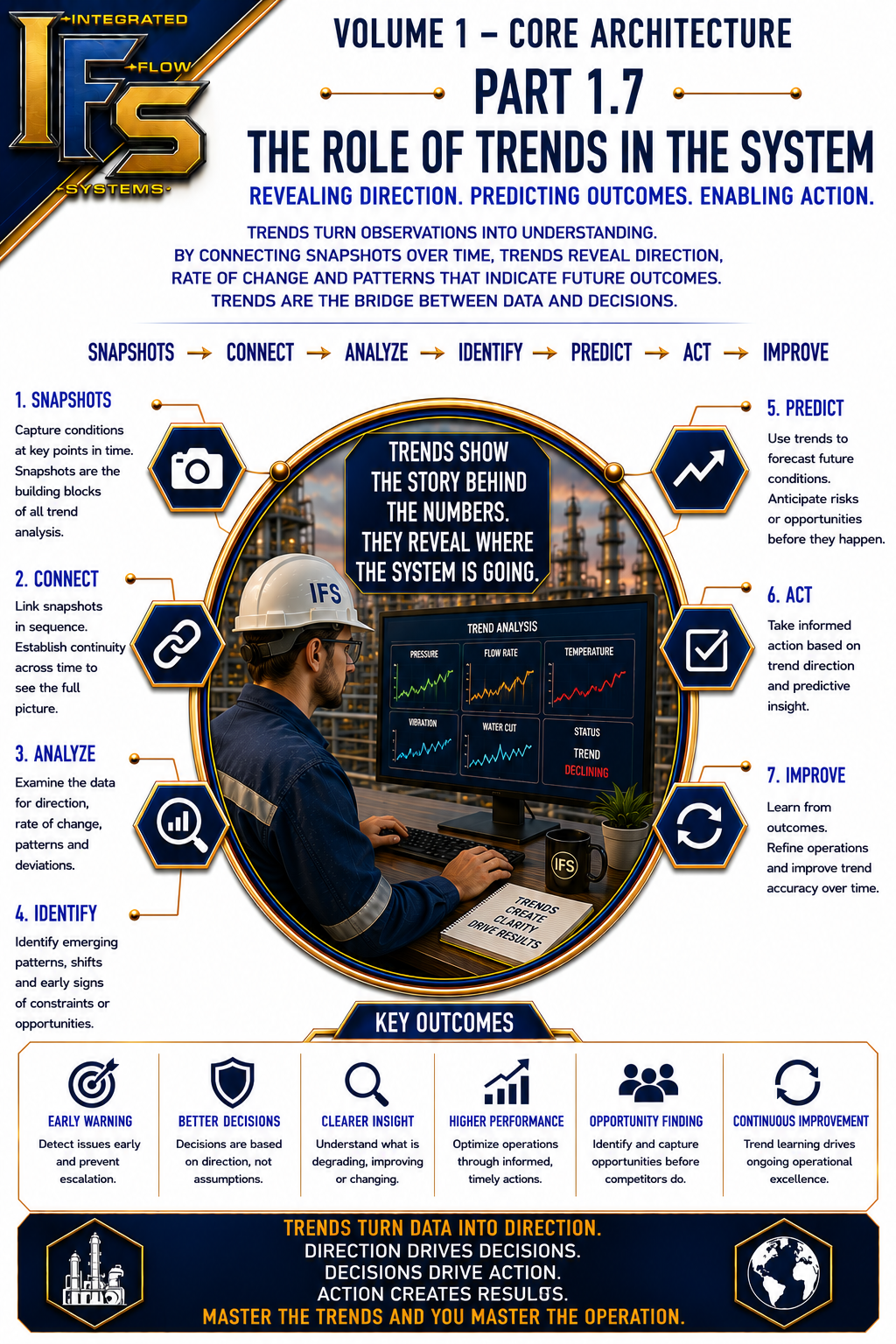
Every operation generates data.
Pressures are recorded.
Temperatures are measured.
Flow rates are monitored.
Equipment is inspected.
Operators document observations.
Production is reported.
Viewed individually, these measurements describe only a single moment in time.
Viewed together over time, they reveal something far more valuable.
They reveal direction.
In Integrated Flow Systems (IFS), Trends transform isolated observations into operational intelligence.
A trend answers the question that a single measurement never can:
"Where is the system going?"
Understanding direction allows organizations to anticipate problems, recognize opportunities and act before conditions become critical.
A trend is the measurable direction of change within a system over time.
It is created by connecting multiple operational snapshots into a continuous picture.
Rather than asking:
"What is happening?"
Trend analysis asks:
Is it improving?
Is it declining?
How fast is it changing?
Is the rate accelerating?
Is it stabilizing?
Has it happened before?
Where is it likely to go next?
Trends convert data into understanding.
No trend exists without history.
Every trend begins with consistent operational snapshots.
Pressure readings.
Production reports.
Inspection records.
Equipment conditions.
Quality measurements.
Operator observations.
Maintenance activities.
Each snapshot captures one moment.
Multiple snapshots connected together create a timeline.
That timeline reveals movement.
IFS treats every snapshot as a building block of operational intelligence.
Operations cannot be understood from isolated events.
Today's production means little without yesterday's.
A vibration reading has little value unless previous readings are available.
A temperature increase becomes significant only when its direction is understood.
Trend analysis connects operational history into one continuous story.
This continuity transforms disconnected information into operational knowledge.
The purpose of trend analysis is not collecting more data.
It is understanding direction.
Conditions may be:
Improving.
Declining.
Stable.
Accelerating.
Decelerating.
Oscillating.
Recovering.
Plateauing.
Each direction carries different operational meaning.
Knowing the direction is often more valuable than knowing the current value.
Direction determines response.
Patterns rarely appear suddenly.
Most operational events develop progressively.
Equipment wear increases gradually.
Flow restrictions slowly develop.
Product quality drifts.
Energy consumption rises.
Production slowly declines.
Maintenance intervals shorten.
Small observations eventually become recognizable patterns.
IFS searches for these patterns before they become operational failures.
This proactive approach shifts organizations from reacting to predicting.
Knowing that something is changing is valuable.
Knowing how quickly it is changing is even more valuable.
Two systems may both be declining.
One declines slowly.
The other declines rapidly.
The operational response should not be the same.
Rate of change determines urgency.
IFS therefore evaluates:
Direction.
Magnitude.
Velocity.
Acceleration.
Duration.
Together these characteristics describe the health of the operation far more accurately than isolated measurements.
Trend analysis allows organizations to look ahead.
Not through speculation.
Through evidence.
When enough historical information exists, trends reveal likely future conditions.
Production forecasts.
Equipment degradation.
Maintenance requirements.
Inventory consumption.
Demand fluctuations.
Energy usage.
Constraint development.
Opportunity formation.
Prediction in IFS is based on observed behavior rather than assumptions.
The future becomes increasingly understandable because the past provides context.
Every operational decision becomes stronger when trend information is available.
Maintenance can be scheduled before failure.
Production adjustments occur before quality declines.
Operators intervene before alarms activate.
Resources are allocated where deterioration is accelerating.
Investment focuses where opportunity is emerging.
Trend-based decisions replace reactive decision-making with proactive management.
Not every trend indicates a problem.
Some reveal improvement.
Increasing efficiency.
Lower energy consumption.
Higher product quality.
Reduced downtime.
Faster production.
Improved recovery.
Stable operating conditions.
Recognizing positive trends allows organizations to replicate success rather than merely correcting failure.
IFS monitors opportunities with the same attention given to operational risk.
Every completed trend becomes part of operational experience.
Successful recoveries.
Repeated failures.
Seasonal behavior.
Equipment life cycles.
Operator improvements.
Maintenance effectiveness.
Constraint development.
These historical patterns become increasingly valuable over time.
The longer the operational memory, the more accurate future trend interpretation becomes.
IFS continuously strengthens itself through accumulated operational knowledge.
Individual equipment trends are useful.
System trends are transformational.
Pressure trends influence production.
Production trends influence inventory.
Inventory trends influence logistics.
Logistics trends influence customer performance.
Every trend interacts with other trends.
IFS studies these relationships because operational systems behave as interconnected networks rather than isolated machines.
Understanding one trend is useful.
Understanding how multiple trends influence one another creates operational intelligence.
Every completed operational cycle improves future trend analysis.
Predictions become more accurate.
Patterns become easier to recognize.
False assumptions decrease.
Operator confidence increases.
Decision quality improves.
Trend analysis therefore becomes a continuously improving capability rather than a fixed analytical tool.
The system learns because its memory grows.
Data explains what has happened.
Trends explain what is happening.
Understanding trends reveals what is likely to happen next.
Integrated Flow Systems places trend analysis at the center of operational intelligence because trends connect the past, explain the present and prepare organizations for the future.
Every snapshot contributes to understanding.
Every trend strengthens decision-making.
Every decision shapes future performance.
Organizations that master trends stop reacting to events after they occur.
They begin influencing outcomes before they happen.
Because in Integrated Flow Systems, trends are not simply graphs.
They are the language through which an operation tells its future.

Every operational system has limits.
Every pipeline has a maximum flow rate.
Every pump has a performance curve.
Every conveyor has a carrying capacity.
Every separator has an efficiency limit.
Every operator has a workload limit.
Every budget has financial limits.
Every schedule has time constraints.
These limits determine how well the system performs.
In Integrated Flow Systems (IFS), these operational limits are called Constraints.
Constraints define where flow slows, where efficiency declines, where risk increases and where opportunity for improvement begins.
The organizations that consistently outperform others are not those with the fewest constraints.
They are the ones that identify and manage them first.
A Constraint is anything that limits the performance, capacity, reliability, quality or efficiency of a system.
Constraints may be:
Physical.
Mechanical.
Operational.
Human.
Environmental.
Financial.
Regulatory.
Informational.
Every operation contains constraints.
The objective is not to eliminate every constraint.
The objective is to understand which constraints matter most and manage them effectively.
Flow naturally seeks the easiest path.
Constraints interrupt that movement.
A partially plugged pipeline reduces production.
A worn pump limits capacity.
An overloaded conveyor slows an entire plant.
A delayed shipment disrupts downstream operations.
An unavailable operator delays maintenance.
A lack of information delays decisions.
Whenever flow encounters resistance, the system begins losing efficiency.
IFS identifies where resistance exists before it grows into operational failure.
Most constraints do not appear suddenly.
They develop gradually.
Pressure slowly increases.
Flow gradually decreases.
Equipment slowly wears.
Energy consumption slowly rises.
Cycle times become slightly longer.
Product quality begins drifting.
Small operational changes often indicate developing constraints long before alarms activate.
Trend monitoring allows operators to recognize these signals early.
Early detection transforms expensive emergencies into manageable maintenance activities.
Symptoms often appear far from the actual problem.
Reduced production may begin at a pump.
The real constraint may exist in a clogged filter.
Poor product quality may appear during packaging.
The actual limitation may originate upstream during mixing.
IFS distinguishes between symptoms and root constraints.
Operators are encouraged to ask:
Where is the restriction actually occurring?
Which Node introduced it?
Which Exchange created it?
Which Flow Corridor carries its effects?
Understanding the location of the constraint is the first step toward eliminating it.
Not every constraint deserves immediate attention.
Some have minimal operational effect.
Others influence the entire system.
IFS evaluates each constraint according to:
Severity.
Frequency.
Duration.
Cost.
Safety impact.
Environmental impact.
Production impact.
Quality impact.
Operational risk.
This allows organizations to focus resources where improvement creates the greatest value.
Every constraint increases uncertainty.
Reduced equipment capacity increases production risk.
Restricted cooling increases equipment failure risk.
Delayed inspections increase safety risk.
Poor communication increases operational risk.
Inventory shortages increase customer risk.
As constraints multiply, operational flexibility decreases.
Small disturbances begin creating larger consequences.
IFS monitors constraint growth because unmanaged constraints often compound into major failures.
Every operational improvement begins with understanding a limitation.
Remove unnecessary waiting.
Reduce pressure losses.
Improve equipment reliability.
Increase production capacity.
Simplify procedures.
Improve operator communication.
Reduce energy consumption.
Optimize scheduling.
Every constraint removed increases operational capability.
IFS therefore views constraints as opportunities waiting to be understood.
The greatest improvements often occur where the greatest limitations once existed.
Once identified, constraints require deliberate management.
Possible responses include:
Monitoring.
Maintenance.
Equipment replacement.
Operational adjustments.
Flow redistribution.
Scheduling improvements.
Training.
Automation.
Redesign.
Temporary workarounds.
The correct response depends on the importance of the constraint and the objectives of the operation.
Effective management often prevents much larger operational disruptions.
Some constraints cannot immediately be eliminated.
They can, however, be relieved.
Additional storage may reduce congestion.
Alternate routing may improve flow.
Temporary equipment may restore capacity.
Scheduling adjustments may reduce bottlenecks.
Preventive maintenance may recover performance.
Constraint relief often creates immediate operational gains while permanent improvements are planned.
IFS recognizes both temporary and permanent solutions as valuable operational tools.
Constraints are dynamic.
Today's primary limitation may disappear tomorrow.
Production increases create new bottlenecks.
Equipment upgrades shift operational balance.
Seasonal conditions alter capacity.
Market demand changes priorities.
Operator experience improves performance.
Every operational improvement changes the location of the next constraint.
Continuous monitoring ensures organizations always understand where the system's current limitations exist.
Constraint management is never finished.
It continuously evolves with the operation.
Very few constraints exist independently.
One restricted Flow Corridor increases pressure elsewhere.
One overloaded Node affects downstream Exchanges.
One delayed maintenance activity influences multiple production systems.
IFS studies these relationships because removing one constraint may expose another.
Understanding how constraints interact allows organizations to optimize the entire system rather than simply relocating problems.
The objective is not moving constraints.
The objective is reducing their overall impact.
Constraints are not signs of failure.
They are characteristics of every operational system.
Every organization has them.
Every process contains them.
Every improvement begins by understanding them.
Integrated Flow Systems treats constraints as measurable operational conditions that can be detected, analyzed, prioritized and managed before they become costly failures.
The organizations that consistently improve are not those that ignore limitations.
They are the ones that identify them earliest, understand them most clearly and respond with discipline.
Because every constraint represents both a limit and an opportunity.
Remove the unnecessary limits, and the system naturally performs better.
Master the constraints, and you master the operation.
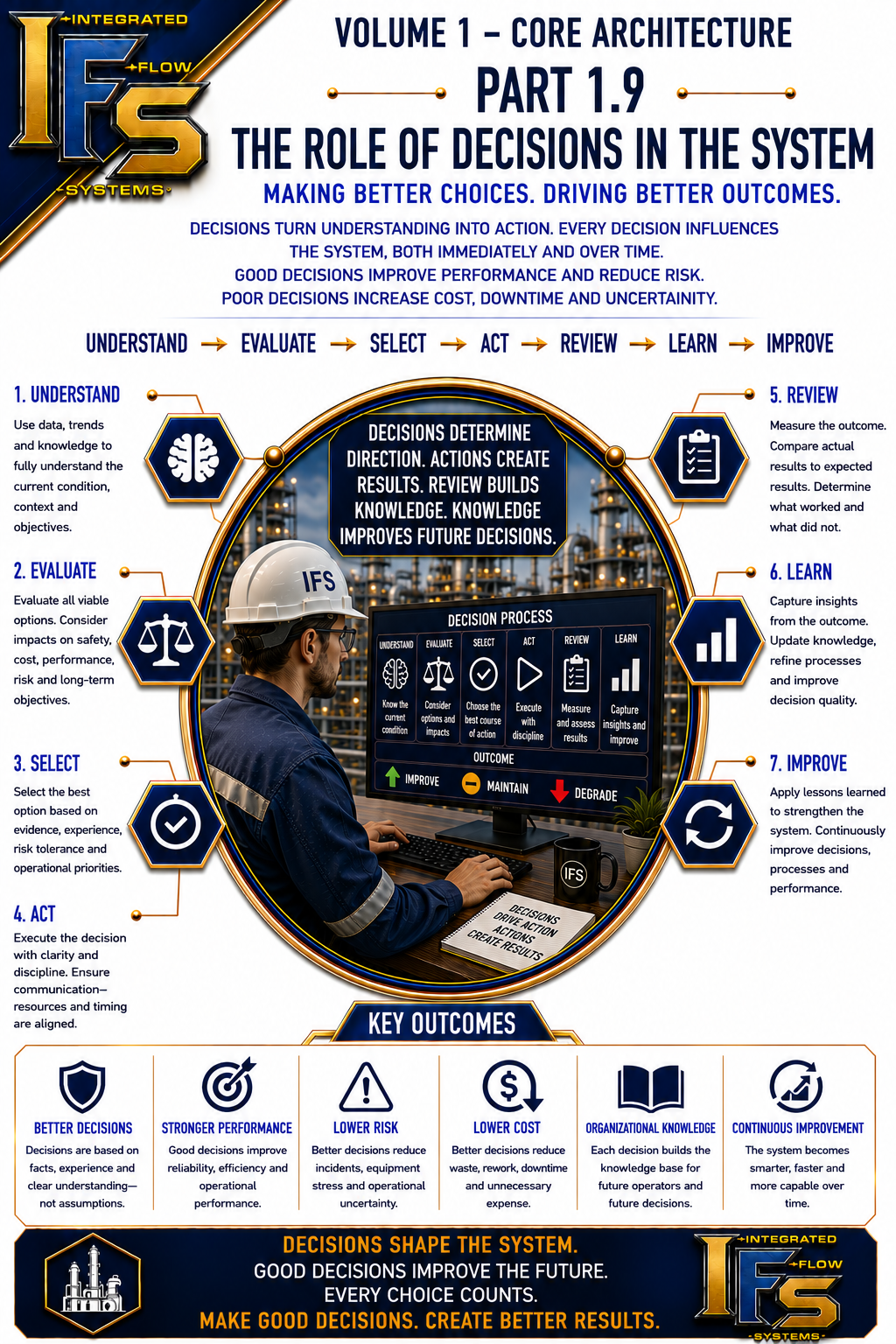
Every operational system exists to make decisions.
Whether the objective is increasing production, reducing downtime, improving safety, lowering costs or protecting equipment, every observation, every measurement and every analysis ultimately serves one purpose:
Making a better decision.
Data alone has no value.
Knowledge alone has no value.
Even understanding alone has limited value.
Only when understanding becomes action does operational intelligence produce measurable results.
Within Integrated Flow Systems (IFS), the Decision is the point where observation becomes action and operational knowledge becomes operational improvement.
Every part of the IFS Framework builds toward the Decision.
Flow provides movement.
Nodes provide context.
Exchanges create change.
Monitoring gathers information.
Trends reveal direction.
Constraints expose limitations.
Memory preserves experience.
The Decision integrates everything.
It determines what happens next.
Without sound decisions, even perfect information produces no improvement.
Operational decisions should never rely upon assumptions.
IFS encourages every decision to be supported by:
Current operating conditions.
Historical performance.
Trend direction.
Constraint severity.
Operational objectives.
Available resources.
Safety requirements.
Previous outcomes stored in Memory.
The more complete the understanding, the higher the probability of selecting the correct course of action.
The fastest decision is not always the best decision.
Operators must first understand:
What changed?
Why did it change?
Where did it begin?
How severe is it?
What happens if nothing is done?
What happens if intervention occurs?
Understanding reduces unnecessary actions and prevents operators from treating symptoms rather than causes.
IFS promotes informed action over reactive action.
Most operational situations have multiple possible responses.
Increase monitoring.
Adjust flow.
Reduce production.
Perform maintenance.
Change operating parameters.
Replace equipment.
Delay intervention.
Continue operating.
Each option carries different risks, costs and benefits.
IFS provides operators with the context needed to evaluate those alternatives logically rather than emotionally.
The best decision is rarely the most aggressive.
Nor is it always the least expensive.
The best decision balances:
Safety.
Reliability.
Production.
Cost.
Quality.
Environmental responsibility.
Long-term performance.
Operational stability.
Every decision represents a trade-off.
IFS makes those trade-offs visible before action is taken.
A correct decision poorly executed often becomes a poor outcome.
Successful implementation requires:
Clear communication.
Defined responsibilities.
Proper timing.
Adequate resources.
Verification of completion.
Operational discipline.
The system records not only what decision was made, but how effectively it was implemented.
Execution quality directly influences operational success.
Every decision produces information.
Did the situation improve?
Did conditions remain unchanged?
Did the intervention create new problems?
Were objectives achieved?
Was the expected outcome realized?
Reviewing results closes the operational loop.
Without review, organizations repeat mistakes.
With review, organizations build intelligence.
Each completed decision becomes part of operational knowledge.
IFS records:
The conditions that existed.
The decision that was chosen.
The reason it was selected.
The actions taken.
The results achieved.
Lessons learned.
Future operators can retrieve these experiences whenever similar situations occur.
Operational knowledge compounds over time.
Every decision strengthens the system.
Decision-making is not static.
Experience improves judgment.
Better monitoring improves understanding.
More accurate trends improve prediction.
Larger memory improves confidence.
As the operational knowledge base expands, decision quality naturally improves.
Organizations become:
More consistent.
More predictable.
More efficient.
More resilient.
Smarter with every operating cycle.
Very few decisions affect only one part of an operation.
Increasing production may increase maintenance demand.
Reducing pump speed may improve equipment life while reducing throughput.
Changing process temperature may improve quality while increasing energy consumption.
Every decision creates downstream consequences.
IFS evaluates decisions across the entire operational network rather than in isolation.
The objective is system optimization, not local optimization.
IFS does not replace operators.
It strengthens operator judgment.
The framework organizes operational information into a logical structure that helps people make better decisions under changing conditions.
Experience remains valuable.
Professional judgment remains essential.
IFS simply ensures that both are supported by complete operational intelligence.
Every action begins with a decision.
Every decision changes the system.
Some improve it.
Some degrade it.
The difference is rarely luck.
It is understanding.
Integrated Flow Systems creates better decisions by ensuring operators understand what is happening, why it is happening, what options exist and what previous experience has already demonstrated.
Because decisions shape performance.
Performance shapes results.
Results build memory.
And memory creates the knowledge that produces even better decisions tomorrow.
In IFS, operational excellence is not achieved by making more decisions.
It is achieved by consistently making better ones.
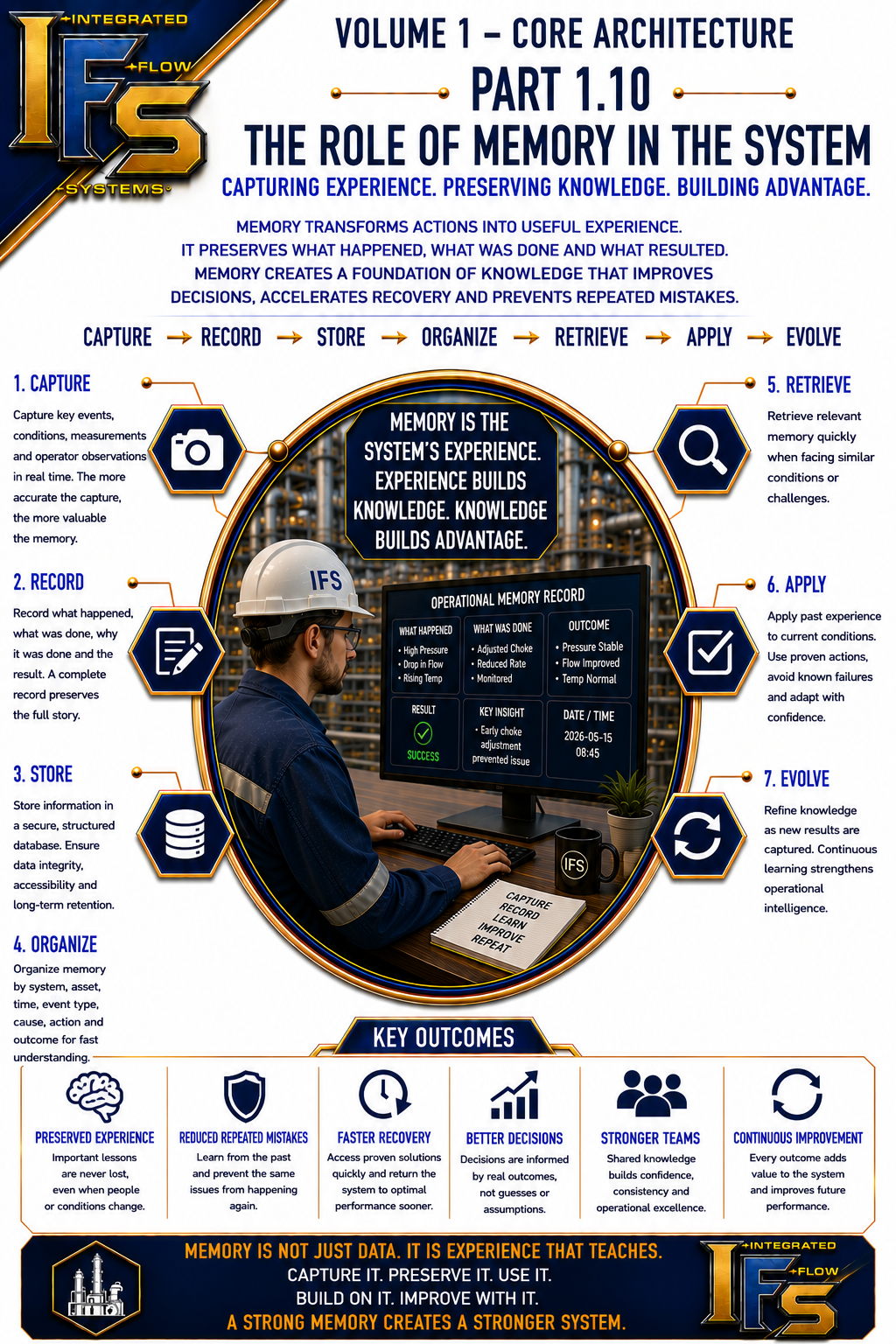
Operations improve because they remember.
Every successful intervention, every equipment failure, every production increase, every maintenance activity and every unexpected event creates information. If that information is forgotten, the operation pays the price again. If it is captured, organized and reused, it becomes one of the most valuable assets an organization possesses.
Within Integrated Flow Systems (IFS), Memory is not simply a historical archive. It is the operational intelligence that allows today's decisions to benefit from yesterday's experience.
Memory transforms isolated events into cumulative knowledge.
Every shift generates experience.
Operators observe changing conditions.
Equipment responds differently under varying loads.
Maintenance teams discover failure mechanisms.
Production crews develop practical solutions.
Engineers identify process improvements.
Unless these experiences are documented, they disappear when the shift ends, personnel retire or organizations change.
IFS treats every operational event as an opportunity to strengthen the knowledge base.
Experience becomes permanent.
Operational memory begins with accurate capture.
The objective is not to record everything.
The objective is to record what matters.
Every significant event should include:
Operating conditions.
Node location.
Flow conditions.
Equipment involved.
Observed symptoms.
Actions performed.
Time sequence.
Measured results.
Operator observations.
Environmental conditions.
The more complete the record, the more valuable the knowledge becomes.
Facts without context create incomplete knowledge.
IFS records not only what happened, but why it happened and how it was resolved.
Each operational record should answer questions such as:
What was observed?
Where did it begin?
What constraints existed?
What decision was made?
Why was that decision selected?
What actions were performed?
What changed afterward?
Was the objective achieved?
This transforms individual incidents into repeatable operational intelligence.
Large organizations accumulate thousands of operational events every year.
Without organization, information becomes difficult to retrieve.
IFS structures memory so it can be searched through:
Facility.
Process area.
Flow corridor.
Node.
Equipment.
Failure mode.
Operational condition.
Trend.
Constraint.
Decision.
Outcome.
Time period.
Instead of searching through documents, operators search through knowledge.
Memory becomes valuable only when it can be found.
When similar conditions appear again, operators should immediately access previous situations.
Questions become easier to answer.
Has this happened before?
What caused it?
What was attempted?
What worked?
What failed?
How long did recovery require?
Who solved it?
Retrieval transforms historical information into operational guidance.
Knowledge unused has little operational value.
IFS encourages operators to actively apply previous experience.
Successful maintenance procedures can be repeated.
Known failure patterns can be recognized earlier.
Previous operating limits become safer guidelines.
Effective troubleshooting methods become standardized.
Each application reduces uncertainty while increasing consistency.
Knowledge only becomes intelligence when it influences current decisions.
Memory is never complete.
Every shift contributes.
Every intervention adds detail.
Every improvement strengthens understanding.
Each new experience either confirms existing knowledge or expands it.
IFS treats memory as a living operational asset that continuously grows alongside the organization.
The knowledge base becomes stronger every day.
People change.
Teams rotate.
Experts retire.
Contractors leave.
Without structured operational memory, organizations lose decades of experience.
IFS preserves operational intelligence independently of individual employees.
Knowledge belongs to the operation.
Not to one person.
This dramatically reduces the loss of expertise during personnel transitions.
Every decision becomes more accurate when supported by experience.
Instead of relying solely on intuition, operators can compare current conditions against previous events.
Similar equipment failures.
Repeated production anomalies.
Known operating limits.
Historical recovery strategies.
Verified maintenance actions.
Operational confidence increases because decisions are supported by evidence rather than assumption.
Raw measurements become data.
Connected data becomes information.
Analyzed information becomes understanding.
Repeated understanding becomes knowledge.
Applied knowledge becomes wisdom.
Memory is the bridge that connects every stage.
Without memory, organizations continuously restart their learning process.
With memory, learning compounds indefinitely.
Organizations that learn faster improve faster.
Organizations that remember more avoid repeating mistakes.
Organizations that preserve experience solve problems sooner.
Memory reduces:
Downtime.
Diagnostic time.
Training requirements.
Repeated failures.
Operational uncertainty.
At the same time, it improves:
Decision quality.
Maintenance planning.
Production consistency.
Operator confidence.
Continuous improvement.
Memory becomes a competitive advantage that competitors cannot easily duplicate.
Every event teaches something.
Every decision creates experience.
Every experience deserves to be preserved.
Integrated Flow Systems treats operational memory as one of the most valuable assets an organization possesses because it allows every generation of operators to begin where the previous generation finished—not where they started.
Memory transforms experience into knowledge.
Knowledge transforms operations into intelligence.
And intelligence creates operations that become safer, faster, more reliable and continuously stronger with every operating cycle.
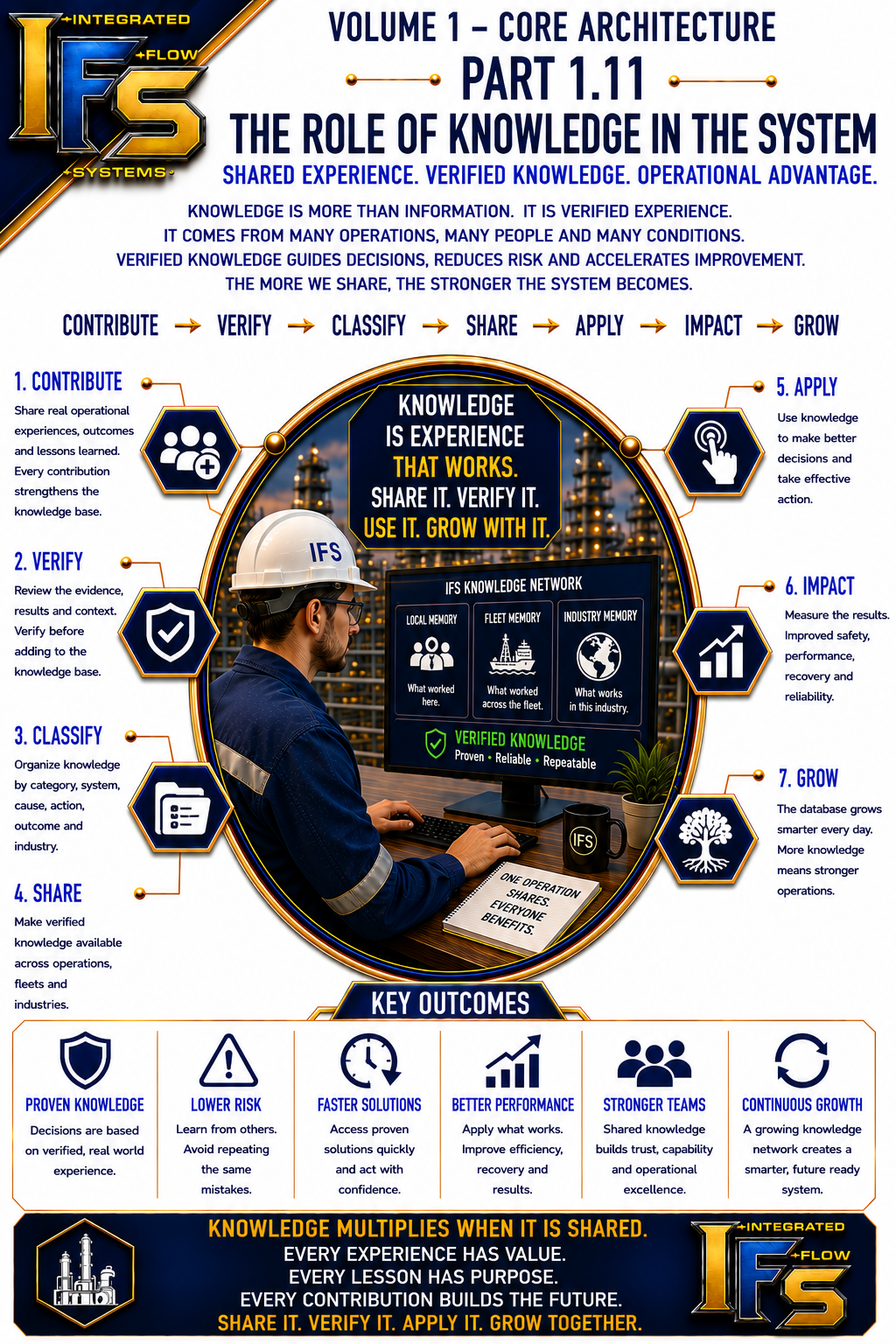
Information explains what is happening.
Memory preserves what has happened.
Knowledge explains what consistently works.
This distinction is fundamental to Integrated Flow Systems (IFS). A single event creates information. A recorded event becomes memory. Multiple verified experiences, repeated under different conditions and producing consistent results, become knowledge.
Knowledge is operational confidence built through evidence.
It is the foundation upon which better decisions, faster recovery and continuous improvement are built.
Every operation generates enormous amounts of information.
Sensor readings.
Operator observations.
Maintenance records.
Production reports.
Inspection results.
Trend analysis.
On their own, these are isolated pieces of information.
When those observations are connected, verified and repeatedly confirmed, they evolve into operational knowledge.
IFS organizes this progression deliberately.
Information becomes memory.
Memory becomes knowledge.
Knowledge becomes operational advantage.
Knowledge is not created by management alone.
Operators create knowledge.
Technicians create knowledge.
Engineers create knowledge.
Maintenance crews create knowledge.
Production teams create knowledge.
Every solved problem.
Every successful intervention.
Every avoided failure.
Every unexpected discovery.
Each contributes another piece to the operational knowledge network.
The strength of the system grows through the collective experience of everyone who works within it.
Not every observation becomes knowledge.
IFS distinguishes between experience and verified experience.
Before knowledge is accepted into the operational database, it should be confirmed through evidence.
Was the outcome repeatable?
Did it solve the original problem?
Were external conditions understood?
Has it worked more than once?
Can similar operators reproduce the result?
Verification prevents assumptions, opinions and isolated successes from becoming operational standards.
Only proven knowledge strengthens the system.
As knowledge expands, organization becomes essential.
IFS classifies knowledge using multiple relationships, including:
Industry.
Facility.
Flow corridor.
Node.
Equipment.
Constraint.
Failure mechanism.
Trend pattern.
Operational condition.
Decision type.
Recovery strategy.
Performance outcome.
This structure allows operators to locate relevant knowledge quickly when similar situations arise.
Knowledge becomes immediately usable rather than permanently archived.
Knowledge has the greatest value when it is shared.
IFS supports multiple levels of operational learning.
Local Knowledge
Solutions developed for one operation.
Fleet Knowledge
Successful practices replicated across multiple facilities or assets.
Industry Knowledge
Verified operational experience collected from similar operations across an entire industry.
Each level expands operational intelligence while reducing duplicated effort.
The goal is simple:
When one operation learns, every operation improves.
Knowledge exists to improve action.
Operators should not repeatedly solve problems that have already been solved elsewhere.
Instead, they should begin with what has already been proven.
Previously successful maintenance procedures.
Verified startup methods.
Known troubleshooting sequences.
Established recovery plans.
Reliable operating limits.
Documented optimization strategies.
Applying verified knowledge reduces uncertainty and accelerates improvement.
Knowledge should always produce measurable results.
IFS evaluates its effectiveness through outcomes such as:
Reduced downtime.
Improved safety.
Lower maintenance costs.
Higher production stability.
Faster diagnostics.
Reduced troubleshooting time.
Improved equipment life.
Greater operational consistency.
If knowledge does not improve measurable performance, it should be questioned, refined or replaced.
Operational knowledge must continuously earn its place.
Unlike physical assets, knowledge becomes stronger every time it is applied.
Every successful application confirms reliability.
Every variation expands understanding.
Every new condition refines the original lesson.
Every improvement increases confidence.
Knowledge is never static.
It evolves with every operating cycle.
IFS encourages continuous refinement rather than fixed procedures.
One of the defining strengths of IFS is the creation of an interconnected knowledge network.
Instead of isolated reports and disconnected documents, operational knowledge becomes linked across the entire framework.
Nodes connect related failures.
Constraints connect recurring limitations.
Trends connect changing conditions.
Decisions connect successful responses.
Memory connects operational history.
Knowledge connects everything together.
This creates an operational intelligence system that improves itself over time.
Organizations often repeat mistakes because lessons remain isolated within individuals.
Experienced employees retire.
Personnel change locations.
Contractors leave.
Shift crews rotate.
When knowledge exists only in people's memories, organizations lose years of operational experience.
IFS preserves verified knowledge within the system itself.
The organization becomes smarter regardless of personnel changes.
Knowledge becomes permanent.
Competitive advantage rarely comes from having more information.
It comes from applying better knowledge faster than others.
Organizations that consistently learn:
Recover faster.
Adapt sooner.
Reduce uncertainty.
Prevent repeated failures.
Recognize opportunities earlier.
Improve continuously.
Knowledge compounds.
Each lesson strengthens the next decision.
Each decision creates better outcomes.
Each outcome creates stronger knowledge.
Information tells you what happened.
Memory tells you what has happened before.
Knowledge tells you what consistently works.
Integrated Flow Systems transforms operational experience into verified knowledge that every operator, every facility and every future generation can use.
Knowledge grows when it is shared.
It becomes stronger when it is verified.
It creates value when it is applied.
And over time, it becomes one of the most powerful assets any organization can possess—not because it stores information, but because it continuously improves the decisions that shape operational performance.
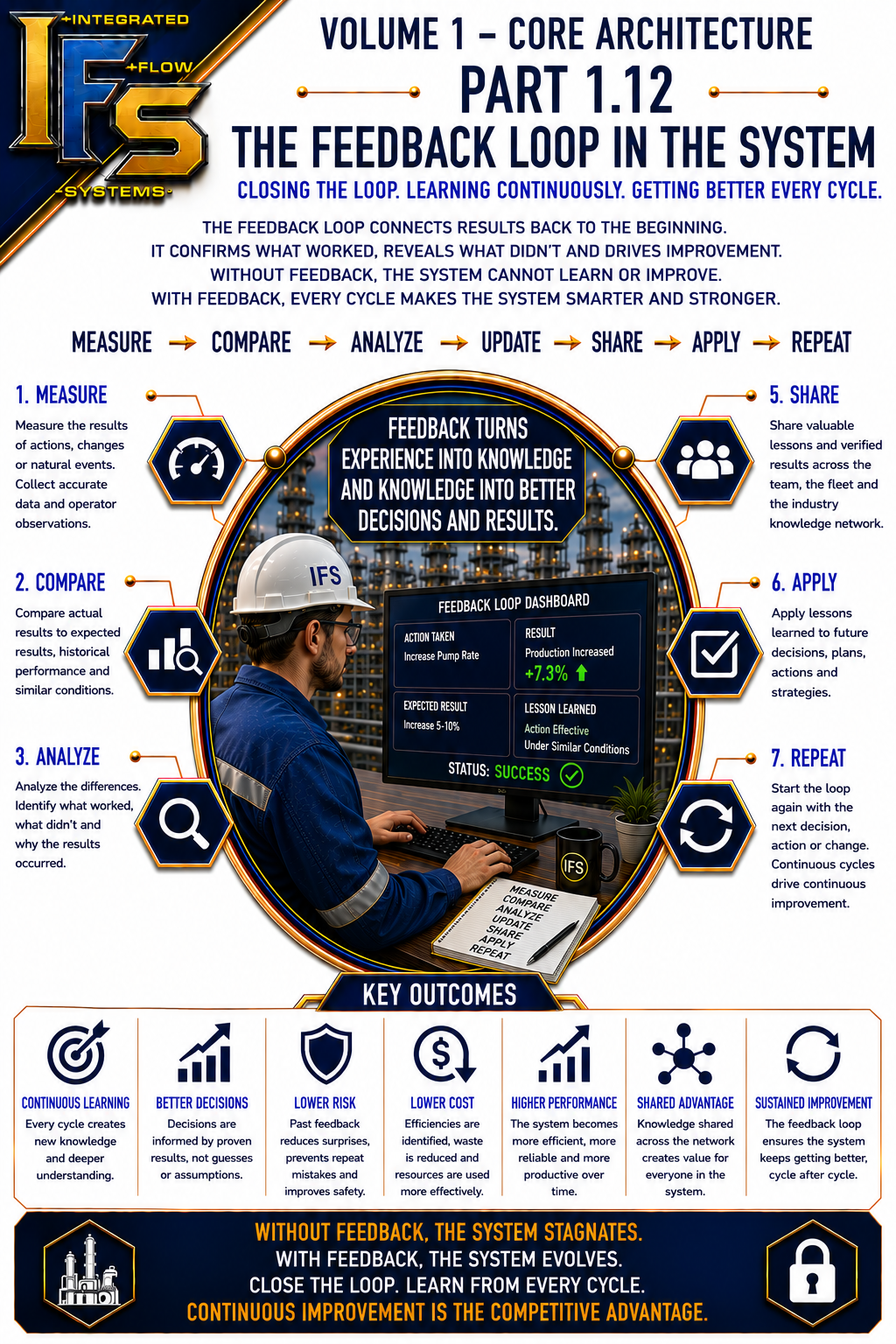
Every operation produces results.
Every result contains information.
Every piece of information contains a lesson.
Whether the outcome is a success, a failure or something in between, it creates an opportunity to improve the next operating cycle. Organizations that fail to capture these lessons remain trapped in repetition. Organizations that build structured feedback systems continuously become safer, faster, more efficient and more reliable.
Within Integrated Flow Systems (IFS), the Feedback Loop is the mechanism that transforms operational results into continuous improvement. It closes the learning cycle by ensuring every action contributes to stronger future performance.
No operational activity ends when the work is completed.
Every adjustment.
Every maintenance activity.
Every production change.
Every startup.
Every shutdown.
Every equipment failure.
Every successful recovery.
Each produces measurable outcomes that can be evaluated.
IFS treats every outcome as valuable feedback regardless of whether the result was expected or unexpected.
Feedback begins with accurate measurement.
Operators cannot improve what they do not measure.
IFS compares actual outcomes against:
Expected performance.
Historical performance.
Industry benchmarks.
Previous similar events.
Operational objectives.
Performance indicators.
Measurements may include:
Production.
Flow.
Pressure.
Temperature.
Energy consumption.
Downtime.
Maintenance hours.
Safety performance.
Equipment condition.
These measurements establish whether the action achieved its intended objective.
Good feedback identifies the difference between expectation and outcome.
Questions include:
Did the action solve the original problem?
Did performance improve as expected?
Were unintended consequences created?
Did another constraint appear?
Was the recovery permanent or temporary?
Were costs reduced?
Was safety improved?
Comparison reveals whether operational understanding was accurate.
It also exposes incorrect assumptions before they become accepted practice.
Numbers alone rarely explain the full story.
IFS investigates why the results occurred.
Was the original diagnosis correct?
Did environmental conditions influence the outcome?
Was operator execution consistent?
Were equipment conditions changing?
Did multiple factors contribute simultaneously?
Understanding cause is more valuable than simply recording results.
The objective is not merely documenting success or failure.
The objective is understanding why success or failure occurred.
Every completed feedback cycle strengthens the operational knowledge base.
IFS updates:
Memory.
Verified Knowledge.
Trend confidence.
Constraint history.
Recovery strategies.
Decision guidance.
Best practices.
Future recommendations.
Each completed cycle makes future decisions faster and more accurate.
The organization becomes progressively more intelligent.
Operational improvement accelerates when lessons are shared.
IFS distributes verified learning across multiple levels.
Shift teams.
Maintenance groups.
Operations.
Engineering.
Fleet operations.
Industry knowledge networks.
One successful recovery can prevent dozens of future failures.
One discovered mistake can eliminate years of repeated problems.
Shared learning multiplies operational value.
Feedback only creates value when it changes future behavior.
Successful actions become recommended practices.
Unsuccessful actions become cautionary examples.
Recovered failures become troubleshooting guides.
Optimized procedures become operational standards.
Every lesson influences future decisions.
IFS transforms operational history into operational guidance.
The Feedback Loop never ends.
Every improvement creates another opportunity to improve.
Every new operating condition provides additional learning.
Every completed cycle generates stronger knowledge.
The organization gradually shifts from reacting to problems toward anticipating them before they occur.
Continuous improvement becomes part of everyday operation rather than a separate initiative.
Individual experience is valuable.
Collective experience is transformational.
Every completed feedback cycle increases:
Knowledge accuracy.
Decision confidence.
Recovery speed.
Equipment reliability.
Operational consistency.
Training quality.
Organizational resilience.
Instead of relying on isolated expertise, IFS builds intelligence that belongs to the entire organization.
One of the greatest costs in operations is solving the same problem repeatedly.
Feedback eliminates repetition by ensuring that:
Mistakes are documented.
Causes are understood.
Solutions are verified.
Knowledge is preserved.
Future operators begin with proven experience.
Each lesson permanently reduces organizational uncertainty.
Continuous improvement is not driven by opinions.
It is driven by evidence.
IFS provides a structured method for evaluating every operational cycle using measurable results instead of assumptions.
Each cycle answers four fundamental questions:
What happened?
Why did it happen?
What was learned?
What should change next time?
Those answers become the starting point for the next cycle.
Improvement becomes systematic rather than accidental.
Every result deserves to be measured.
Every measurement deserves to be understood.
Every lesson deserves to be preserved.
Every lesson deserves to improve the next decision.
Integrated Flow Systems places the Feedback Loop at the center of continuous operational intelligence because learning is not a separate activity—it is built directly into the operation itself.
Without feedback, organizations repeat yesterday.
With feedback, every operating cycle becomes smarter than the one before.
The system never stops learning.
The operation never stops improving.
Whether you're looking to reduce downtime, improve efficiency, preserve equipment, or better understand your operational data, we're ready to help.
Complete the form below and we'll discuss how Integrated Flow Systems can be applied to your operation.
Let's start the conversation.