Explore operational insights, industry graphics, reference materials, and practical examples designed to support better decisions and more consistent performance across complex industrial systems.

Every operation exists in a constant state of change.
Pressures rise.
Flows fluctuate.
Temperatures drift.
Equipment wears.
Operators respond.
Conditions evolve.
Without capturing these moments, operational knowledge disappears as quickly as the conditions that created it.
Within Integrated Flow Systems (IFS), a Snapshot is a structured record of an operation at a specific moment in time. It captures not only the data, but also the context surrounding that data. Each snapshot becomes a permanent reference point that allows future conditions to be compared against past reality.
Snapshots are the foundation of operational intelligence.
A snapshot captures the operation exactly as it exists at one point in time.
It freezes the current operating environment before conditions continue changing.
Each snapshot records:
Date and time.
Operating location.
Equipment status.
Flow conditions.
Production values.
Operator observations.
Environmental conditions.
Current constraints.
Active alarms.
Recent changes.
The goal is to preserve reality before it changes.
Operational data alone rarely explains what is happening.
IFS records both measurable information and operational context.
This includes:
Sensor readings.
Equipment configuration.
Operator comments.
Visual observations.
Maintenance activities.
Weather conditions.
Process changes.
Shift transitions.
Unusual events.
Context transforms raw data into usable operational knowledge.
One snapshot provides information.
Multiple snapshots reveal behavior.
Consistent snapshots allow operators to identify:
Performance improvement.
Performance decline.
Constraint growth.
Equipment degradation.
Production instability.
Process recovery.
Emerging opportunities.
Without consistency, trend analysis becomes unreliable.
Reliable trends require reliable snapshots.
Each snapshot becomes part of the organization's permanent memory.
Instead of relying upon individual experience, IFS creates a growing operational knowledge base that survives personnel changes and shift rotations.
Every snapshot strengthens:
Historical records.
Trend confidence.
Equipment history.
Constraint history.
Recovery history.
Decision support.
Operational understanding.
Knowledge grows with every captured event.
Snapshots allow operations to compare current conditions against previous operating states.
Questions include:
Has production improved?
Is pressure behaving normally?
Has vibration increased?
Are temperatures changing?
Has this condition occurred before?
What happened last time?
Comparison removes guesswork from operational decision-making.
Past performance becomes an active tool rather than archived information.
Better decisions require accurate information.
Snapshots provide decision-makers with evidence instead of assumptions.
Operators can determine:
Whether conditions are stable.
Whether intervention is necessary.
Whether performance is improving.
Whether risk is increasing.
Whether previous solutions remain effective.
Evidence increases confidence.
Confidence improves decisions.
Snapshots document exactly what existed before and after operational changes.
This creates a permanent record of:
Conditions before intervention.
Actions performed.
Conditions after intervention.
Measured results.
Lessons learned.
Accurate records improve communication between shifts, departments, and management while reducing uncertainty about what actually occurred.
Many operational problems develop gradually.
Individual snapshots may appear normal.
Long-term collections reveal hidden patterns.
IFS uses sequential snapshots to support:
Trend Analysis.
Constraint Identification.
Performance Evaluation.
Failure Investigation.
Predictive Maintenance.
Opportunity Recognition.
Each additional snapshot increases analytical accuracy.
Operational intelligence is not created from isolated events.
It is built from thousands of accurately recorded moments.
Each snapshot contributes to:
Better understanding.
Stronger trend analysis.
Improved diagnostics.
Faster troubleshooting.
Higher confidence.
Greater operational consistency.
The organization's intelligence grows one snapshot at a time.
Operations generate valuable knowledge every hour.
Without structured snapshots, much of that knowledge disappears during shift changes, personnel turnover, or the passage of time.
IFS preserves operational experience by ensuring that:
Conditions are recorded.
Observations are documented.
Decisions are traceable.
Outcomes are measurable.
Knowledge remains available for future operations.
Every captured moment becomes a permanent operational asset.
Improvement does not begin with change.
It begins with observation.
IFS follows a simple operational progression:
Observe.
Capture.
Document.
Analyze.
Understand.
Act.
Improve.
Each step depends upon the quality of the snapshot that begins the process.
Strong observations produce strong intelligence.
Every operation tells a story.
Every snapshot captures part of that story.
Every collection of snapshots reveals operational truth.
Integrated Flow Systems places snapshots at the foundation of operational intelligence because organizations cannot improve what they fail to capture.
Without snapshots, there is no clarity.
Without clarity, there is no confidence.
Without confidence, there are no consistently better decisions.
Capture today.
Understand today.
Improve tomorrow.

Every operation tells a story.
Data records what happened.
Context explains why it happened.
Without context, numbers become isolated facts. They may be accurate, but they rarely provide enough information to support confident operational decisions. Context connects conditions, events, equipment, people, and processes into a complete operational picture.
Within Integrated Flow Systems (IFS), context transforms information into operational intelligence. It allows operators to understand not only what is happening, but why it is happening and what should happen next.
Context gives data its meaning.
Every operation produces measurable information.
Pressure.
Flow.
Temperature.
Production.
Vibration.
Energy consumption.
Equipment status.
These measurements describe the operation.
They do not explain it.
IFS treats operational data as one part of a much larger story.
A snapshot captures a moment.
Context explains that moment.
The same pressure reading may indicate:
Normal operation.
Equipment wear.
Process instability.
Operator adjustment.
Environmental influence.
Product change.
Maintenance activity.
The number remains identical.
Its meaning changes entirely with context.
Operations never occur in isolation.
Every condition is influenced by surrounding factors.
IFS records operational context including:
Current operating mode.
Equipment configuration.
Maintenance activities.
Weather conditions.
Shift changes.
Production targets.
Recent operational adjustments.
Known constraints.
Active alarms.
Environmental conditions.
The surrounding environment often explains what raw measurements cannot.
Operational events are rarely independent.
Small changes often influence larger outcomes.
IFS connects:
Equipment changes.
Flow changes.
Maintenance activities.
Operator actions.
Production results.
Constraint development.
Recovery efforts.
Relationships reveal patterns that isolated events cannot.
Understanding improves when connections become visible.
Not every event causes another.
Some events simply occur at the same time.
IFS uses context to distinguish:
Direct causes.
Contributing factors.
Independent events.
Environmental influences.
Operational responses.
Understanding these differences prevents incorrect conclusions and improves future decision-making.
Good decisions require accurate cause-and-effect relationships.
Context reduces uncertainty.
Operators make stronger decisions when they understand:
What changed.
Why it changed.
What influenced the change.
What risks remain.
What opportunities exist.
The decision becomes based on operational understanding rather than isolated measurements.
Confidence increases because the complete situation is visible.
Context makes organizational memory more valuable.
Instead of storing only numbers, IFS preserves the complete operational situation surrounding each event.
This includes:
Conditions.
Actions.
Observations.
Equipment state.
Environmental influences.
Operational decisions.
Measured outcomes.
Future operators inherit knowledge instead of isolated records.
Patterns become more meaningful when context is preserved.
IFS compares not only measurements but also operating conditions.
Trend analysis considers:
Similar equipment states.
Comparable operating modes.
Matching production conditions.
Environmental influences.
Previous recoveries.
Historical constraints.
Context improves trend accuracy by ensuring that comparable situations are evaluated together.
Many operational mistakes occur because information is viewed without sufficient context.
IFS reduces misinterpretation by asking:
What happened?
What changed beforehand?
What else was occurring?
Who made adjustments?
What conditions influenced the result?
Has this happened before?
Answering these questions prevents assumptions from replacing evidence.
Understanding becomes more reliable.
Operational intelligence requires more than information.
It requires understanding.
Every completed operational record becomes more valuable when context is included.
Each contextual record strengthens:
Decision quality.
Problem diagnosis.
Trend confidence.
Recovery planning.
Training effectiveness.
Operational consistency.
Knowledge becomes practical because it explains both the event and the environment that produced it.
Individual measurements provide pieces of information.
Context assembles those pieces into a complete operational picture.
IFS encourages operators to move beyond isolated readings and understand the relationships that drive operational performance.
When the complete picture becomes visible, uncertainty decreases.
Better understanding produces better decisions.
Better decisions produce better outcomes.
Every operation has a story.
Every measurement is part of that story.
Every decision depends upon understanding the complete picture.
Integrated Flow Systems places context at the center of operational intelligence because data without meaning cannot consistently improve operations.
Without context, information creates confusion.
With context, information becomes understanding.
Understanding creates confident decisions.
Confident decisions create reliable results.
Capture the context.
Understand the story.
Drive the right action.
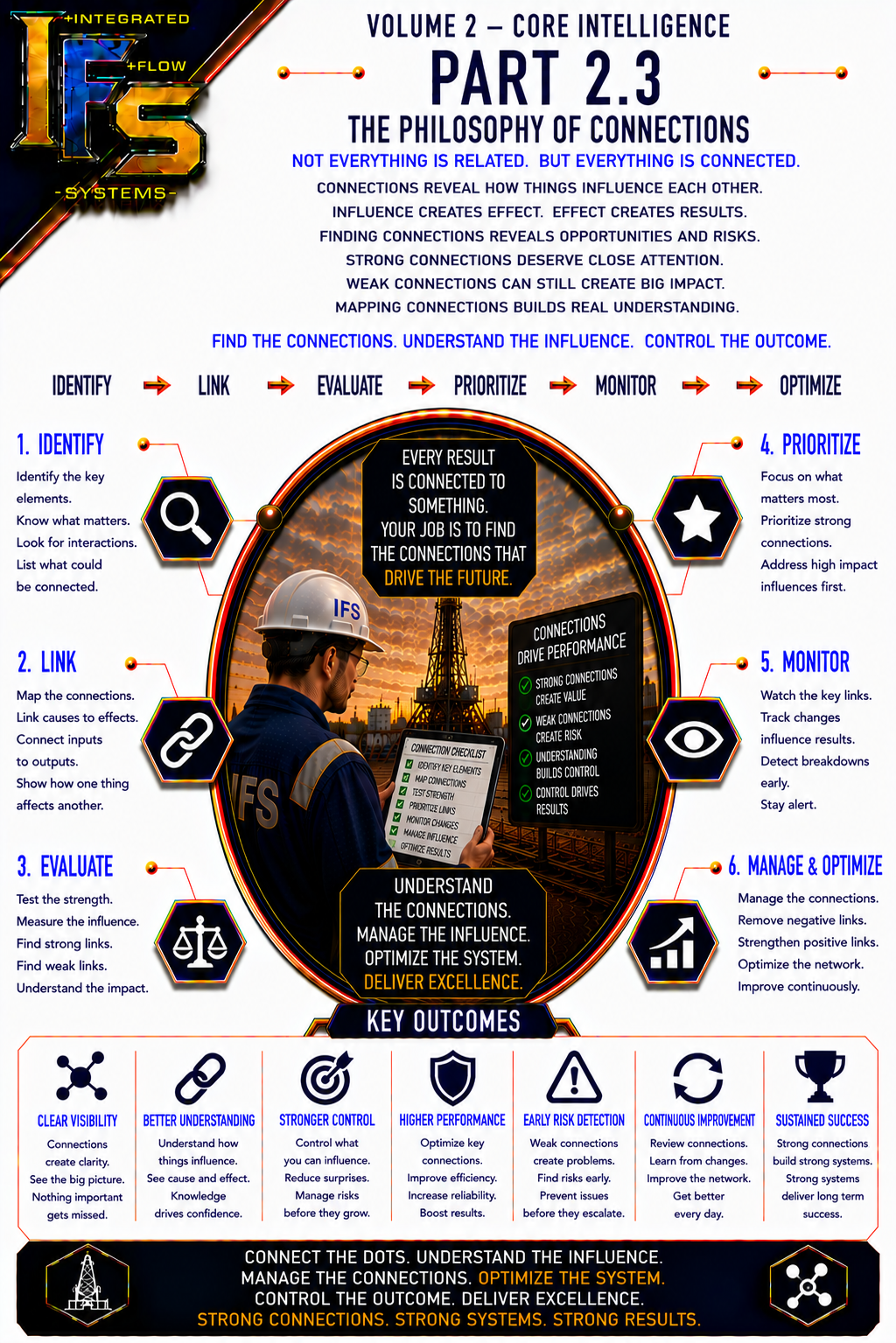
No operation exists in isolation.
Every piece of equipment influences something else.
Every flow affects another flow.
Every decision creates consequences.
Some connections are obvious.
Others remain hidden until problems begin to develop.
Within Integrated Flow Systems (IFS), understanding connections is essential to understanding the operation itself. By identifying how systems, equipment, people, and processes influence one another, organizations gain the ability to predict outcomes, prevent failures, and optimize performance.
Connections transform isolated information into complete operational understanding.
Industrial systems operate as networks rather than individual components.
Every node exchanges something with another node.
Materials.
Energy.
Information.
Pressure.
Heat.
Resources.
Time.
Each exchange creates a connection.
When one connection changes, other parts of the operation respond.
Understanding the network is more valuable than understanding any single component.
The first step is recognizing what is connected.
IFS identifies relationships between:
Equipment.
Processes.
Operators.
Flow paths.
Control systems.
Maintenance activities.
Environmental conditions.
Production objectives.
Each identified connection becomes part of the operational map.
The more complete the map, the stronger the operational understanding.
Every action produces consequences.
Some effects appear immediately.
Others develop gradually over time.
IFS traces:
Actions to outcomes.
Inputs to outputs.
Constraints to performance.
Maintenance to reliability.
Decisions to production.
Changes to results.
Following cause and effect reduces uncertainty and strengthens operational confidence.
Not every connection has the same influence.
Some relationships strongly affect operational performance.
Others produce only minor changes.
IFS evaluates each connection by considering:
Frequency.
Strength.
Consistency.
Reliability.
Operational impact.
Risk.
High-impact connections receive greater attention because they have the greatest influence on operational success.
Many operational problems originate from relationships that are not immediately obvious.
A small change in one area may produce significant consequences elsewhere.
Examples include:
Flow restrictions affecting downstream production.
Equipment wear increasing energy consumption.
Maintenance delays reducing system reliability.
Operator changes influencing production consistency.
Environmental conditions affecting process stability.
Hidden connections often explain problems that isolated analysis cannot.
IFS creates a structured map of operational relationships.
This includes:
Node-to-node connections.
Flow corridors.
Constraint pathways.
Information exchanges.
Energy movement.
Material movement.
Decision pathways.
Understanding these relationships allows operators to see the operation as an integrated system rather than a collection of independent assets.
Not every connection requires the same level of monitoring.
IFS prioritizes relationships based upon:
Operational importance.
Failure potential.
Economic impact.
Safety implications.
Environmental influence.
Production dependency.
Critical connections receive continuous attention because failures within them create the greatest operational consequences.
Connections evolve as operations change.
Equipment ages.
Production increases.
Operating conditions shift.
Constraints develop.
IFS continuously monitors how relationships strengthen, weaken, or change over time.
Trend analysis reveals when important connections begin behaving differently before larger problems emerge.
Monitoring relationships improves operational awareness.
Understanding connections creates opportunities for improvement.
IFS identifies opportunities to:
Reduce bottlenecks.
Improve flow efficiency.
Increase equipment reliability.
Strengthen coordination.
Improve maintenance planning.
Reduce operational risk.
Optimize production.
Small improvements across multiple connections often produce significant gains across the entire operation.
Every identified relationship strengthens organizational knowledge.
Each verified connection improves:
Operational understanding.
Decision quality.
Trend interpretation.
Problem diagnosis.
Recovery planning.
Training effectiveness.
Future recommendations.
The operational network becomes increasingly intelligent with every completed learning cycle.
Industrial operations succeed because systems work together.
Equipment does not create value alone.
Processes do not operate independently.
People do not solve problems in isolation.
Success comes from understanding how every part contributes to the whole.
IFS encourages operators to think in systems rather than components.
When the connections become visible, better decisions naturally follow.
Every result is connected to something.
Every connection influences performance.
Every influence creates opportunity or risk.
Integrated Flow Systems places connections at the center of operational intelligence because understanding relationships is the key to understanding operations.
Without connections, information remains fragmented.
With connections, information becomes understanding.
Understanding creates control.
Control creates consistent operational excellence.
Find the connections.
Understand the influence.
Control the outcome.

Every operation generates patterns.
Every pattern contributes to a trend.
Patterns reveal behavior.
Trends reveal direction.
Organizations that recognize patterns early gain time to respond. Organizations that understand trends gain the ability to anticipate future conditions before they become operational problems.
Within Integrated Flow Systems (IFS), Patterns and Trends transform individual observations into operational foresight. They allow operators to move beyond reacting to events and begin managing the future before it arrives.
Recognizing patterns is the beginning of operational intelligence.
No operational event occurs completely at random.
Equipment failures.
Pressure changes.
Production fluctuations.
Maintenance activities.
Operator interventions.
Environmental influences.
Each leaves behind observable characteristics.
When similar characteristics appear repeatedly, a pattern begins to emerge.
Patterns are the operational footprints left by repeating behavior.
One occurrence may simply be an isolated event.
Repeated occurrences create patterns.
Patterns observed over time become trends.
IFS monitors how conditions evolve by tracking:
Pressure.
Flow.
Temperature.
Production.
Energy consumption.
Equipment condition.
Constraint development.
Operator observations.
The direction of change is often more important than the current value itself.
Early detection creates operational advantage.
IFS continuously looks for:
Small deviations.
Repeated anomalies.
Gradual deterioration.
Unexpected improvements.
Behavior changes.
Emerging constraints.
Developing opportunities.
Many significant operational events begin with subtle changes that are easy to overlook.
Recognizing these changes early allows corrective action before larger problems develop.
Not every pattern has operational significance.
IFS evaluates every pattern by asking:
Is it repeating?
Is it accelerating?
Has it occurred before?
Does it affect performance?
Does it influence safety?
Does it create opportunity?
Context determines whether a pattern represents normal variation or meaningful operational change.
Understanding always comes before action.
Industrial operations generate enormous amounts of information.
Much of it represents normal operational variation.
IFS separates meaningful signals from background noise by evaluating:
Frequency.
Consistency.
Magnitude.
Duration.
Operational impact.
Historical comparison.
This prevents operators from reacting unnecessarily while ensuring important trends receive immediate attention.
Trends provide insight into where the operation is heading.
IFS uses verified trends to estimate:
Equipment degradation.
Production performance.
Constraint growth.
Maintenance requirements.
Recovery potential.
Operational opportunities.
Forecasting does not predict the future with certainty.
It improves preparation by identifying the most likely direction based upon current evidence.
Trend information strengthens decision-making.
Operators can determine:
Whether intervention is necessary.
Whether conditions are improving.
Whether risks are increasing.
Whether previous actions were successful.
Whether operational strategies require adjustment.
Trend-based decisions reduce uncertainty because they are supported by measurable evidence.
Every repeated event strengthens organizational knowledge.
IFS records recurring:
Failures.
Recoveries.
Operational successes.
Constraint development.
Maintenance outcomes.
Performance improvements.
Repeated observations increase confidence that the organization truly understands the operational behavior.
Knowledge grows through repetition.
Patterns and trends are never static.
Operations continue changing.
Equipment continues aging.
Processes continue evolving.
IFS continuously monitors operational behavior to identify:
New patterns.
Changing trends.
Strengthening relationships.
Weakening performance.
Emerging risks.
New opportunities.
Continuous observation keeps operational intelligence current.
Organizations become more effective when they recognize change before change becomes disruption.
Patterns provide awareness.
Trends provide direction.
Together they strengthen:
Operational planning.
Maintenance scheduling.
Risk management.
Production optimization.
Decision confidence.
Resource allocation.
Long-term performance.
The ability to anticipate becomes one of the organization's greatest operational advantages.
Recognizing a trend has little value unless it influences future decisions.
IFS follows a structured progression:
Detect.
Recognize.
Analyze.
Interpret.
Forecast.
Decide.
Act.
Each step builds upon the previous one.
Understanding creates confidence.
Confidence produces decisive action.
Every operation leaves patterns.
Every pattern contributes to a trend.
Every trend reveals where the operation is heading.
Integrated Flow Systems places Patterns and Trends at the center of operational intelligence because the future is often visible long before it arrives.
Without recognizing patterns, opportunities are missed.
Without understanding trends, risks grow unnoticed.
Recognize early.
Understand deeply.
Act decisively.
Today's insight becomes tomorrow's advantage.
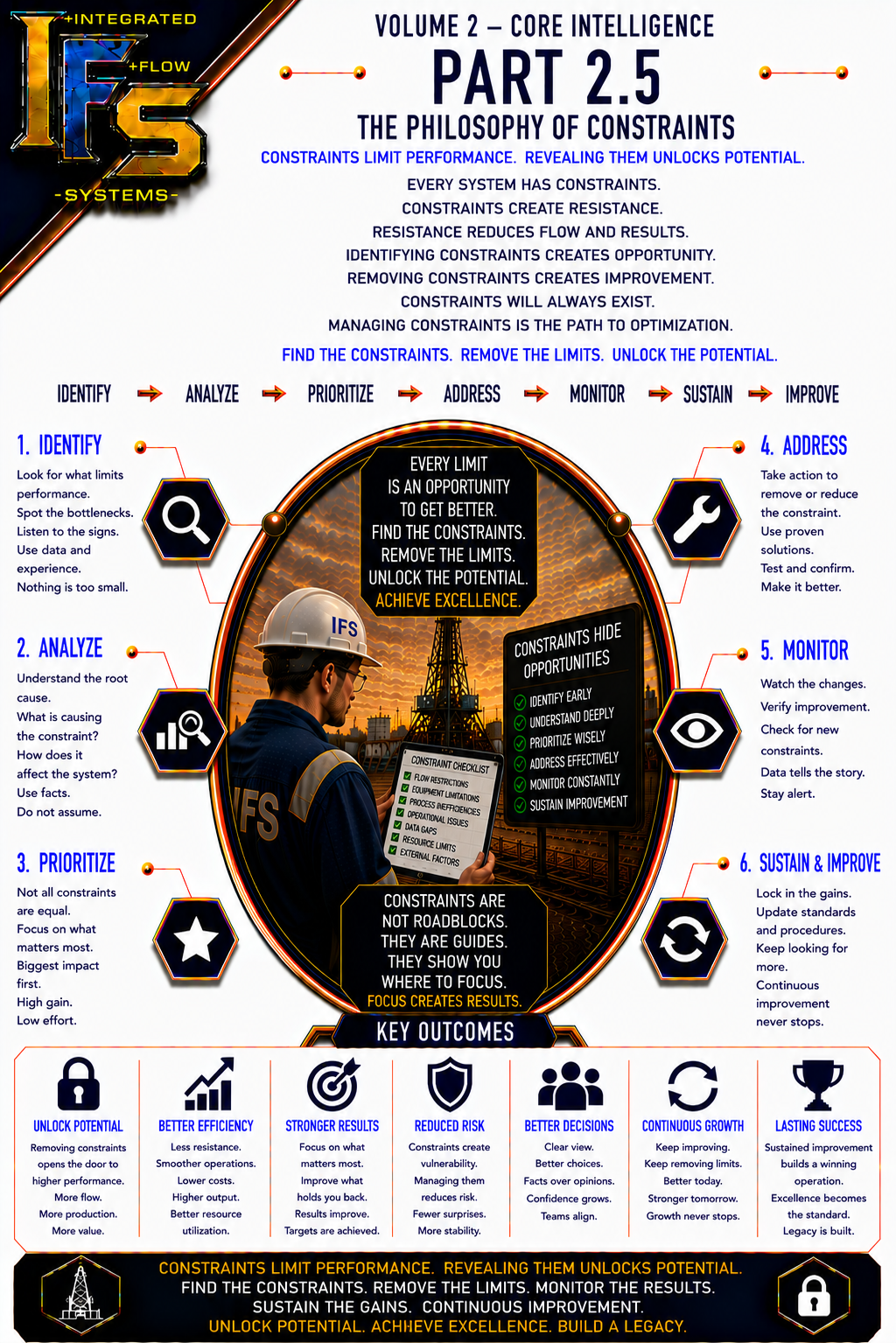
Every operation has limits.
Every system contains resistance.
Every process encounters restrictions.
These limits are known as constraints.
Constraints reduce efficiency, restrict flow, increase costs, and limit operational performance. Some constraints are obvious. Others remain hidden until they create downtime, safety concerns, or production losses.
Within Integrated Flow Systems (IFS), constraints are not viewed as obstacles to accept—they are opportunities to understand. Every identified constraint becomes a starting point for operational improvement.
Finding constraints is the first step toward removing them.
No operation performs without limitations.
Equipment reaches capacity.
Flow becomes restricted.
Pressure creates resistance.
Resources become limited.
Processes compete for time.
People have operational limits.
Every system operates within constraints.
Recognizing these limitations allows organizations to manage them instead of being controlled by them.
Every constraint interrupts the movement of something valuable.
Materials.
Energy.
Information.
Production.
Time.
Resources.
Decisions.
As resistance increases, flow decreases.
Reduced flow creates lower efficiency, slower production, increased costs, and greater operational risk.
Understanding where resistance develops is essential for improving performance.
The first responsibility is discovering what limits performance.
IFS identifies constraints by examining:
Equipment limitations.
Process bottlenecks.
Flow restrictions.
Maintenance issues.
Resource shortages.
Operational procedures.
Environmental conditions.
Human factors.
Every identified constraint becomes part of the operational knowledge base.
You cannot improve what you have not identified.
Removing symptoms rarely removes constraints.
IFS investigates the underlying cause by asking:
What created the restriction?
Why did it develop?
When did it begin?
How does it affect the operation?
What other systems does it influence?
Has it occurred before?
Understanding the root cause produces permanent improvement instead of temporary relief.
Some constraints have little operational impact.
Others determine the performance of the entire operation.
IFS evaluates every constraint according to:
Operational impact.
Safety risk.
Production loss.
Economic cost.
Frequency.
Probability of failure.
Ease of correction.
The highest-value improvements often come from addressing a small number of critical constraints.
Every operational limit identifies an opportunity for improvement.
Reducing resistance may produce:
Higher production.
Improved reliability.
Lower operating costs.
Reduced downtime.
Greater equipment life.
Improved safety.
Better resource utilization.
The greatest opportunities often exist where the greatest constraints are found.
Constraints are not static.
They strengthen.
They weaken.
They shift.
New constraints emerge as older ones are removed.
IFS continuously monitors:
Constraint growth.
Constraint reduction.
Operational response.
System recovery.
Performance improvement.
Emerging bottlenecks.
Continuous monitoring ensures improvements remain effective over time.
Removing one constraint often shifts the limitation somewhere else.
The system improves until another bottleneck becomes dominant.
IFS monitors the entire operational network to determine:
Where the new limiting factor appears.
How it affects surrounding processes.
Whether previous improvements remain effective.
Which constraint should be addressed next.
Continuous optimization requires continuous observation.
Every resolved constraint strengthens operational intelligence.
IFS records:
The original limitation.
The verified cause.
Actions taken.
Measured results.
Lessons learned.
Recommended practices.
Future operators begin with proven knowledge instead of repeating previous investigations.
Knowledge compounds over time.
Operational excellence is achieved by continually reducing unnecessary resistance.
IFS follows a structured improvement cycle:
Identify.
Analyze.
Prioritize.
Address.
Monitor.
Sustain.
Improve.
Each completed cycle increases system capability while revealing the next opportunity for optimization.
Improvement never stops because operations never stop changing.
Constraints reveal where attention should be focused.
Instead of attempting to improve everything equally, IFS directs effort toward the limitations that produce the greatest operational impact.
This improves:
Decision quality.
Resource allocation.
Maintenance planning.
Operational efficiency.
Production performance.
Long-term reliability.
The greatest gains often come from solving the right problem rather than solving more problems.
Every system has constraints.
Every constraint limits potential.
Every identified constraint creates an opportunity for improvement.
Integrated Flow Systems places constraints at the center of operational intelligence because understanding what limits performance is the key to improving performance.
Constraints are not roadblocks.
They are guides.
They reveal where improvement will create the greatest value.
Find the constraints.
Remove the limits.
Unlock the potential.
Continuous improvement begins where resistance ends.
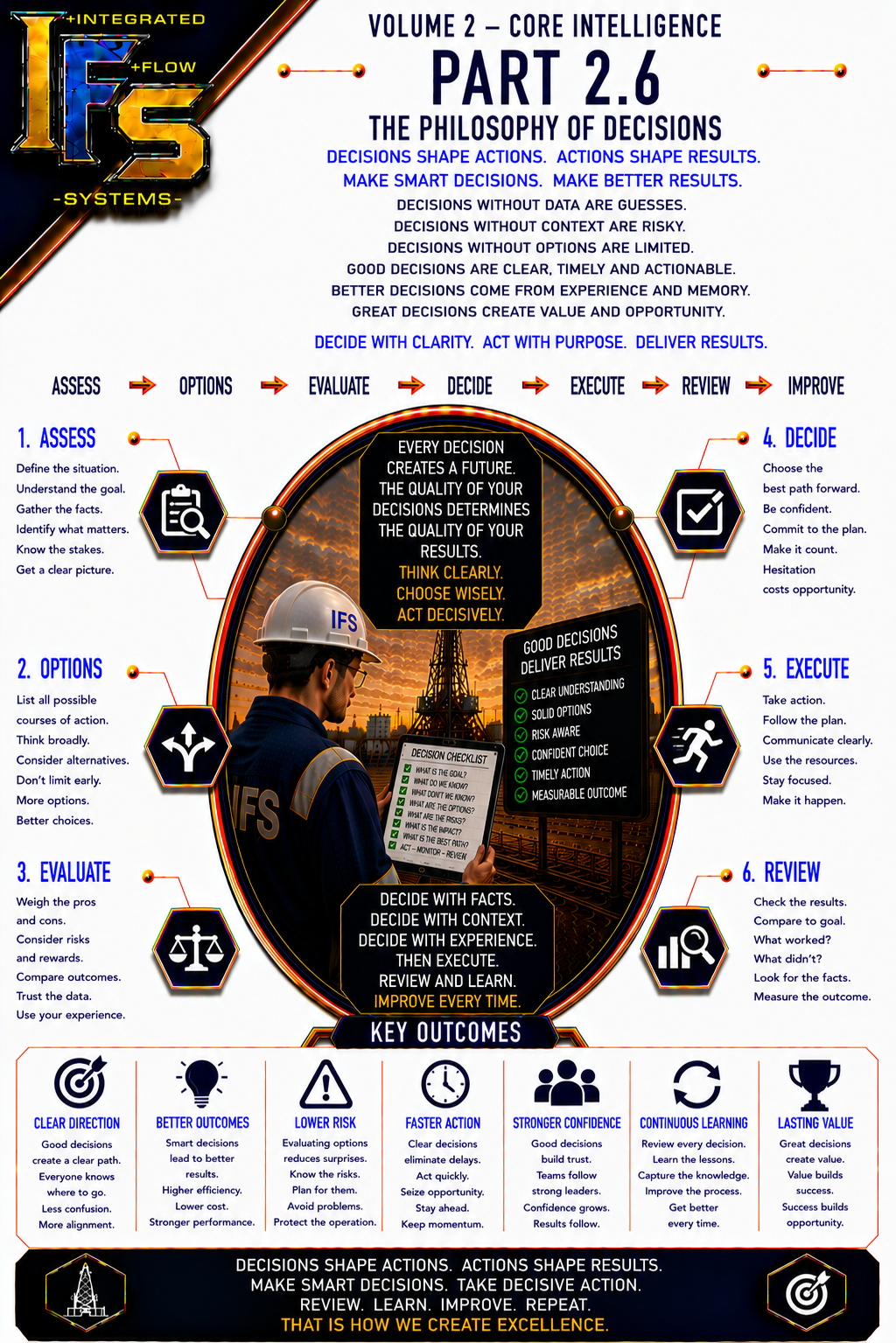
Every operation depends on decisions.
Every decision creates action.
Every action produces results.
The quality of an operation is ultimately determined by the quality of the decisions made throughout it. Good decisions improve safety, efficiency, reliability, and performance. Poor decisions create unnecessary risk, wasted resources, and missed opportunities.
Within Integrated Flow Systems (IFS), decisions are not based on assumptions or intuition alone. They are built upon facts, context, operational memory, trends, and verified knowledge. Every decision becomes part of a continuous cycle of learning and improvement.
Better decisions create better operations.
No operational decision exists in isolation.
Every choice influences:
Production.
Safety.
Equipment reliability.
Maintenance.
Costs.
Resources.
People.
Future decisions.
Some consequences appear immediately.
Others develop gradually over time.
Understanding the long-term impact of decisions is essential to operational success.
Strong decisions begin with a clear understanding of the situation.
IFS first establishes:
What is happening?
What is the objective?
What constraints exist?
What information is available?
What risks are present?
What opportunities exist?
Clear assessment prevents operators from solving the wrong problem.
Understanding always comes before deciding.
Every operational problem has multiple possible responses.
IFS encourages operators to identify and evaluate alternatives before committing to action.
Possible options may include:
Taking no action.
Increasing monitoring.
Adjusting operating conditions.
Performing maintenance.
Changing procedures.
Escalating the issue.
Implementing corrective action.
Considering multiple options improves both flexibility and decision quality.
Every option carries consequences.
IFS evaluates each alternative by considering:
Operational risk.
Safety impact.
Production effect.
Economic cost.
Resource requirements.
Probability of success.
Long-term sustainability.
The objective is not simply selecting the fastest solution.
It is selecting the most effective solution.
Once sufficient information has been gathered, action must follow.
IFS encourages decisions that are:
Fact-based.
Timely.
Clear.
Defensible.
Measurable.
Purpose-driven.
Delaying a necessary decision often creates greater risk than making a well-supported decision promptly.
Confidence comes from preparation, not hesitation.
A decision has little value unless it is carried out effectively.
IFS emphasizes disciplined execution through:
Clear communication.
Defined responsibilities.
Consistent procedures.
Resource coordination.
Operational monitoring.
Performance verification.
Successful execution transforms planning into measurable results.
Every completed decision provides an opportunity to learn.
IFS reviews:
Did the decision achieve its objective?
Were the expected results obtained?
Did new constraints appear?
Were unintended consequences created?
Could a better option have been chosen?
Review converts operational experience into organizational knowledge.
Every outcome improves future decision-making.
Good decisions should not disappear with the end of a shift.
IFS preserves:
The situation.
Available options.
The selected action.
Supporting evidence.
Measured outcomes.
Lessons learned.
Future recommendations.
This growing knowledge base allows future operators to benefit from previous experience instead of repeating the same analysis.
Organizational intelligence improves with every recorded decision.
Decision-making improves through repetition and learning.
Each completed cycle strengthens:
Operational judgment.
Risk awareness.
Trend recognition.
Confidence.
Planning accuracy.
Response speed.
Knowledge compounds with every successful review.
Experience becomes structured intelligence rather than individual memory.
Organizations achieve consistency when everyone follows the same decision framework.
IFS promotes a structured process:
Assess.
Identify options.
Evaluate.
Decide.
Execute.
Review.
Improve.
A consistent decision process reduces uncertainty while improving communication, accountability, and operational performance.
Operations do not improve by chance.
They improve because better decisions are made every day.
When decisions are supported by accurate information, operational context, verified knowledge, and continuous feedback, organizations become more resilient, more efficient, and better prepared for future challenges.
Every decision shapes the next operating cycle.
Every operating cycle shapes the future of the organization.
Every decision creates action.
Every action creates results.
Every result creates knowledge.
Integrated Flow Systems places decisions at the center of operational intelligence because every improvement begins with choosing the right course of action.
Decide with facts.
Decide with context.
Decide with experience.
Then act with confidence.
Review the outcome.
Learn continuously.
Improve every time.

Every operation generates information.
Information alone has limited value.
Understanding creates intelligence.
Intelligence creates better decisions.
Operational intelligence is not simply collecting more data. It is the ability to transform observations, measurements, experience, and knowledge into timely actions that improve operational performance.
Within Integrated Flow Systems (IFS), Operational Intelligence is the result of every core principle working together. Snapshots, context, connections, patterns, trends, constraints, memory, and decisions combine to create a complete understanding of the operation.
Operational intelligence is not one component.
It is the product of the entire system.
Industrial operations generate enormous amounts of information every day.
Sensor readings.
Production reports.
Maintenance records.
Operator observations.
Equipment alarms.
Laboratory results.
Inspection reports.
None of these, by themselves, represent intelligence.
Intelligence begins when information is organized, connected, understood, and applied.
Every intelligent decision starts with accurate observation.
IFS gathers information from:
Operators.
Equipment.
Instrumentation.
Maintenance.
Engineering.
Production systems.
Historical records.
Every observation contributes another piece of the operational picture.
The more complete the picture becomes, the more reliable the intelligence becomes.
Operational intelligence grows by linking information together.
IFS combines:
Current conditions.
Historical snapshots.
Operational context.
Equipment history.
Constraint development.
Trend analysis.
Verified knowledge.
Recovery experience.
These connections transform isolated facts into operational understanding.
Knowledge becomes significantly more valuable when relationships are understood.
Fast decisions are valuable.
Correct decisions are invaluable.
IFS encourages operators to understand:
What is happening.
Why it is happening.
What may happen next.
Which options exist.
What risks remain.
Only after understanding is established should action begin.
Intelligence reduces unnecessary reaction.
Every completed operating cycle increases organizational knowledge.
IFS continuously expands:
Operational memory.
Verified solutions.
Constraint history.
Recovery strategies.
Performance benchmarks.
Decision guidance.
Every lesson permanently strengthens future operational intelligence.
Organizations become smarter with experience only if experience is preserved.
Understanding the present improves understanding of the future.
IFS uses operational intelligence to anticipate:
Equipment degradation.
Constraint growth.
Production changes.
Maintenance requirements.
Emerging risks.
Operational opportunities.
Prediction is not guesswork.
It is the logical extension of verified operational knowledge.
Operational intelligence improves every level of decision-making.
Operators understand conditions more clearly.
Supervisors prioritize resources more effectively.
Maintenance focuses on higher-value work.
Engineering gains stronger operational insight.
Management receives clearer operational visibility.
Better understanding creates better decisions throughout the organization.
Operational intelligence is never complete.
Every shift adds knowledge.
Every event adds understanding.
Every recovery improves confidence.
Every failure reveals another lesson.
IFS continuously evaluates new information against existing knowledge, ensuring that operational understanding remains current as conditions evolve.
Learning becomes part of everyday operations.
IFS follows a structured progression:
Data becomes information.
Information becomes context.
Context becomes understanding.
Understanding becomes intelligence.
Intelligence becomes action.
Action creates results.
Results create knowledge.
Knowledge strengthens future intelligence.
Every completed cycle makes the organization more capable than it was before.
Operational intelligence improves every aspect of performance.
It strengthens:
Safety.
Reliability.
Efficiency.
Production.
Maintenance.
Planning.
Communication.
Continuous improvement.
Instead of reacting to isolated events, organizations begin managing the operation as an intelligent, connected system.
Operational excellence becomes sustainable rather than accidental.
The greatest organizations do not depend upon a few experienced individuals.
They build systems that preserve and distribute knowledge.
IFS ensures that intelligence belongs to the operation itself.
Knowledge survives:
Shift changes.
Personnel turnover.
Equipment replacement.
Organizational growth.
Every operator contributes.
Every operator benefits.
The intelligence becomes collective rather than individual.
Information alone does not improve operations.
Understanding does.
Understanding becomes intelligence when it consistently produces better decisions.
Integrated Flow Systems places Operational Intelligence at the center of every operation because intelligence is created when observation, knowledge, experience, and evidence work together.
Observe carefully.
Understand completely.
Decide confidently.
Act deliberately.
Learn continuously.
Build operational intelligence every day.
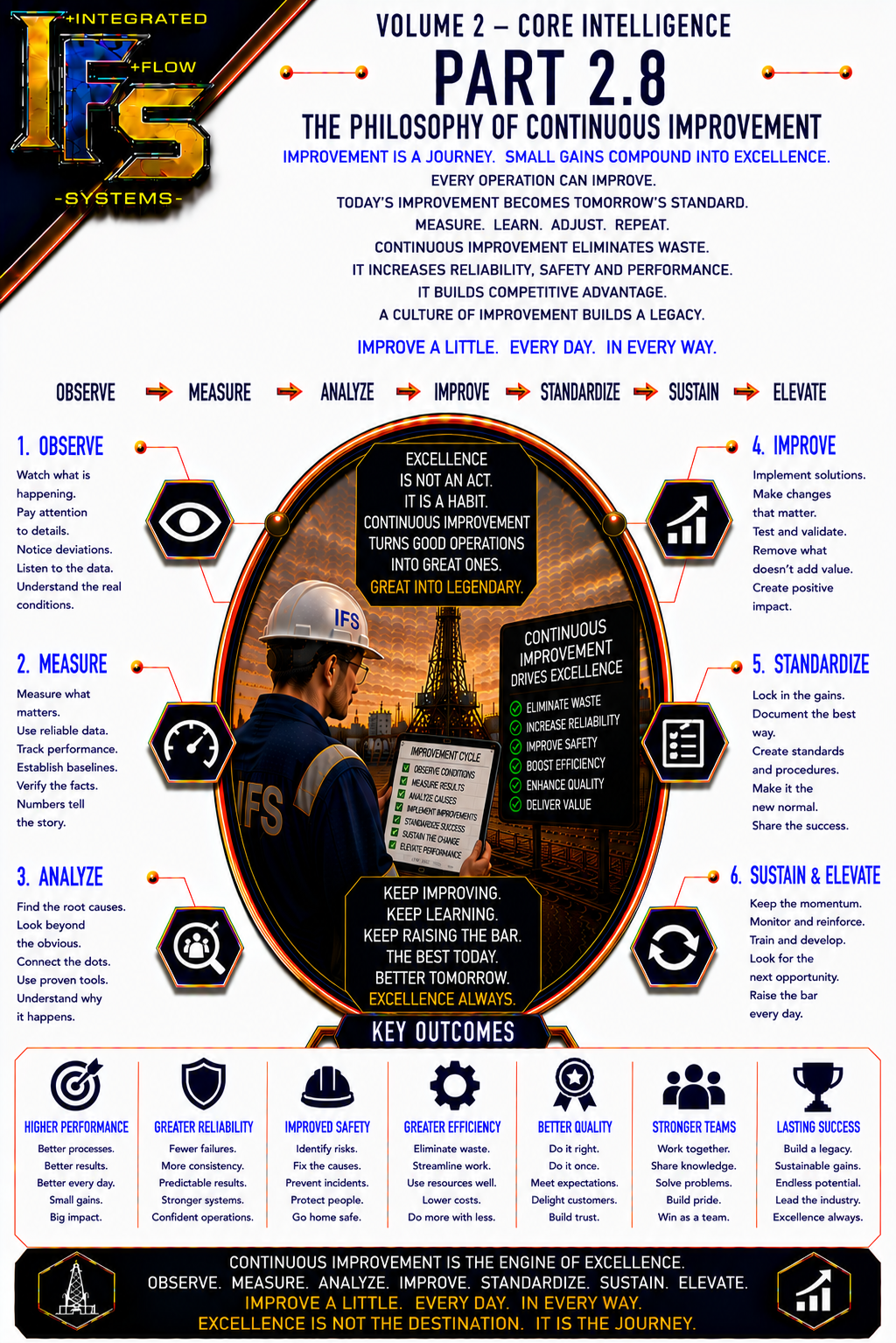
Every operation can improve.
Every improvement creates another opportunity.
Operational excellence is not a destination.
It is a continuous process.
Industrial operations constantly evolve. Equipment ages. Operating conditions change. Production objectives shift. New technologies emerge. Organizations that continuously improve remain competitive, resilient, and efficient. Those that stop improving gradually fall behind.
Within Integrated Flow Systems (IFS), Continuous Improvement is not treated as a separate initiative. It is built directly into the operation through observation, measurement, learning, and feedback. Every operating cycle becomes an opportunity to make the next cycle better.
Improvement becomes part of everyday work.
Organizations cannot improve what they do not understand.
IFS begins every improvement cycle by establishing:
Current performance.
Operational objectives.
Existing constraints.
Known risks.
Available opportunities.
Verified measurements.
Understanding the present condition establishes the foundation for meaningful improvement.
Every operating cycle generates knowledge.
Successful outcomes reveal effective practices.
Failures expose weaknesses.
Unexpected events uncover hidden relationships.
Routine operations confirm what is working well.
IFS captures learning from every operational outcome because every experience contains information that improves future performance.
Nothing is wasted.
Major breakthroughs are valuable.
Small improvements are consistent.
IFS encourages continual refinement of:
Operating procedures.
Maintenance practices.
Equipment settings.
Resource utilization.
Communication.
Decision-making.
Monitoring.
Many small improvements accumulated over time often outperform one large improvement implemented once.
Progress compounds.
Improvement must be measurable.
IFS evaluates changes using objective evidence rather than opinion.
Measurements may include:
Production.
Flow efficiency.
Downtime.
Equipment reliability.
Maintenance frequency.
Energy consumption.
Safety performance.
Recovery time.
Comparing measurable results confirms whether true improvement has occurred.
Evidence replaces assumptions.
Not every improvement produces the expected outcome.
IFS evaluates every completed action by asking:
Did performance improve?
What changed?
What remained the same?
Were unintended consequences created?
What should be done differently next time?
Every outcome strengthens organizational understanding regardless of whether expectations were achieved.
Learning is continuous.
Continuous improvement focuses on removing activities that reduce operational value.
IFS identifies unnecessary:
Downtime.
Waiting.
Rework.
Excess movement.
Resource consumption.
Information delays.
Decision delays.
Flow restrictions.
Reducing waste improves efficiency without necessarily increasing complexity.
Better operations often result from removing obstacles rather than adding new processes.
Successful improvements should become standard practice.
IFS converts verified success into:
Standard operating procedures.
Maintenance standards.
Decision guidance.
Training materials.
Best practices.
Operational recommendations.
Standardization ensures improvements are consistently repeated throughout the organization.
Success becomes predictable.
Continuous improvement is not limited to management.
Every operator contributes.
Every technician observes.
Every engineer analyzes.
Every supervisor guides.
IFS encourages every member of the organization to identify opportunities, report observations, and contribute verified improvements.
Operational intelligence grows through participation.
Improvement becomes everyone's responsibility.
Removing one constraint often reveals another.
Improving one process creates opportunities elsewhere.
Increasing efficiency exposes new possibilities.
IFS recognizes improvement as a continuous operational cycle.
Observe.
Measure.
Analyze.
Improve.
Verify.
Standardize.
Repeat.
Each completed cycle increases organizational capability.
The system becomes stronger with every iteration.
Sustained improvement creates lasting competitive advantage.
Organizations gradually improve:
Reliability.
Safety.
Production.
Equipment life.
Resource efficiency.
Decision quality.
Operational consistency.
Knowledge.
The accumulation of continuous improvements produces results that cannot be achieved through isolated projects alone.
Operational excellence becomes part of the organization's identity.
Every completed improvement cycle expands organizational knowledge.
Successful practices become proven methods.
Unsuccessful practices become valuable lessons.
Recovered failures become future guidance.
Verified improvements become operational standards.
The organization learns continuously because every improvement strengthens its operational intelligence.
Knowledge compounds over time.
Every operation can improve.
Every improvement creates new knowledge.
Every new lesson creates another opportunity.
Integrated Flow Systems places Continuous Improvement at the center of operational intelligence because excellence is achieved through constant learning, disciplined measurement, and systematic refinement.
Improve what you understand.
Measure what you improve.
Learn from every result.
Standardize every success.
Repeat without end.
Continuous improvement is how good operations become exceptional operations.
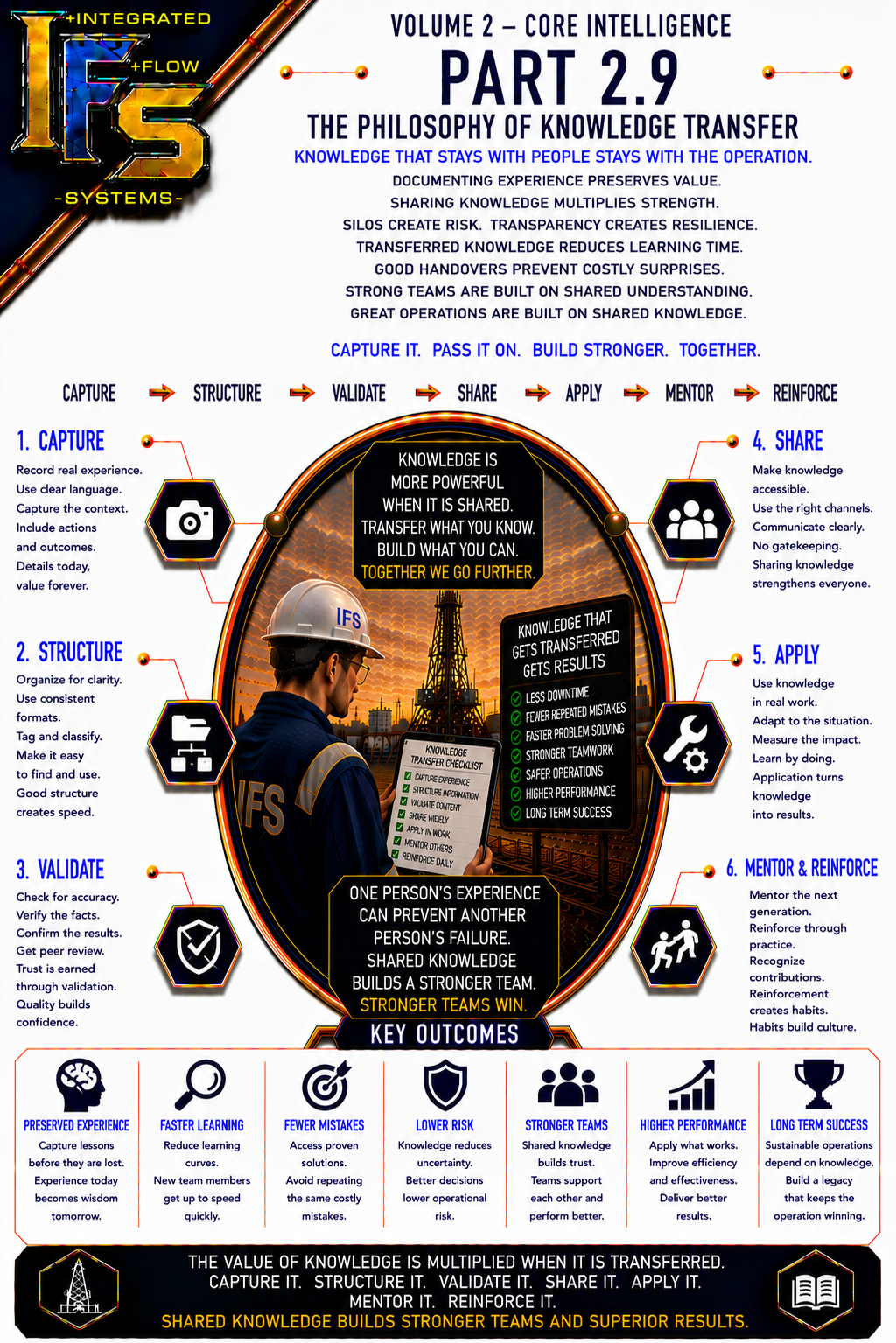
Operational excellence is not achieved by chance.
It is achieved by design.
Every observation.
Every decision.
Every improvement.
Every lesson.
Every operating cycle contributes to the long-term performance of the organization.
Operational excellence is the cumulative result of consistently making better decisions over time. It is not a single project, a single technology, or a single achievement. It is a disciplined way of operating.
Within Integrated Flow Systems (IFS), Operational Excellence is the outcome of every principle working together. It is the visible result of a system that continuously observes, learns, improves, and adapts.
Excellence is not perfection.
It is continuous progression toward better performance.
Operational excellence is created through consistent daily actions.
Every inspection.
Every snapshot.
Every maintenance activity.
Every operational adjustment.
Every review.
Every improvement.
Small, disciplined actions accumulate into exceptional long-term performance.
Consistency creates excellence.
Good operations occasionally perform well.
Excellent operations perform well consistently.
IFS promotes disciplined execution through:
Standard procedures.
Reliable measurements.
Structured decision-making.
Continuous monitoring.
Verified learning.
Consistent documentation.
Discipline reduces variability and increases confidence across the entire operation.
Reliable systems are built upon reliable habits.
Operational excellence cannot be based on opinion.
IFS measures performance using objective evidence.
Examples include:
Production efficiency.
Equipment reliability.
Safety performance.
Downtime.
Resource utilization.
Energy efficiency.
Maintenance effectiveness.
Operational consistency.
Measurement confirms progress while identifying the next opportunity for improvement.
Performance becomes visible.
Operational excellence is never isolated to one department.
It depends upon every part of the operation working together.
Operations.
Maintenance.
Engineering.
Production.
Planning.
Management.
Safety.
Information sharing.
Every department contributes to the overall performance of the system.
The operation succeeds together.
Organizations improve when knowledge is preserved.
IFS strengthens excellence by capturing:
Successful practices.
Operational experience.
Verified solutions.
Lessons learned.
Decision history.
Constraint history.
Trend analysis.
Knowledge prevents repeated mistakes and accelerates future success.
Experience becomes organizational intelligence.
Operations continually change.
New equipment is installed.
Production demands shift.
Environmental conditions vary.
Technology advances.
IFS continuously evaluates changing conditions to ensure operational practices evolve alongside the operation itself.
Organizations that adapt remain competitive.
Organizations that stop adapting gradually lose performance.
Consistent operations produce consistent results.
IFS reduces unnecessary variation by encouraging:
Standard operating procedures.
Consistent measurements.
Repeatable decision processes.
Verified maintenance practices.
Reliable communication.
Structured reviews.
Lower variability improves reliability, predictability, and operational confidence.
Consistency creates stability.
Leadership establishes the operational culture.
IFS supports leaders by providing:
Operational visibility.
Reliable information.
Verified performance.
Decision support.
Organizational knowledge.
Continuous feedback.
Strong leadership reinforces disciplined operations while encouraging continuous improvement throughout every level of the organization.
Leadership sustains excellence.
Organizations that consistently improve outperform those that simply maintain.
Operational excellence produces:
Higher productivity.
Lower operating costs.
Greater equipment life.
Reduced downtime.
Improved safety.
Faster recovery.
Stronger customer confidence.
Long-term profitability.
Competitive advantage becomes the natural outcome of disciplined operational intelligence.
There is no final version of operational excellence.
Every improvement reveals another opportunity.
Every lesson uncovers additional understanding.
Every innovation creates new possibilities.
IFS treats excellence as an ongoing operational journey rather than a fixed destination.
Continuous improvement ensures excellence continues to grow.
Operational excellence is not produced by one engine.
It is produced by every engine working together.
Observation provides awareness.
Snapshots preserve knowledge.
Context creates understanding.
Connections reveal influence.
Patterns identify behavior.
Constraints reveal opportunity.
Decisions guide action.
Feedback creates learning.
Continuous improvement strengthens every future cycle.
Together they create an intelligent operation capable of sustained excellence.
Operational excellence is not something an organization achieves once.
It is something it chooses every day.
Integrated Flow Systems places Operational Excellence at the highest level of operational intelligence because excellence is the natural result of disciplined observation, informed decisions, continuous learning, and systematic improvement.
Observe with purpose.
Decide with confidence.
Improve without interruption.
Learn from every operation.
Build excellence every day.
Operational excellence is not the goal.
It is the way the operation works.
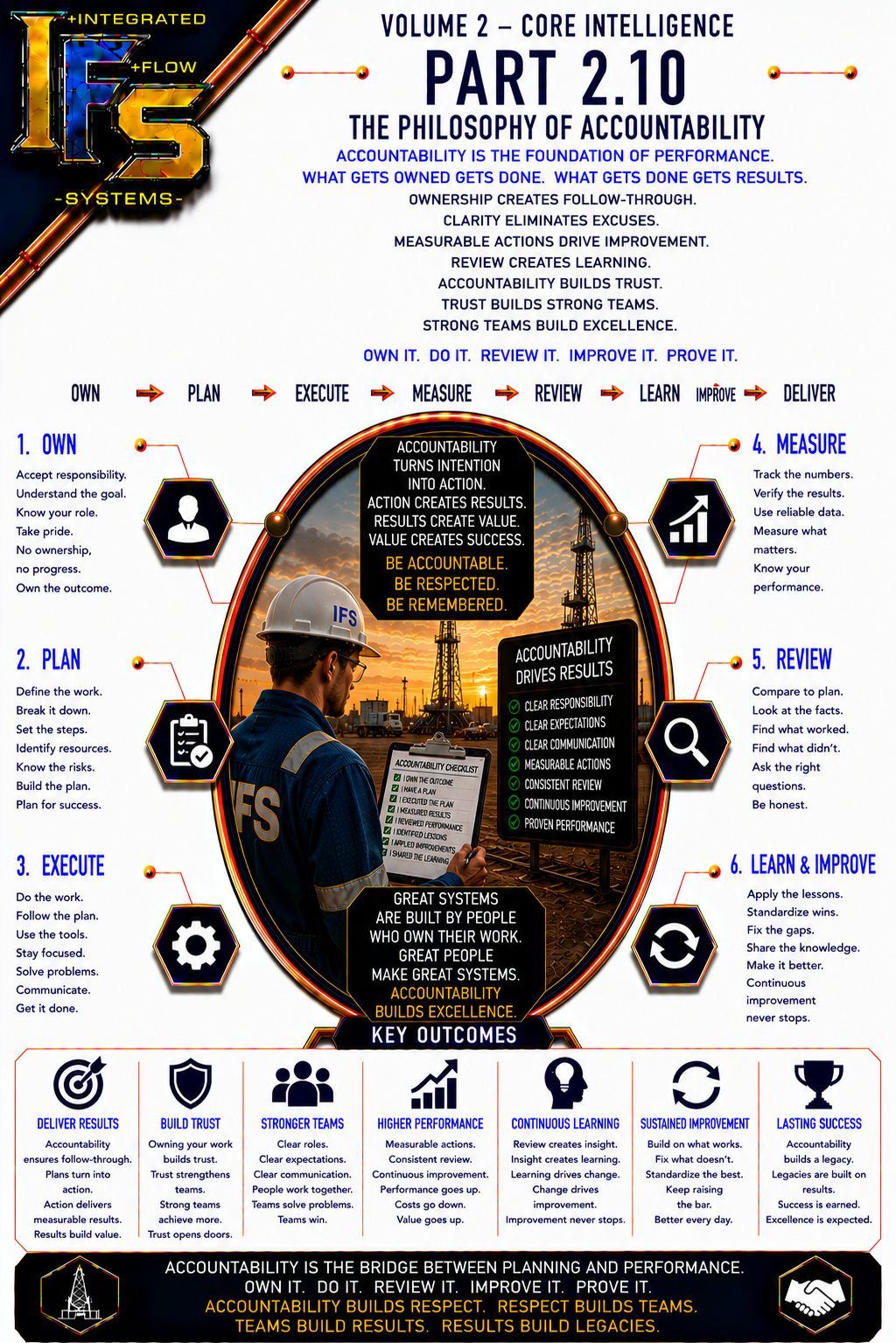
Every operation consists of many parts.
Every part performs a function.
No part creates value alone.
True performance is achieved when every part works together as one integrated system.
Industrial operations are often organized into departments, disciplines, and individual assets. While this structure supports management, it can unintentionally create isolated thinking. Equipment is viewed separately from processes. Maintenance becomes separated from production. Engineering becomes separated from operations.
Within Integrated Flow Systems (IFS), integration removes these boundaries by connecting every operational element into one coordinated intelligence network. Every node, every flow, every exchange, and every decision contributes to the performance of the entire system.
Integration creates unity.
Unity creates operational intelligence.
Although operations consist of many individual components, they function as one interconnected system.
Production depends upon maintenance.
Maintenance depends upon planning.
Planning depends upon accurate information.
Information depends upon observation.
Every department contributes to every operational outcome.
IFS treats the operation as one living system rather than independent activities.
Operational intelligence grows when relationships are connected.
IFS integrates:
Equipment.
Processes.
Operators.
Maintenance.
Engineering.
Production.
Safety.
Environmental monitoring.
Business objectives.
Knowledge management.
No information exists independently.
Everything influences something else.
One of the greatest barriers to operational performance is isolated information.
Departments often optimize their own performance without understanding the impact on the larger operation.
IFS removes these barriers by creating shared operational visibility across the organization.
Everyone works from the same operational understanding.
The operation begins making unified decisions instead of isolated ones.
Integration depends upon information moving freely.
IFS ensures that operational knowledge flows between:
Field operations.
Control rooms.
Maintenance.
Engineering.
Supervision.
Management.
Historical memory.
Decision support.
When information moves efficiently, decisions improve throughout the organization.
Better decisions require complete information.
IFS combines:
Current operating conditions.
Historical experience.
Operational context.
Trend analysis.
Constraint identification.
Verified knowledge.
Organizational memory.
Decision-makers see the complete operational picture rather than isolated pieces of information.
Understanding becomes more complete.
Within IFS, every operational node participates in a larger network.
Each node exchanges:
Material.
Energy.
Information.
Resources.
Time.
Operational influence.
When one node improves, surrounding nodes often improve as well.
When one node fails, the effects may propagate throughout the system.
Integration makes these relationships visible.
Integrated systems recover more effectively because information is shared quickly.
IFS allows organizations to:
Recognize developing problems.
Coordinate responses.
Allocate resources efficiently.
Reduce duplicated effort.
Preserve operational continuity.
The operation becomes more resilient because every part supports the whole.
Knowledge becomes more valuable when it is shared across the entire organization.
IFS distributes verified learning between:
Shifts.
Facilities.
Assets.
Business units.
Industry overlays.
Knowledge networks.
One improvement benefits many operations.
One lesson prevents many future failures.
Shared intelligence accelerates organizational growth.
Integration is the foundation of the OIED architecture.
Every Core Volume.
Every Industry Overlay.
Every Universal Engine.
Every Node Library.
Every Knowledge Module.
Every Appendix.
Every future expansion.
All operate using the same Universal Operational Architecture.
Industries may differ.
The architecture does not.
Operational intelligence cannot exist when information remains fragmented.
Integration allows:
Snapshots to support trends.
Context to explain patterns.
Constraints to guide decisions.
Feedback to strengthen memory.
Knowledge to improve future operations.
Every core principle reinforces every other principle.
Together they create a unified operational intelligence platform.
Operations perform best when they operate as one system.
Knowledge becomes more valuable when it is shared.
Decisions become stronger when every connection is visible.
Integrated Flow Systems places Integration at the heart of operational intelligence because no part of an operation succeeds alone.
Connect the operation.
Connect the knowledge.
Connect the people.
Connect the decisions.
When everything works together, the operation becomes greater than the sum of its parts.
Integration is where operational excellence becomes operational intelligence.
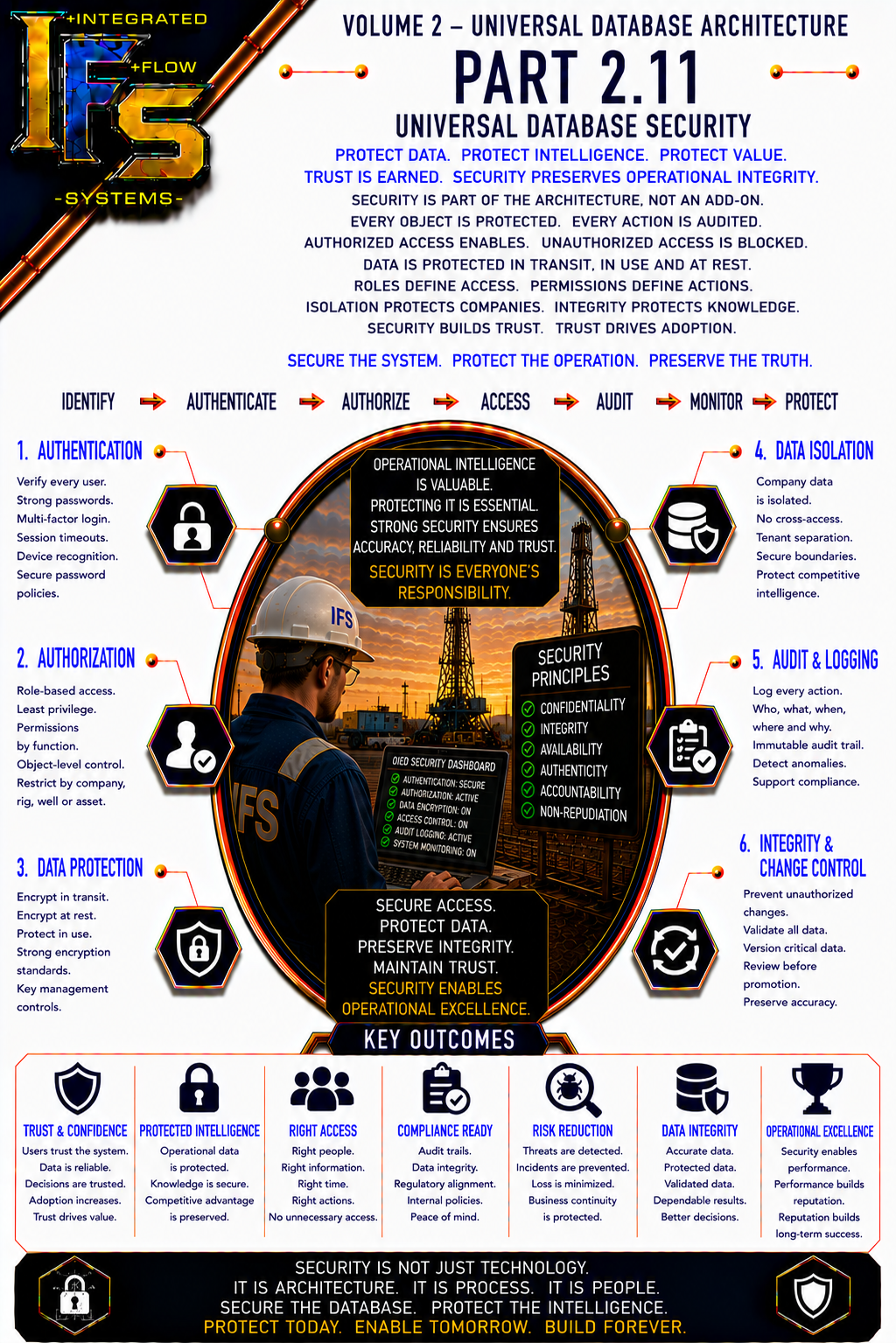
Every operation changes.
Every system evolves.
Every condition shifts.
Organizations that adapt continue improving.
Organizations that resist change gradually lose performance.
Industrial operations are never static. Equipment ages. Production targets change. Reservoirs decline. Markets fluctuate. New technologies emerge. Environmental conditions evolve. Operational excellence depends upon the ability to recognize change and respond intelligently.
Within Integrated Flow Systems (IFS), Adaptation is the structured process of adjusting operations based on new information, changing conditions, and verified operational knowledge. Adaptation allows organizations to remain effective without abandoning consistency.
Adaptation keeps operations aligned with reality.
Every industrial operation experiences continuous change.
Equipment wears.
Flow characteristics evolve.
Production varies.
Maintenance alters system behavior.
Operators gain experience.
Environmental conditions shift.
IFS recognizes that change is normal rather than exceptional.
The operation must evolve with the conditions it encounters.
Adaptation begins by identifying that conditions have changed.
IFS continuously monitors:
Production performance.
Equipment condition.
Flow behavior.
Pressure response.
Temperature trends.
Maintenance history.
Operator observations.
Constraint development.
Recognizing change early creates time to respond before performance declines.
Awareness always precedes adaptation.
Not every change requires intervention.
Some changes represent normal operational variation.
Others indicate developing opportunities or risks.
IFS evaluates:
The magnitude of change.
The rate of change.
The duration of change.
The operational impact.
Historical comparisons.
Future implications.
Understanding prevents unnecessary adjustments while ensuring meaningful changes receive attention.
Once change has been understood, the operation must respond appropriately.
Possible responses include:
Increasing monitoring.
Adjusting operating procedures.
Scheduling maintenance.
Changing operating parameters.
Updating operational priorities.
Investigating root causes.
Implementing corrective action.
Every response is guided by evidence rather than assumption.
Purposeful adaptation produces consistent improvement.
Every successful adjustment expands operational knowledge.
IFS records:
The original condition.
The observed change.
The response selected.
Measured outcomes.
Lessons learned.
Future recommendations.
Each completed adaptation improves future responses to similar situations.
Experience becomes structured intelligence.
Operations require both consistency and adaptability.
Too little change creates stagnation.
Too much change creates instability.
IFS balances these competing needs by preserving proven operational practices while allowing continuous refinement when evidence supports improvement.
Stable systems adapt intelligently.
They do not change unnecessarily.
Organizations that adapt recover more effectively from unexpected events.
IFS improves resilience by helping operators:
Recognize changing conditions.
Adjust quickly.
Coordinate responses.
Reduce operational disruption.
Maintain production.
Protect equipment.
Adaptation transforms uncertainty into manageable operational change.
Every completed adaptation creates another opportunity for refinement.
IFS continuously evaluates:
Operational procedures.
Maintenance strategies.
Monitoring practices.
Decision processes.
Resource allocation.
Knowledge management.
Small adjustments made consistently produce significant long-term improvements.
Improvement becomes continuous rather than occasional.
Adaptive organizations learn faster than changing conditions.
IFS strengthens organizational capability by encouraging:
Observation.
Measurement.
Analysis.
Communication.
Knowledge sharing.
Continuous learning.
The organization becomes increasingly capable of responding to new challenges without losing operational consistency.
Adaptability becomes a competitive advantage.
Operations that adapt remain effective despite changing environments.
They experience:
Greater reliability.
Higher efficiency.
Improved safety.
Better resource utilization.
Reduced downtime.
Stronger operational confidence.
Long-term success depends not on avoiding change, but on responding to it intelligently.
Adaptation is where operational intelligence becomes operational improvement.
Observation identifies change.
Snapshots preserve it.
Context explains it.
Patterns reveal its direction.
Constraints expose its impact.
Decisions determine the response.
Feedback measures the outcome.
Adaptation applies the lesson.
Each completed cycle strengthens the next.
The operation becomes progressively more capable over time.
Every operation changes.
Every change teaches.
Every lesson creates a better way forward.
Integrated Flow Systems places Adaptation at the center of long-term operational success because the most successful organizations are not the strongest or the fastest—they are the ones that learn and adapt continuously.
Observe the change.
Understand the change.
Respond to the change.
Learn from the change.
Adapt continuously.
Continuous adaptation transforms operational intelligence into lasting operational excellence.

Every operation follows a cycle.
Every cycle creates knowledge.
Every completed cycle improves the next one.
Industrial operations are not a series of isolated events. Every observation leads to understanding. Every understanding leads to a decision. Every decision produces results. Every result creates new knowledge that strengthens future operations.
Within Integrated Flow Systems (IFS), the Operational Intelligence Cycle is the repeating process that transforms daily operations into continuous organizational improvement. Every completed cycle increases operational awareness, strengthens decision-making, and expands organizational intelligence.
The cycle never ends.
It simply becomes stronger.
Operational intelligence starts by observing reality.
IFS captures information through:
Operator observations.
Equipment monitoring.
Sensor measurements.
Visual inspections.
Maintenance findings.
Production reports.
Environmental conditions.
Every observation becomes the starting point for understanding the operation.
Good decisions begin with good observations.
Observations are preserved through structured snapshots.
Each snapshot records:
Operating conditions.
Equipment status.
Flow conditions.
Production values.
Known constraints.
Operator comments.
Environmental influences.
Every snapshot captures a complete operational moment before conditions change.
Snapshots preserve knowledge that would otherwise be lost.
Individual measurements have limited value without surrounding information.
IFS adds context by recording:
What was occurring.
Why conditions existed.
What recently changed.
Who performed actions.
What objectives were being pursued.
What constraints were already present.
Context transforms isolated information into operational understanding.
Meaning is created through context.
Operations function through relationships.
IFS identifies how systems influence one another.
Equipment interactions.
Flow relationships.
Information exchange.
Energy transfer.
Constraint pathways.
Operational dependencies.
Understanding connections reveals how one event influences another throughout the operation.
The system becomes visible.
As operations continue, repeating relationships begin to emerge.
IFS identifies recurring:
Equipment behavior.
Operational responses.
Production characteristics.
Maintenance outcomes.
Constraint development.
Recovery sequences.
Repeated behavior forms recognizable operational patterns.
Patterns reveal how the operation behaves over time.
Patterns observed repeatedly create trends.
IFS continuously evaluates:
Direction of change.
Rate of change.
Operational stability.
Constraint growth.
Performance improvement.
Equipment degradation.
Trends allow operators to understand where the operation is heading rather than simply where it is today.
Direction becomes visible.
Operational intelligence supports informed action.
IFS uses verified information to determine:
Whether intervention is necessary.
Which response is most appropriate.
What risks exist.
What opportunities are emerging.
What resources should be allocated.
Every decision is supported by operational evidence rather than assumptions.
Knowledge guides action.
Every operational decision changes the system.
Results may include:
Improved production.
Reduced downtime.
Equipment recovery.
Unexpected consequences.
New constraints.
Improved efficiency.
Operational learning.
Every result provides new information for the organization.
Nothing is wasted.
Every outcome is evaluated.
IFS measures:
Expected versus actual performance.
Operational effectiveness.
Constraint reduction.
Equipment response.
Safety outcomes.
Resource utilization.
Lessons learned.
Feedback confirms whether the decision achieved its intended objective.
Every outcome strengthens future understanding.
Verified experience becomes organizational knowledge.
IFS preserves:
Successful practices.
Recovered failures.
Verified solutions.
Decision history.
Trend history.
Constraint history.
Future recommendations.
Organizational memory expands with every completed cycle.
Knowledge compounds continuously.
Operational intelligence is self-reinforcing.
Yesterday's knowledge becomes today's starting point.
Every new observation benefits from:
Historical knowledge.
Previous decisions.
Verified experience.
Recognized patterns.
Documented trends.
Organizational memory.
The next cycle begins stronger than the previous one.
Learning never resets.
Operational intelligence is not a one-time achievement.
Every operating shift.
Every maintenance activity.
Every production change.
Every equipment inspection.
Every operational event.
Creates another opportunity to strengthen the cycle.
Continuous learning becomes continuous improvement.
Continuous improvement becomes operational excellence.
Operational intelligence is not created by isolated actions.
It is created through a continuous cycle of observation, understanding, decision, learning, and improvement.
Integrated Flow Systems places the Operational Intelligence Cycle at the center of organizational success because every completed cycle makes the next cycle stronger.
Observe with accuracy.
Understand with clarity.
Decide with confidence.
Learn from every outcome.
Repeat without end.
The cycle never stops.
The intelligence never stops growing.
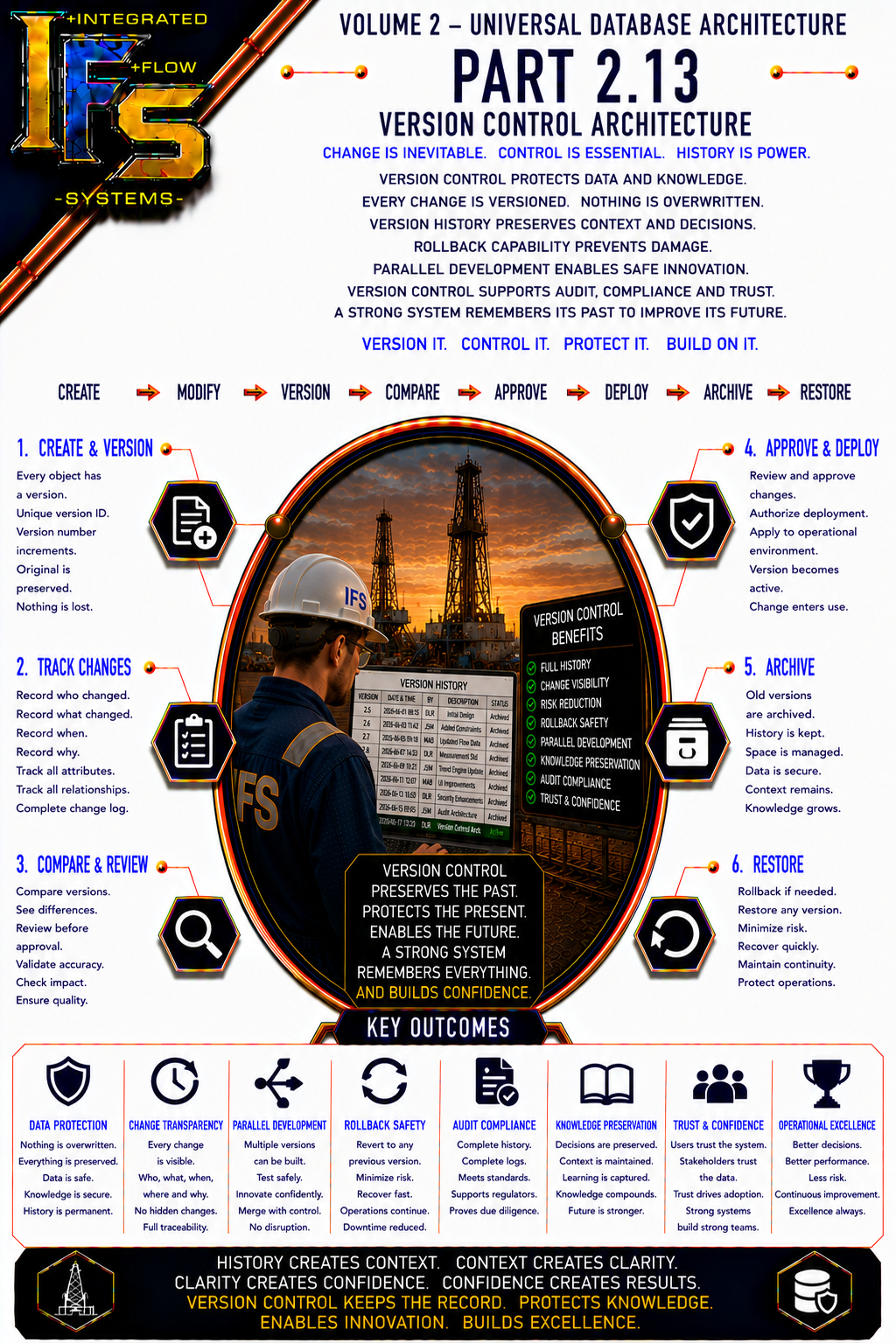
Every operation is communicating.
The question is whether anyone is listening.
Equipment speaks through vibration.
Processes speak through flow.
Systems speak through pressure.
Production speaks through performance.
Operators speak through observation.
Every operation continuously provides information about its condition. Organizations that recognize these signals early gain the opportunity to respond before minor changes become major problems.
Within Integrated Flow Systems (IFS), Operational Awareness is the continuous understanding of what is happening throughout the operation, why it is happening, and what it may become. It transforms observation into anticipation.
Awareness is the foundation of intelligent operations.
Operational awareness starts by paying attention.
IFS encourages continuous observation of:
Equipment condition.
Flow behavior.
Production performance.
Environmental influences.
Operator observations.
Maintenance activities.
Safety conditions.
Every observation contributes to a more complete understanding of the operation.
Awareness begins by seeing what others overlook.
Operations constantly produce signals.
Some are obvious.
Some are subtle.
IFS evaluates:
Pressure changes.
Flow variations.
Temperature movement.
Equipment vibration.
Energy consumption.
Production trends.
Operator concerns.
Alarm frequency.
Every signal may indicate normal operation, emerging risk, or developing opportunity.
Understanding begins by recognizing that every signal deserves evaluation.
A single measurement rarely explains the situation.
IFS combines operational signals with:
Historical conditions.
Current operating mode.
Equipment history.
Environmental factors.
Recent maintenance.
Production objectives.
Known constraints.
Context transforms isolated observations into operational understanding.
Meaning always depends upon the surrounding conditions.
Operational awareness extends beyond individual equipment.
IFS encourages operators to understand:
How systems interact.
How one change influences another.
Where constraints are developing.
Which processes depend upon one another.
How local events affect the larger operation.
The operation is viewed as one connected system rather than isolated components.
Complete awareness produces complete understanding.
Operational awareness is most valuable before problems become visible.
IFS continuously monitors for:
Emerging constraints.
Changing trends.
Equipment degradation.
Flow instability.
Production variation.
Unexpected improvement.
Early recognition creates operational time.
Time allows thoughtful decisions instead of emergency responses.
Conditions change continuously.
Operational awareness must remain current.
IFS encourages operators to continually evaluate:
What has changed?
What remains stable?
What is improving?
What is declining?
What requires attention?
Situational awareness prevents decisions from being based upon outdated information.
Current understanding creates current intelligence.
Shared awareness improves organizational performance.
IFS provides operational visibility across:
Operations.
Maintenance.
Engineering.
Supervision.
Management.
Every department works from the same operational picture.
Shared awareness improves communication, coordination, and decision-making.
Everyone sees the same operation.
Operational uncertainty creates operational risk.
IFS reduces uncertainty by combining:
Real-time observations.
Historical knowledge.
Verified trends.
Operational context.
Decision history.
Constraint analysis.
The more complete the awareness, the lower the uncertainty.
Better awareness produces greater operational confidence.
Every good decision depends upon accurate awareness.
Operators understand:
What is happening.
Why it is happening.
What may happen next.
Which options exist.
What consequences are likely.
Awareness transforms reaction into preparation.
Prepared organizations outperform reactive organizations.
Operational awareness belongs to everyone.
Every operator observes.
Every technician reports.
Every supervisor evaluates.
Every engineer contributes.
IFS creates a culture where awareness is continuously shared, verified, and expanded.
The organization becomes more intelligent because everyone contributes to the operational picture.
Collective awareness becomes organizational strength.
Organizations improve by recognizing opportunities as quickly as they recognize problems.
Operational awareness identifies:
Hidden constraints.
Emerging opportunities.
Successful practices.
Developing risks.
Changing operating conditions.
Every observation contributes another opportunity to improve performance.
Awareness becomes the beginning of every improvement cycle.
Operations are constantly communicating.
The most successful organizations are those that understand what the operation is saying.
Integrated Flow Systems places Operational Awareness at the center of operational intelligence because awareness creates understanding before action is required.
Observe continuously.
Understand completely.
Share openly.
Respond intelligently.
Improve constantly.
Operational awareness is not watching the operation.
It is understanding the operation while it is still changing.
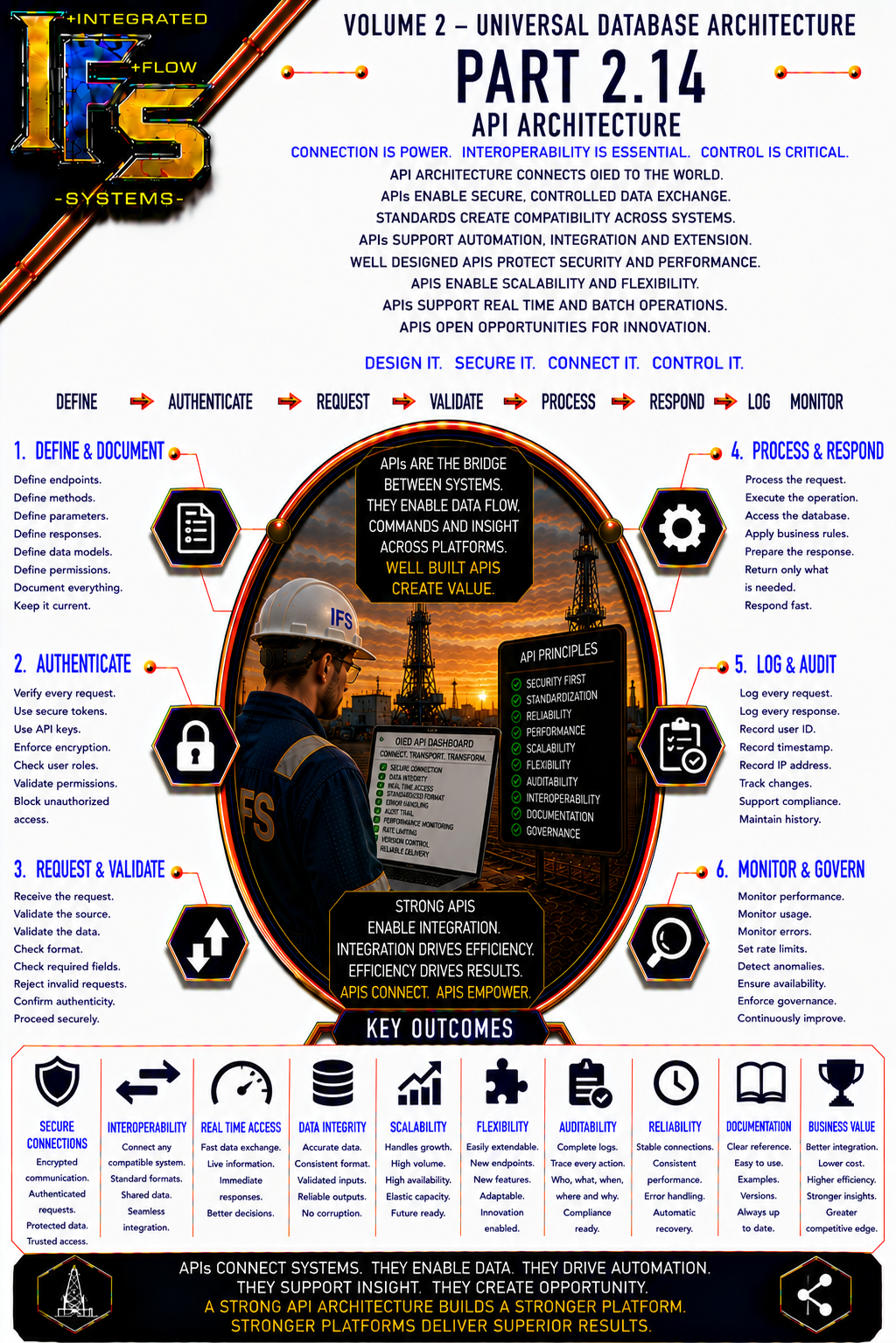
Knowledge gathers information.
Experience validates knowledge.
Wisdom knows how to apply both.
Industrial operations produce enormous amounts of information. They also produce years of experience. Neither alone guarantees better decisions. Operational wisdom is created when verified knowledge, practical experience, and sound judgment work together to consistently produce the best possible outcome.
Within Integrated Flow Systems (IFS), Operational Wisdom is the highest level of operational intelligence. It is the ability to recognize what matters most, understand why it matters, and apply that understanding at the right time and in the right way.
Wisdom transforms intelligence into operational mastery.
Every intelligent operation begins by building knowledge.
IFS gathers knowledge from:
Operational observations.
Equipment performance.
Trend analysis.
Constraint identification.
Maintenance history.
Production results.
Operator experience.
Verified solutions.
Knowledge creates the foundation upon which operational wisdom is built.
Not every theory survives real-world operation.
Experience confirms what actually works.
IFS continuously validates knowledge through:
Measured results.
Repeated observations.
Verified recoveries.
Operational performance.
Long-term outcomes.
Successful implementation.
Experience transforms assumptions into proven operational practices.
Verified knowledge becomes trusted knowledge.
Operational wisdom looks beyond individual events.
It considers:
Long-term consequences.
System-wide impacts.
Future opportunities.
Potential risks.
Organizational objectives.
Human factors.
Operational sustainability.
Wise decisions optimize the entire operation rather than one isolated component.
The whole always matters more than the individual part.
Industrial operations constantly require balance.
Safety.
Production.
Reliability.
Cost.
Maintenance.
Environmental responsibility.
Time.
IFS evaluates every decision by considering how these priorities influence one another.
Operational wisdom seeks balance instead of extremes.
The best decision benefits the entire system.
Not every situation requires intervention.
Sometimes observation is the best response.
IFS helps operators determine when to:
Continue monitoring.
Gather additional information.
Allow the system to stabilize.
Delay intervention.
Escalate immediately.
Take corrective action.
Knowing when not to act is often as valuable as knowing when to act.
Patience can be an operational strategy.
Every result strengthens operational wisdom.
Success confirms effective practices.
Failure reveals hidden weaknesses.
Unexpected outcomes expose new relationships.
IFS records every outcome because wisdom grows through continuous learning.
Every experience becomes part of future judgment.
Nothing is wasted.
Operational wisdom should never remain with one individual.
IFS distributes verified experience across:
Shift teams.
Maintenance groups.
Engineering.
Operations.
Management.
Industry knowledge networks.
Shared wisdom strengthens the entire organization.
The organization becomes smarter than any individual within it.
Wise organizations recover more effectively.
They recognize:
Developing risks.
Emerging opportunities.
Changing conditions.
Resource limitations.
System interactions.
Operational priorities.
Wisdom improves resilience because decisions are based upon understanding rather than urgency.
Prepared organizations recover faster.
Leadership depends upon more than information.
Leaders require judgment.
IFS supports leadership by providing:
Verified knowledge.
Operational context.
Historical experience.
Trend analysis.
Constraint evaluation.
Decision guidance.
Wisdom allows leaders to make decisions that strengthen both today's operation and tomorrow's organization.
Leadership becomes more consistent.
Operational excellence is sustained through wise decisions repeated consistently over time.
IFS combines:
Knowledge.
Experience.
Observation.
Measurement.
Learning.
Adaptation.
Continuous improvement.
These elements create operational wisdom that continually strengthens performance across the entire organization.
Wisdom is the highest expression of operational intelligence.
No organization knows everything.
Every new operation.
Every new challenge.
Every new technology.
Every unexpected event.
Creates another opportunity to learn.
IFS recognizes that operational wisdom is always growing.
The smartest organizations remain committed to continuous learning.
Growth never stops.
Knowledge tells us what happened.
Experience tells us what worked.
Wisdom tells us what should happen next.
Integrated Flow Systems places Operational Wisdom at the highest level of operational intelligence because wisdom transforms information into lasting organizational capability.
Learn continuously.
Verify consistently.
Share openly.
Lead wisely.
Improve forever.
Operational wisdom is not knowing more.
It is consistently making better decisions because the organization has learned how to think through the operation as one connected system.

Every industry operates differently.
Every operation is unique.
Every process has specialized equipment.
Yet beneath those differences lies the same operational structure.
Materials move.
Energy moves.
Information moves.
Decisions are made.
Constraints develop.
Performance changes.
Within Integrated Flow Systems (IFS), the Universal Operational Architecture recognizes that every industrial operation follows the same fundamental operational principles. Industries differ in implementation, but they share a common operational framework.
The architecture remains constant.
Only the application changes.
Regardless of industry, every operation contains the same essential elements.
Nodes.
Flows.
Exchanges.
Constraints.
Decisions.
Memory.
Monitoring.
Feedback.
Continuous improvement.
Whether drilling a well, operating a refinery, managing a desalination plant, moving cargo across an ocean, or producing paper, these operational foundations remain unchanged.
The structure is universal.
Each industry uses different terminology.
Different equipment.
Different products.
Different operating procedures.
Yet the operational relationships remain remarkably similar.
A pump moves flow.
A conveyor moves material.
A pipeline moves product.
A vessel moves cargo.
A transmission line moves electricity.
Different industries.
The same operational logic.
Every operation consists of operational nodes.
A node may be:
A drill bit.
A pump.
A separator.
A heat exchanger.
A crusher.
A conveyor.
A ship.
A storage tank.
A reactor.
A compressor.
Each performs a specific operational function.
Each exchanges something with another node.
Each follows the same Universal Node Architecture.
The node changes.
The architecture does not.
Every operation manages movement.
Material flows.
Energy flows.
Information flows.
Heat flows.
Pressure flows.
Chemical flows.
Financial value flows.
Knowledge flows.
IFS treats every operation as a collection of interacting flows.
Managing flow is more important than managing equipment.
Equipment exists to support flow.
Every industry experiences constraints.
Restricted flow.
Equipment limitations.
Resource shortages.
Information delays.
Maintenance issues.
Human limitations.
Environmental conditions.
The source may differ.
The behavior is remarkably similar.
Constraints always reduce operational performance until they are understood and managed.
Operational intelligence follows the same progression regardless of industry.
Observe.
Capture.
Understand.
Connect.
Recognize patterns.
Identify constraints.
Decide.
Act.
Measure.
Learn.
Improve.
The intelligence engine never changes.
Only the operational vocabulary changes.
IFS separates operational intelligence from industry terminology.
The Translation Layer allows the same operational engines to function across multiple industries.
Oil and Gas.
Mining.
World Shipping.
Pulp and Paper.
Desalination.
Power Generation.
Chemical Processing.
Future industries.
Each industry simply loads the appropriate operational node definitions while the underlying intelligence engines remain unchanged.
The architecture scales without redesign.
Because every industry follows the same operational principles, expanding IFS does not require rebuilding the platform.
New industries require:
Node definitions.
Operational terminology.
Industry workflows.
Equipment libraries.
Industry-specific knowledge.
The operational engines remain exactly the same.
Growth becomes modular rather than structural.
The Universal Operational Architecture allows every module to contribute to one continuously growing knowledge platform.
Each industry expands:
Node libraries.
Operational knowledge.
Verified solutions.
Constraint intelligence.
Trend recognition.
Decision guidance.
Every new industry strengthens the platform rather than creating another disconnected application.
Knowledge compounds across industries.
Technology will change.
Industries will evolve.
Equipment will improve.
Processes will become more efficient.
New operational challenges will emerge.
The Universal Operational Architecture remains stable because it is built upon operational principles rather than specific technologies.
The implementation evolves.
The architecture endures.
The long-term strength of IFS is not its ability to serve one industry.
It is its ability to serve any operational industry using one governed architecture.
One intelligence platform.
One operational framework.
One universal node architecture.
One memory system.
One decision engine.
Unlimited operational applications.
The platform grows without losing consistency.
Operations may appear different.
Operational intelligence is not.
Integrated Flow Systems places the Universal Operational Architecture at the highest level of the platform because every industry is simply another implementation of the same operational principles.
Build one architecture.
Govern one platform.
Translate many industries.
Learn from every operation.
Improve every implementation.
The industries evolve.
The architecture remains.
One platform.
Unlimited operations.

Operations are alive.
Not biologically.
Operationally.
They change.
They respond.
They adapt.
They recover.
They decline.
Every operation exists as a continuously changing system of interactions. Equipment operates. Materials move. Energy transfers. Information flows. Decisions alter future conditions. Nothing remains completely static.
Within Integrated Flow Systems (IFS), every operation is treated as a Living Operational System. Rather than managing isolated equipment or disconnected processes, IFS manages the operation as one continuously evolving operational environment.
The operation is never finished.
It is always becoming.
No operation remains identical from one moment to the next.
Production changes.
Flow changes.
Pressure changes.
Equipment ages.
Operators change.
Environmental conditions evolve.
Customer demands shift.
IFS recognizes continuous change as the natural state of industrial operations.
Operational intelligence must evolve with the operation.
Industrial systems are interconnected.
One adjustment creates another response.
Increasing flow affects pressure.
Changing pressure affects production.
Production influences maintenance.
Maintenance affects reliability.
Reliability changes operational decisions.
Nothing changes alone.
Every action creates a chain of operational consequences.
Every operating cycle adds experience.
Every decision produces evidence.
Every recovery improves understanding.
Every failure exposes another lesson.
IFS continuously incorporates new operational knowledge into the organization's memory.
Learning becomes automatic.
The operation becomes progressively more intelligent over time.
Just as physical systems require maintenance, operational systems require continuous care.
IFS monitors:
Equipment health.
Process stability.
Flow efficiency.
Constraint growth.
Knowledge accuracy.
Operational consistency.
Decision quality.
Healthy systems remain adaptable while maintaining reliable performance.
Operational health requires continuous attention.
Living systems expand.
Operational systems should do the same.
IFS allows organizations to continuously add:
New equipment.
New facilities.
New operating procedures.
New knowledge.
New industries.
New operational engines.
The platform grows without disrupting the architecture.
Growth becomes structured rather than chaotic.
Successful operations balance two competing needs.
Stability.
Adaptability.
Too much stability prevents improvement.
Too much change creates instability.
IFS preserves proven operational practices while allowing continuous refinement as new evidence becomes available.
The strongest systems are both reliable and adaptable.
A Living Operational System improves because experience accumulates.
Every completed cycle strengthens:
Operational memory.
Trend recognition.
Constraint identification.
Decision confidence.
Recovery strategies.
Knowledge networks.
Time becomes an operational advantage.
Experience compounds instead of disappearing.
Operational intelligence does not belong to software.
It belongs to the organization.
Every operator contributes observations.
Every technician contributes experience.
Every engineer contributes analysis.
Every supervisor contributes leadership.
IFS captures these contributions and preserves them as organizational intelligence.
People strengthen the system.
The system strengthens people.
Operational improvement is continuous.
New observations generate new knowledge.
New knowledge produces better decisions.
Better decisions improve operational performance.
Improved performance creates new opportunities.
The cycle repeats continuously.
Every completed cycle strengthens the next.
Improvement becomes part of the operation itself.
Whether managing:
An oil field.
A mine.
A refinery.
A desalination plant.
A pulp mill.
A shipping fleet.
A power station.
Or an industry yet to be developed.
The same Living Operational System applies.
Industries differ.
Operational behavior does not.
One architecture supports continuous evolution everywhere.
Individual experience eventually leaves with the individual.
A Living Operational System preserves that experience permanently.
Knowledge survives:
Retirements.
Shift changes.
Equipment replacement.
Facility expansion.
Organizational growth.
Every generation begins where the previous generation finished.
Operational intelligence never starts over.
It continues growing.
Operations are not static machines.
They are living operational systems that continuously observe, learn, adapt, and improve.
Integrated Flow Systems places the Living Operational System at the highest level of operational thinking because lasting operational excellence is achieved when the entire organization learns together, evolves together, and improves together.
Observe continuously.
Learn collectively.
Adapt intelligently.
Improve permanently.
Build a system that becomes stronger every day.
A Living Operational System never reaches perfection.
It simply becomes better with every operating cycle.
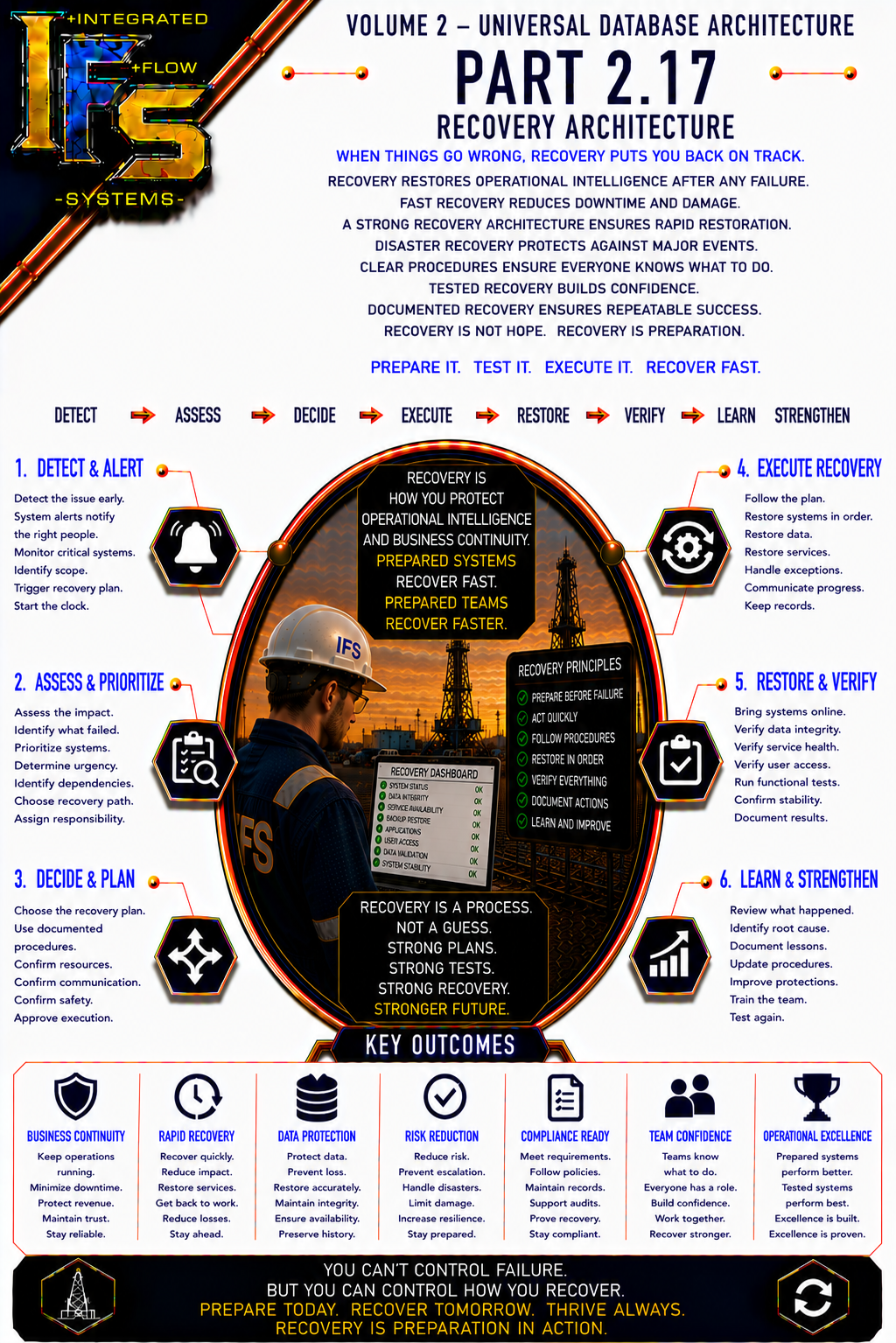
Operational intelligence is not limited by industry.
It is not limited by equipment.
It is not limited by geography.
It is not limited by technology.
It is limited only by the organization's ability to observe, understand, learn, and improve.
Every industrial operation manages the movement of materials, energy, information, people, and decisions. Although the industries appear different, the operational principles remain remarkably consistent.
Within Integrated Flow Systems (IFS), Universal Operational Intelligence is the application of one operational philosophy across every operational environment. It recognizes that intelligence is created by understanding operations—not by understanding industries.
Industries are different.
Operational intelligence is universal.
Most operational systems are designed for one industry.
IFS is designed for operations themselves.
Whether the operation produces:
Oil.
Natural gas.
Coal.
Electricity.
Fresh water.
Steel.
Paper.
Chemicals.
Or moves cargo across the world's oceans.
The operational questions remain the same.
What is flowing?
What is changing?
What is constrained?
What requires attention?
What should happen next?
These questions are universal.
Different industries use different equipment.
Different terminology.
Different operating procedures.
Different regulations.
Yet every industry still depends upon:
Observation.
Measurement.
Flow.
Exchange.
Constraints.
Decisions.
Feedback.
Learning.
Continuous improvement.
The operational language changes.
The intelligence does not.
Everything within an operation moves.
Materials move.
Energy moves.
Information moves.
Heat moves.
Pressure moves.
Resources move.
Time moves.
Knowledge moves.
IFS begins by understanding these movements rather than focusing only on equipment.
Equipment supports flow.
Flow creates value.
Managing flow improves the entire operation.
Operational intelligence improves through experience.
Every industry creates:
Operational history.
Equipment history.
Maintenance history.
Constraint history.
Recovery history.
Decision history.
IFS preserves this experience as organizational memory.
The operation becomes smarter because it remembers.
A lesson learned in one industry often applies to another.
Understanding:
Constraint behavior.
Flow management.
Equipment reliability.
Operational coordination.
Decision processes.
Trend recognition.
May improve completely different industries.
Knowledge expands because operational principles remain consistent.
Learning becomes transferable.
Universal Operational Intelligence follows the same cycle everywhere.
Observe.
Capture.
Understand.
Connect.
Recognize patterns.
Identify constraints.
Decide.
Act.
Measure.
Learn.
Improve.
The cycle remains unchanged regardless of the operation.
Consistency creates intelligence.
Every new industry strengthens the platform.
Each implementation contributes:
New node definitions.
New operational knowledge.
New recovery methods.
New trend examples.
New constraint behaviors.
New best practices.
The platform becomes increasingly intelligent because every implementation contributes to the whole.
Growth benefits everyone.
Physical assets depreciate.
Operational intelligence appreciates.
Every lesson learned.
Every verified solution.
Every successful recovery.
Every documented improvement.
Increases the long-term value of the organization.
Knowledge becomes one of the organization's most valuable operational assets.
Regardless of industry, operational intelligence improves:
Safety.
Reliability.
Efficiency.
Maintenance.
Production.
Planning.
Communication.
Leadership.
Decision-making becomes more consistent because it is supported by structured operational understanding instead of isolated experience.
Understanding replaces uncertainty.
Universal Operational Intelligence allows one governed platform to support unlimited operational environments.
One architecture.
One operational framework.
One intelligence engine.
One memory system.
One decision philosophy.
Many industries.
Unlimited future applications.
The platform expands without changing its foundation.
Every operation teaches something new.
Every industry contributes another perspective.
Every improvement strengthens the platform.
IFS continuously expands operational intelligence while maintaining one stable architecture.
The system evolves because knowledge evolves.
The foundation remains unchanged.
Operational intelligence does not belong to one industry.
It belongs to every operation that seeks to improve.
Integrated Flow Systems places Universal Operational Intelligence at the highest level of its architecture because every operation follows the same fundamental principles of observation, understanding, decision-making, learning, and continuous improvement.
Observe every operation.
Learn from every industry.
Preserve every lesson.
Share every improvement.
Build one universal operational intelligence platform.
One architecture.
One philosophy.
Unlimited operational intelligence.
Whether you're looking to reduce downtime, improve efficiency, preserve equipment, or better understand your operational data, we're ready to help.
Complete the form below and we'll discuss how Integrated Flow Systems can be applied to your operation.
Let's start the conversation.