Explore operational insights, industry graphics, reference materials, and practical examples designed to support better decisions and more consistent performance across complex industrial systems.
Most drilling investigations begin because something is going wrong.
A well begins losing production.
Equipment performance declines.
Costs increase.
An alarm activates.
Integrated Flow Systems (IFS) believes opportunities deserve the same level of attention as problems.
Sometimes the most valuable question isn't:
"Why is this well underperforming?"
It's:
"Why is this well outperforming?"
Every well in a drilling program is expected to perform within a reasonable operating range.
Formation characteristics may differ slightly, but when neighboring wells share similar geology, equipment, drilling plans, and operating procedures, their performance should generally follow similar trends.
In this case, one well quietly begins separating itself from the rest.
Not dramatically.
Just enough for Snapshot Memory to notice.
As operational snapshots accumulate, IFS identifies several encouraging trends.
The well is showing:
Production increasing slightly above nearby wells.
Connection times improving.
Overall drilling efficiency steadily increasing.
Four consecutive operational gains.
Nearby wells remaining essentially unchanged.
Nothing about the improvement appears extraordinary.
Everything still falls within expected operating limits.
Yet one question keeps growing louder.
Why is only this well improving?
Most monitoring systems are designed to recognize problems.
IFS also looks for positive trends.
When performance improves consistently instead of randomly, Snapshot Memory generates an Opportunity Alert.
Not because something is wrong.
Because something is working.
That distinction is important.
Organizations often spend enormous effort solving failures while unintentionally overlooking their greatest successes.
At this stage, no explanation is available.
The drilling team hasn't identified a better formation.
No equipment changes have been documented.
No special procedures have been introduced.
The only confirmed observation is simple:
One well continues improving while the others remain stable.
That makes the improvement worth investigating.
Exceptional performance rarely appears by chance.
More often, it begins with a series of small operational differences that quietly compound over time.
Snapshot Memory recognizes those differences before anyone understands their cause.
The objective isn't merely to celebrate better performance.
The objective is to discover whether that success can be repeated across every well in the field.
Because every unexplained improvement may be hiding tomorrow's new best practice.
In Part 2, the improvement continues. Six consecutive gains confirm that the trend is becoming repeatable rather than random, and IFS begins monitoring the connected operational flows to understand what makes this well different from the others.
In Part 1, Integrated Flow Systems (IFS) identified something unusual—not because a well was underperforming, but because it was quietly outperforming every comparable well around it.
At first, the improvement was small.
A slight production increase.
Marginally faster connection times.
A gradual improvement in drilling efficiency.
Four consecutive gains.
Interesting—but not yet conclusive.
Now, additional operational snapshots have been collected.
The trend is no longer simply interesting.
It is becoming consistent.
Random improvements happen.
A favorable rock layer.
A fortunate drilling interval.
A temporary operational advantage.
These events occur throughout the industry.
What separates luck from opportunity is repetition.
As Snapshot Memory continues comparing operational performance, the same well records six consecutive production gains while nearby wells continue performing within their expected range.
The improvement is no longer isolated.
It is becoming predictable.
IFS treats improving performance exactly the same way it treats increasing risk.
Both begin with trends.
Both strengthen through consistency.
Both deserve investigation.
The system now raises the Opportunity Alert from Low to Moderate.
Not because the improvement is dramatic.
Because it continues repeating.
Every new snapshot increases confidence that something operationally significant is occurring.
Higher production is the result.
It is rarely the cause.
To understand why this well continues improving, IFS begins monitoring the operational flows that influence drilling performance.
Rather than focusing only on production numbers, Snapshot Memory expands the investigation to include connected operational behaviors such as:
Mud properties.
Pump efficiency.
Connection times.
Flowback rates.
Choke behavior.
Weight on bit.
Rate of Penetration (ROP).
Every one of these systems influences the others.
IFS isn't searching for a failure.
It's searching for the small operational advantage that keeps producing better results.
One of the most valuable ideas behind Opportunity Alerts is that successful operations create patterns just as failures do.
When a process repeatedly produces better outcomes, the operational data will eventually reveal the relationship.
The challenge is knowing where to look.
By monitoring connected flow systems instead of isolated performance numbers, IFS begins building the operational story behind the improvement.
The production increase may simply be the visible result of something much smaller happening elsewhere in the drilling process.
At this stage, no conclusions have been reached.
The system has not identified the cause.
It has only confirmed that the improvement is real, repeatable, and worthy of deeper investigation.
That alone is valuable.
Because organizations often overlook their greatest competitive advantage—not because it doesn't exist, but because no one thought to investigate success with the same discipline used to investigate failure.
In Part 3, the Opportunity Alert escalates again. Eight consecutive gains confirm the improvement is no coincidence, and Snapshot Memory begins connecting operational flows across the entire drilling process. The investigation shifts from "Is this real?" to "What small difference is creating this extraordinary result?"

In Part 2, the investigation confirmed that the improving well was no longer an isolated success.
Production continued climbing.
Connection times continued improving.
Drilling efficiency remained higher than neighboring wells.
Most importantly, the gains kept repeating.
With six consecutive improvements, Snapshot Memory recognized that the pattern was becoming operationally significant.
Now, another series of snapshots has been added.
The opportunity has become impossible to ignore.
Exceptional performance isn't defined by one outstanding day.
It's defined by repeating the same success over and over again.
As additional operational data is collected, the well records eight consecutive gains while nearby wells continue performing at their normal levels.
The improvement is no longer simply measurable.
It is becoming dependable.
That changes the investigation.
IFS increases the Opportunity Alert to High because confidence in the trend has grown—not because the production increase is dramatic, but because the pattern continues without interruption.
Most operational systems stop once they discover which well is performing better.
IFS treats that as the beginning of the investigation.
The real question is no longer:
"Which well is performing better?"
The question becomes:
"What connected operational flows are allowing it to perform better?"
Every drilling operation is made up of dozens of connected flow systems.
A small improvement in one area often creates larger improvements somewhere else.
Snapshot Memory now begins monitoring the relationships between operational flows, including:
Mud properties and drilling stability.
Pump efficiency and hydraulic performance.
Connection times and productive drilling time.
Flowback rates and circulation efficiency.
Choke behavior and pressure stability.
Weight on bit and drilling efficiency.
Rate of Penetration and overall well performance.
None of these systems operate independently.
IFS watches them together because small improvements often begin where no one is looking.
At this stage, nothing suggests the well is using different equipment.
Nothing indicates better geology.
Nothing points toward a mechanical advantage.
Yet the operational behavior remains consistently superior.
Snapshot Memory recognizes something important.
This isn't a problem waiting to happen.
It's an advantage waiting to be understood.
Instead of investigating failure, IFS is investigating excellence.
With every new snapshot, the operational picture becomes clearer.
The production gains continue.
The supporting flow systems remain connected.
The confidence level continues increasing.
The investigation is no longer asking whether the opportunity is real.
It is preparing to identify the small operational difference responsible for the entire pattern.
Sometimes the greatest competitive advantage isn't a new technology or a major investment.
Sometimes it's a small habit that no one realized was making a difference.
In Part 4, the investigation uncovers the answer. A single driller had quietly developed a slightly different connection sequence. It wasn't documented, wasn't required, and wasn't intentional as an improvement—but it consistently reduced connection time, improved drilling continuity, and increased overall well performance. Snapshot Memory transforms one person's habit into a repeatable best practice for every well in the fleet.
In Part 3, the evidence became overwhelming.
The well had now recorded eight consecutive gains.
Production continued climbing.
Connection times continued improving.
Operational efficiency remained consistently higher than neighboring wells.
Snapshot Memory had already confirmed one thing:
This wasn't luck.
This was repeatable performance.
Now the investigation reached its final question.
What was different?
The engineering team reviewed every obvious possibility.
The formation was comparable.
The drilling equipment matched the surrounding wells.
Mud systems were operating within specification.
The drilling program followed the same objectives.
Nothing explained why one well continued outperforming the others.
So the investigation shifted away from the equipment and toward the operation itself.
During a detailed review of operational snapshots, crews noticed something almost invisible.
One driller consistently completed connections slightly differently.
Nothing dramatic.
Nothing formally documented.
No written procedure.
Just a personal habit that had evolved through experience.
The driller had developed a smoother connection sequence that reduced unnecessary pauses and maintained better drilling continuity between connections.
Each individual improvement saved only a small amount of time.
On its own, it hardly seemed worth mentioning.
Snapshot Memory revealed what no single shift could see.
That slightly different connection sequence created:
Faster connection times.
More productive drilling minutes.
Better flow continuity.
Less interruption to drilling rhythm.
Higher overall operational efficiency.
Gradually increasing production performance.
No single connection created the advantage.
Hundreds of slightly better connections did.
The improvement wasn't mechanical.
It wasn't geological.
It wasn't accidental.
It was operational.
Without Snapshot Memory, this improvement might have remained with one driller for years.
Instead, IFS documented the sequence, verified the results, and confirmed that the improvement was repeatable.
The recommendation became clear:
Document the new connection sequence.
Standardize the practice.
Train additional crews.
Monitor implementation.
Compare future wells against the new operational standard.
One person's experience had become an opportunity for the entire drilling program.
Most organizations investigate failure.
Very few investigate success.
Integrated Flow Systems treats both with equal importance.
Every unexplained improvement becomes an opportunity to ask:
What changed?
Why did it work?
Can it be repeated?
Can every crew benefit?
This transforms operational excellence from individual experience into organizational knowledge.
The greatest opportunities are often hidden inside the smallest operational differences.
A slightly smoother connection.
A slightly better sequence.
A habit developed through experience.
Individually, these improvements may appear insignificant.
Connected through Snapshot Memory, they become measurable, understandable, and repeatable.
That is how one well becomes the benchmark for every well that follows.
Because the true value of operational excellence isn't discovering that one crew performs better.
It's discovering why they perform better—and giving every crew the opportunity to do the same.
Integrated Flow Systems (IFS) transforms isolated successes into repeatable best practices by connecting operational snapshots, recognizing positive trends, uncovering hidden opportunities, and turning one well's advantage into an improvement across an entire fleet.
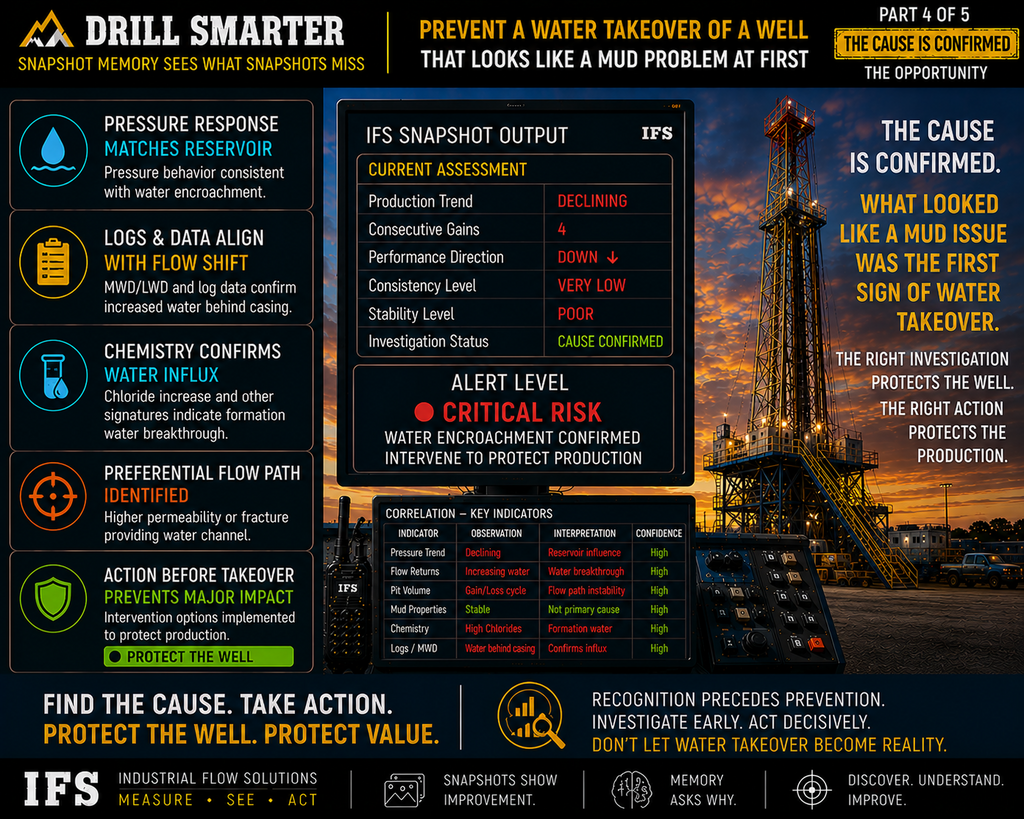
The investigation is complete.
The trend that first appeared as a series of small, disconnected anomalies has now been fully explained.
What initially looked like a routine mud issue was never primarily a mud problem.
Snapshot Memory recognized that the operational pattern did not match the expected behavior of normal drilling fluid changes.
Instead, it pointed toward an entirely different mechanism.
Early formation water encroachment.
Because Integrated Flow Systems detected the pattern before the situation escalated, the drilling team had time to respond methodically rather than react under pressure.
Additional monitoring confirmed the developing trend.
Targeted investigations verified the source.
The drilling program was adjusted before significant formation water entered the wellbore.
The result was a controlled correction instead of an expensive well control event.
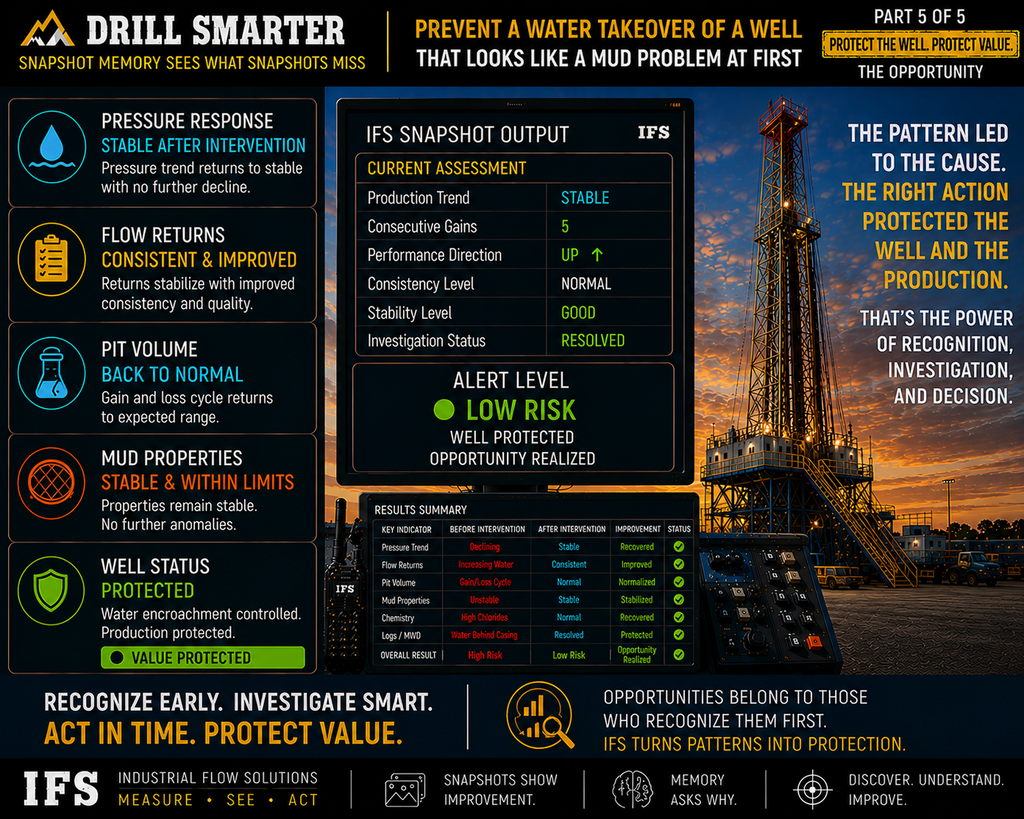
Following the intervention, Snapshot Memory continued monitoring the system through successive operational snapshots.
The improvement was measurable across multiple connected flow systems.
Pressure response stabilized.
Flow returns became consistent.
Pit volume returned to expected operating ranges.
Mud properties remained stable and within program limits.
No additional water-related anomalies appeared.
Instead of assuming the problem was solved, IFS confirmed that the improving trend continued over time.
The pattern had truly been eliminated.
The greatest value wasn't simply preventing a kick.
It was protecting everything connected to the well.
Early recognition helped preserve:
Well integrity.
Productive drilling time.
Drilling fluid quality.
Formation stability.
Equipment utilization.
Operational continuity.
Crew confidence.
Production potential.
Overall project economics.
A single avoided escalation protected far more than one operational parameter.
It protected the value of the entire drilling operation.
Perhaps the most important outcome occurs after the event.
Every snapshot collected during this investigation now becomes permanent operational knowledge.
Future wells displaying the same combination of pressure changes, flow-return instability, pit volume cycling, and otherwise stable mud properties will immediately be compared against this verified historical pattern.
What once required an investigation can now be recognized much earlier.
Every solved problem strengthens the next decision.
Integrated Flow Systems is not designed to react to failures.
It is designed to recognize developing patterns before they become failures.
One abnormal reading rarely tells the full story.
One snapshot captures a moment.
Snapshot Memory captures the direction.
By connecting observations across time, IFS helps operators distinguish between routine operational variation and meaningful system change.
That difference allows crews to investigate earlier, intervene sooner, reduce uncertainty, and protect both operational performance and asset value.
Because the true advantage isn't solving a major problem.
It's recognizing the small pattern that prevents the major problem from ever happening.
Integrated Flow Systems (IFS) transforms operational snapshots into actionable memory, helping drilling teams identify subtle flow-system changes, protect well integrity, preserve production, reduce operational risk, and continuously improve drilling performance through deterministic pattern recognition and Snapshot Memory.
Whether you're looking to reduce downtime, improve efficiency, preserve equipment, or better understand your operational data, we're ready to help.
Complete the form below and we'll discuss how Integrated Flow Systems can be applied to your operation.
Let's start the conversation.