Explore operational insights, industry graphics, reference materials, and practical examples designed to support better decisions and more consistent performance across complex industrial systems.
Every major drilling event has a beginning.
Surprisingly, that beginning is often so subtle that it blends into normal daily operations. There are no alarms. No dramatic pressure spikes. No obvious equipment failures. Everything appears to be operating within acceptable limits.
Yet beneath the surface, the operating window protecting the well may already be changing.
This is where Integrated Flow Systems (IFS) begins paying attention.
Oil and gas wells are dynamic systems. As drilling progresses, formation characteristics, pore pressure, mechanical response, and drilling conditions continually evolve.
Operators monitor dozens of important measurements, including:
Pressure margin
Rate of Penetration (ROP)
Torque
Connection gas
Flow returns
Pit volume
Trip tank volume
Viewed individually, each of these values may appear perfectly normal.
The challenge is recognizing when several small changes begin moving in the same direction.
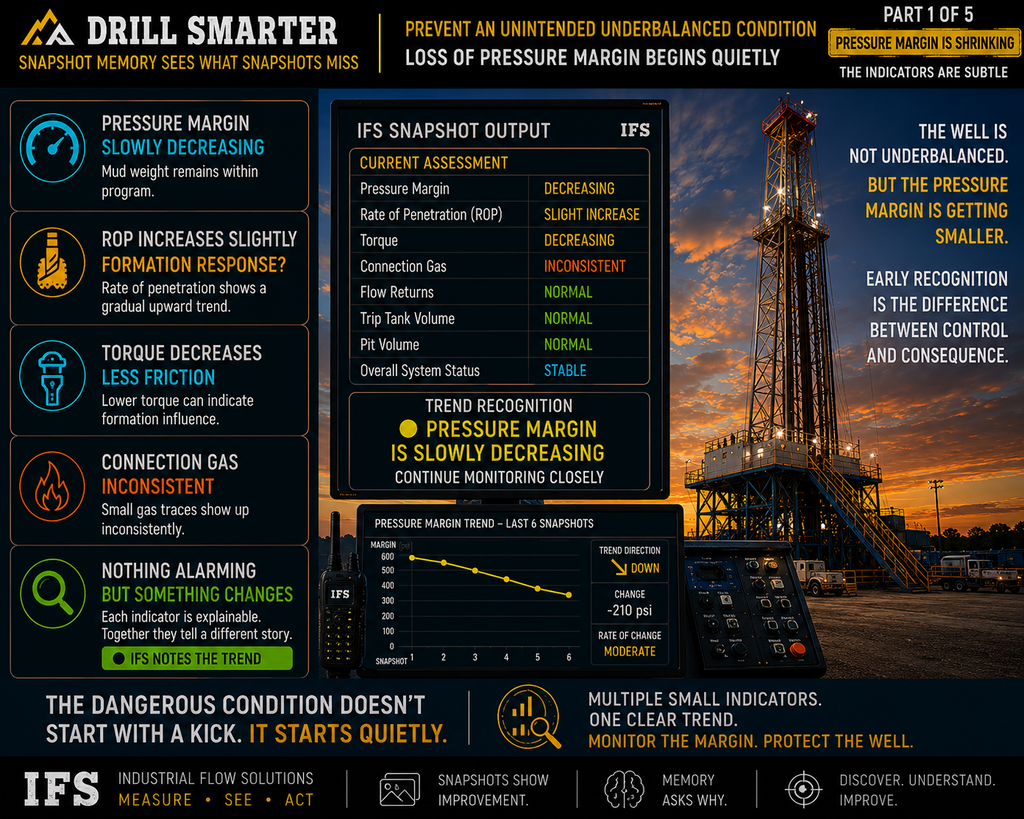
In this scenario, the pressure margin is slowly decreasing.
At the same time:
ROP begins increasing slightly.
Torque gradually decreases.
Small traces of connection gas appear.
Flow returns remain normal.
Pit volumes remain stable.
None of these observations immediately indicate a well control issue.
In fact, most could easily be explained by changing formation conditions.
That is exactly why they deserve attention.
Rather than reacting to one measurement, IFS compares multiple operational snapshots over time.
Its purpose is simple:
Is the drilling system changing, even if every individual reading still appears acceptable?
At this stage, no intervention is recommended.
The system simply records that a trend is developing and increases operational awareness.
Serious drilling events rarely begin with a single failure.
They begin with small changes that slowly build into recognizable patterns.
Recognizing those patterns early gives engineers and drilling teams more time to investigate, validate assumptions, and make informed operational decisions before conditions become more complex.
In Part 2, the pattern becomes harder to ignore. The individual indicators still appear routine—but together, they no longer fit the expected story.
In Part 1, Integrated Flow Systems (IFS) identified a subtle trend. Nothing had failed, and every individual indicator still appeared explainable. The system simply recognized that several measurements were beginning to move in the same direction.
Now, another series of operational snapshots has been recorded.
The question is no longer whether something has changed.
The question is whether those changes are connected.
Drilling operations are full of fluctuations. Returns vary. Gas readings change. Pit volumes move slightly throughout normal operations. Experienced drilling crews see these variations every day.
Looking at today's data alone, there is still no single indicator demanding an immediate response.
However, IFS isn't looking at today's data.
It is comparing today's data to everything that came before it.
As Snapshot Memory reviews the latest sequence, several small indicators continue developing:
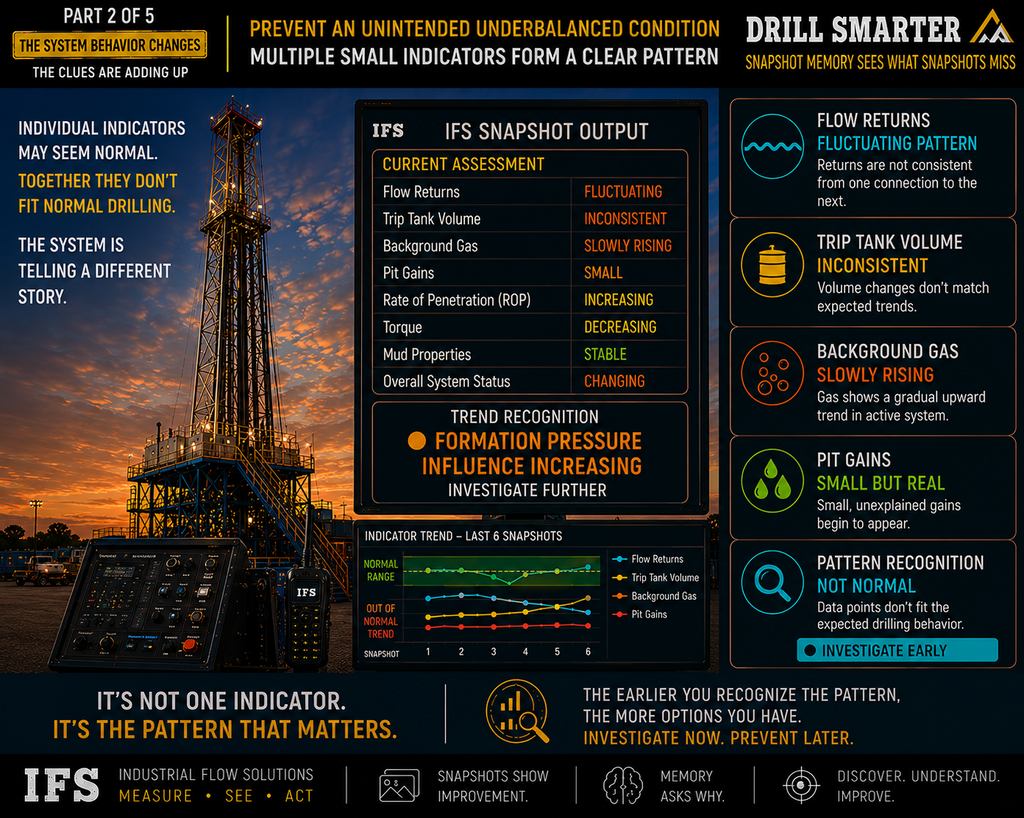
Flow returns begin fluctuating from one connection to the next.
Trip tank volumes become less predictable.
Background gas trends upward slowly.
Small pit gains begin appearing.
Rate of Penetration continues increasing.
Torque continues decreasing.
Mud properties remain stable.
Individually, each observation still has reasonable explanations.
Collectively, they begin describing a system whose behavior is no longer following the expected drilling pattern.
This is one of the fundamental differences between monitoring data and understanding a flow system.
Traditional monitoring asks whether each individual value is inside its operating limit.
IFS asks a different question:
Do all of these measurements make sense together?
When several indicators begin reinforcing one another, they create a pattern that deserves investigation—even if every individual measurement remains within acceptable operating limits.
Every new snapshot strengthens the operational memory of the system.
Instead of resetting with every shift, IFS continues building the story:
Which indicators are repeating?
Which trends are becoming stronger?
Which relationships are remaining consistent?
Which assumptions are becoming less likely?
At this point, the system isn't declaring an underbalanced condition.
It is recognizing that formation influence appears to be increasing, and that the overall drilling system is behaving differently than expected.
One of the greatest advantages of recognizing patterns early is having more options.
When crews identify changing system behavior before conditions become critical, they have time to review drilling parameters, verify formation expectations, and investigate possible causes while the well remains stable.
IFS does not replace engineering judgment.
It provides earlier situational awareness, allowing engineers and drilling teams to investigate based on evolving trends instead of waiting for unmistakable symptoms.
In Part 3, the pattern strengthens further. The trend is no longer just developing—it begins pointing toward a specific operational concern, giving the drilling team clearer direction on where to focus their investigation.

In Part 2, the individual indicators stopped behaving like isolated events. Flow returns, trip tank volume, background gas, and pit gains were no longer moving independently. Together, they suggested that something within the well was beginning to change.
Now, another series of snapshots has been added to the operational record.
The trend is becoming harder to dismiss.
One of the most important observations at this stage is that the well has not experienced a kick.
Circulation is still being maintained. Operations continue. Surface indicators remain manageable.
However, the drilling system is no longer behaving like a comfortably overbalanced well.
The pressure balance between the wellbore and the formation is approaching equilibrium.
That changes everything.
As the pressure margin narrows, the formation begins to play a more active role in the drilling process.
IFS identifies several important developments:
Pressure balance approaches equilibrium.
Small influxes begin appearing intermittently.
Background gas continues to rise.
Flow returns become increasingly unstable.
Pit gains are now present instead of occasional.
Mud properties begin approaching operational limits.
Overall system status shifts from stable to at risk.
Each new snapshot strengthens the same conclusion.
The formation is beginning to participate in the flow system.
This stage represents a critical transition.
The challenge is no longer identifying individual measurements.
The challenge is recognizing that the operating environment itself has changed.
IFS Snapshot Memory compares today's conditions with the previous sequence of events and asks:
Is the pressure margin continuing to shrink?
Are formation responses becoming more frequent?
Are independent indicators now reinforcing one another?
Is this still normal drilling behavior?
The answers increasingly point in one direction.
The system behavior has shifted.
Perhaps the greatest advantage of identifying this stage is that operators still have choices
.
The well remains under control.
No major well control event has occurred.
Because the developing pattern has been recognized early, engineers and drilling teams can investigate the changing conditions before they become difficult to manage.
That additional time can support better planning, better verification, and more informed operational decisions.
What began as several unrelated observations has now developed into a recognizable operational pattern.
The evidence continues building with every new snapshot.
IFS doesn't simply record measurements—it records how the drilling system evolves over time, allowing crews to recognize meaningful changes before they become emergencies.
In Part 4, the formation's influence becomes unmistakable. The trend is no longer developing—it is confirming the diagnosis, giving the drilling team a clear opportunity to intervene before a full well control event occurs.
In Part 3, the pattern had become unmistakable. The pressure margin had narrowed, intermittent influxes had begun, and the formation was actively influencing the well. While the situation remained under control, the trend clearly indicated that action was needed before the condition escalated.
This is where Integrated Flow Systems (IFS) delivers its greatest value.
The objective has never been to react to a well control event.
The objective is to prevent one from ever occurring.
Because the developing trend was identified early, the drilling team has time to respond methodically instead of reacting under pressure.
Rather than waiting for a kick or significant influx, the operational focus shifts toward restoring a healthy pressure margin and confirming that the well returns to a stable operating condition.
Early recognition creates early options.
With the pattern clearly established, IFS recommends a systematic approach to restoring well stability.
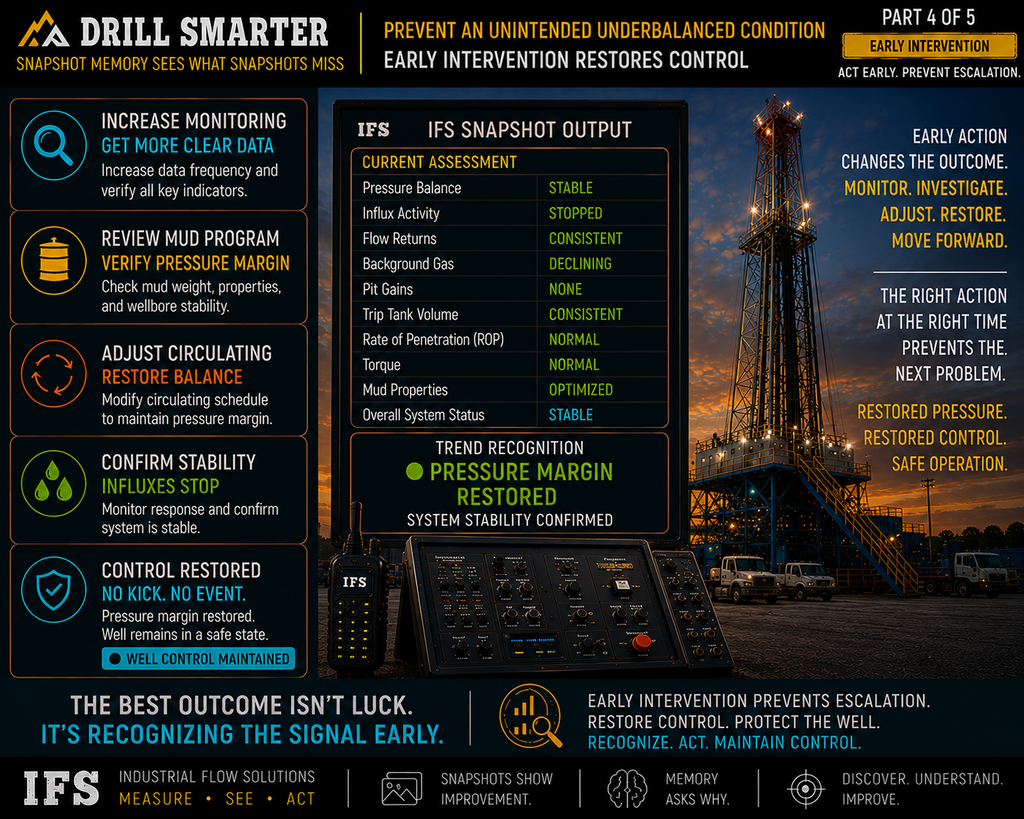
The team begins by increasing monitoring frequency to verify that every critical indicator is accurately reflecting current downhole conditions.
Attention then turns to the mud program, confirming that mud weight, rheology, and overall pressure margin continue to provide the intended level of well control.
If required, circulating practices and operational parameters are adjusted to restore the desired balance between the wellbore and the formation.
These actions are not emergency responses.
They are controlled operational corrections made while the well is still manageable.
As new snapshots are recorded, the operational picture changes.
The indicators that had been steadily moving toward increased risk begin moving back toward stability.
IFS observes:
Pressure balance returns to a stable operating range.
Influx activity stops.
Flow returns become consistent.
Background gas begins declining.
Pit gains disappear.
Trip tank volumes stabilize.
Drilling performance returns to expected behavior.
Mud properties are optimized.
Overall system status returns to Stable.
The trend has reversed because the underlying condition was addressed before it became a well control event.
One successful adjustment does not complete the investigation.
IFS continues monitoring the system through additional snapshots to confirm that stability is sustained rather than temporary.
This verification process ensures that:
Pressure margin remains healthy.
Formation influence has diminished.
Flow behavior remains predictable.
No secondary trends begin developing.
Operational memory now records not only the developing problem, but also the successful resolution.
That knowledge becomes part of the system's growing experience for future wells.
The most successful well control event is the one that never happens.
By recognizing the developing pattern early, investigating before assumptions became costly, and making measured operational adjustments, the drilling team restored control without experiencing a kick, a shutdown, or significant non-productive time.
This is exactly how IFS is designed to support drilling operations.
It transforms subtle operational changes into actionable flow intelligence while there is still time to make informed decisions.
In Part 5, we look back at the entire sequence and explore how Snapshot Memory turns one successful intervention into permanent operational knowledge, helping future drilling crews recognize the same pattern even earlier.

The goal of every drilling operation is not simply to respond when something goes wrong.
The goal is to recognize changing conditions early enough that the problem never develops into an operational event.
In this scenario, that goal was achieved.
By identifying a series of small but connected changes, the drilling team restored pressure margin before the well became unintentionally underbalanced. No kick occurred. No emergency response was required. The well remained under control because the warning signs were recognized while there was still time to act.
This is the outcome Integrated Flow Systems (IFS) was designed to support.
Looking back across all five operational snapshots, the progression becomes clear.
The sequence began with a slight reduction in pressure margin that, on its own, appeared insignificant. Additional snapshots revealed small changes in drilling performance, gas behavior, flow stability, and pit activity. None of these indicators individually demanded immediate intervention, but together they described a developing trend.
Rather than waiting for a major event, the drilling team investigated the pattern, verified the changing conditions, and made measured operational adjustments.
The result was exactly what every drilling operation strives for:
Pressure margin returned to a safe operating range.
Influx activity stopped.
Flow returns became consistent.
Background gas declined.
Pit gains disappeared.
Drilling parameters stabilized.
The well remained safely overbalanced.
Operations continued without interruption.
The story ended with control—not because of luck, but because of early recognition.
The value of this event extends beyond the well itself.
IFS records not only the measurements, but the complete operational journey:
What changed first.
Which indicators strengthened the trend.
When the formation began influencing the system.
What actions were taken.
Which adjustments proved successful.
How stability was confirmed.
That complete sequence becomes part of Snapshot Memory.
The next time a similar pattern begins developing, engineers and drilling teams won't be starting from zero. They'll have a verified operational history showing how the situation evolved and how it was successfully managed.
Each completed scenario makes the entire system smarter.
Traditional reporting often focuses on documenting incidents after they occur.
Integrated Flow Systems focuses on preserving the knowledge that prevented the incident.
Every resolved event becomes another reference point for future operations, strengthening the organization's ability to recognize subtle trends, validate decisions, and respond with greater confidence.
Over time, this creates a growing library of operational intelligence built from real field experience rather than isolated data points.
Successful drilling is not measured by how well a crew reacts to emergencies.
It is measured by how consistently they prevent emergencies from developing.
Integrated Flow Systems brings together flow relationships, trend recognition, Snapshot Memory, and operational knowledge into one connected decision-support framework.
By recognizing patterns early, understanding how individual indicators work together, and preserving every successful outcome, IFS helps transform experience into repeatable operational knowledge.
Because the greatest success in oil and gas drilling is often invisible.
It is the well that never kicks.
The shutdown that never happens.
The non-productive time that never occurs.
The hazard that was recognized early enough to prevent.
Recognize Early. Act Early. Stay in Control.
That is the purpose of Integrated Flow Systems (IFS)—helping oil and gas professionals Measure • See • Act, turning connected flow intelligence into safer operations, stronger well control, reduced non-productive time, and continuously improving operational knowledge across every well, every rig, and every drilling program.
Whether you're looking to reduce downtime, improve efficiency, preserve equipment, or better understand your operational data, we're ready to help.
Complete the form below and we'll discuss how Integrated Flow Systems can be applied to your operation.
Let's start the conversation.