Explore operational insights, industry graphics, reference materials, and practical examples designed to support better decisions and more consistent performance across complex industrial systems.

Every well that eventually experiences a kick begins the same way.
Nothing appears to be wrong.
Flow in matches expectations. Pit volume remains steady. Mud weight stays within program. Rate of penetration is consistent. The drilling operation continues without interruption, and every individual measurement appears to support one conclusion:
The well is behaving normally.
That is exactly why the earliest stages of a developing problem are so easy to overlook.
Every drilling crew depends on accurate information.
A single operational snapshot provides an important picture of the well at one specific moment in time. It answers questions such as:
Is flow in normal?
Is pit volume stable?
Is mud weight acceptable?
Is drilling progressing as planned?
On this particular shift, every answer appears reassuring.
Nothing in today's snapshot suggests an immediate well control concern.
Integrated Flow Systems (IFS) approaches the same information from a different perspective.
Rather than asking whether today's measurements are acceptable, Snapshot Memory asks:
How does today's operation compare with yesterday?
Then:
How does it compare with the day before that?
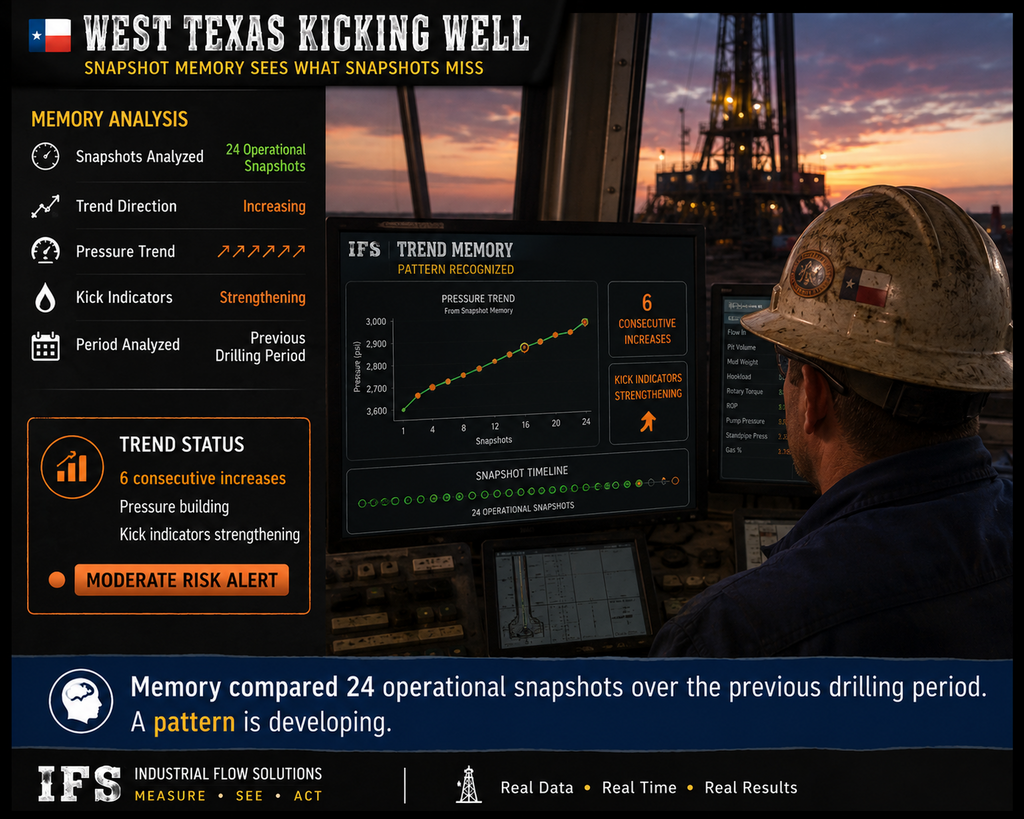
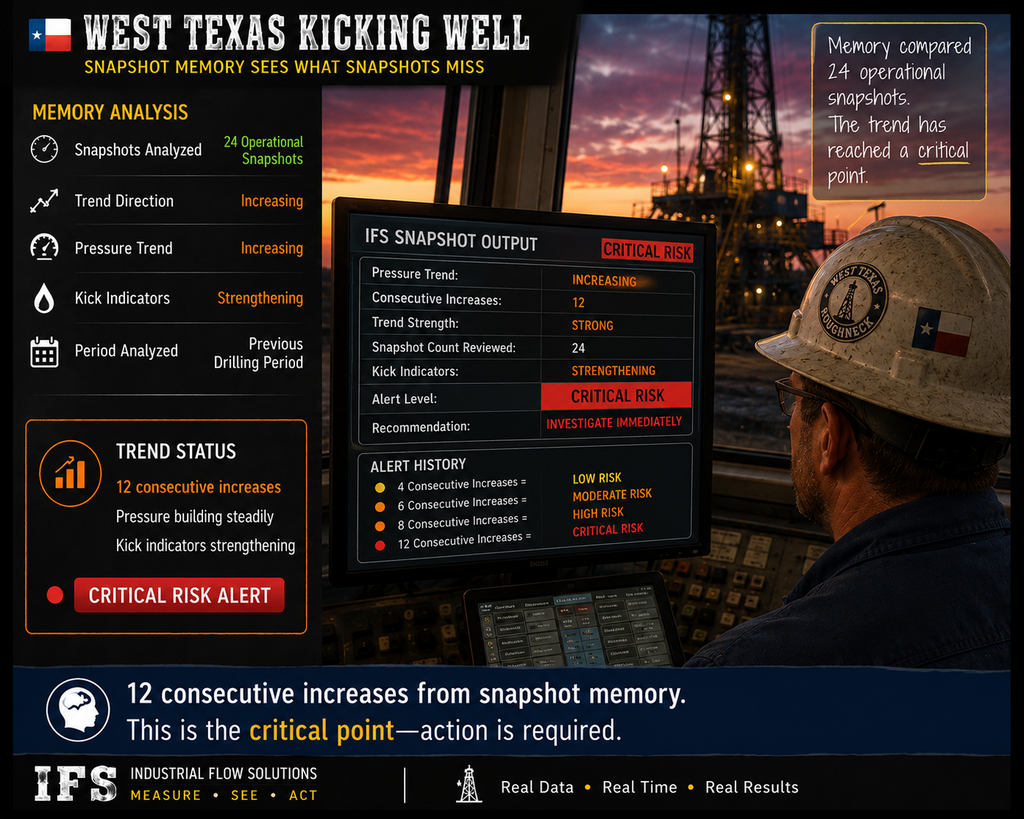
When individual snapshots are connected together, small directional changes begin to emerge that would otherwise remain hidden.
Over several consecutive operational snapshots, one subtle observation begins repeating.
Pressure has increased slightly.
Not enough to trigger an alarm.
Not enough to stop drilling.
Not enough for any individual snapshot to justify intervention.
But enough that Snapshot Memory records the direction.
Four consecutive increases do not automatically indicate danger.
They do indicate that the system deserves closer attention.
At this stage, there is no kick.
No influx.
No abnormal pit gain.
No obvious operational problem.
The well continues drilling normally.
Yet operational memory has already noticed that something is slowly changing beneath the surface.
This is where Integrated Flow Systems begins providing value—not by predicting failure, but by recognizing that today's drilling conditions are no longer identical to yesterday's.
Sometimes the earliest warning isn't an alarm.
It's a direction.
In Part 2, additional snapshots are collected. Individual readings still appear normal, but the repeating trend becomes more difficult to ignore as Snapshot Memory continues building the story.

Whether you're looking to reduce downtime, improve efficiency, preserve equipment, or better understand your operational data, we're ready to help.
Complete the form below and we'll discuss how Integrated Flow Systems can be applied to your operation.
Let's start the conversation.