Explore operational insights, industry graphics, reference materials, and practical examples designed to support better decisions and more consistent performance across complex industrial systems.
Every operational problem creates questions.
The first challenge is resisting the temptation to answer them too quickly.
When fuel consumption begins increasing, warm-up times grow longer, hydraulic pressure starts creeping upward, and idle time slowly expands, it's natural to search for an obvious explanation. Weather. Equipment. Maintenance. Operators.
Most investigations begin there.
Integrated Flow Systems (IFS) does too—but with one important difference.
IFS doesn't begin by looking for what must be wrong.
It begins by determining what can already be ruled out.
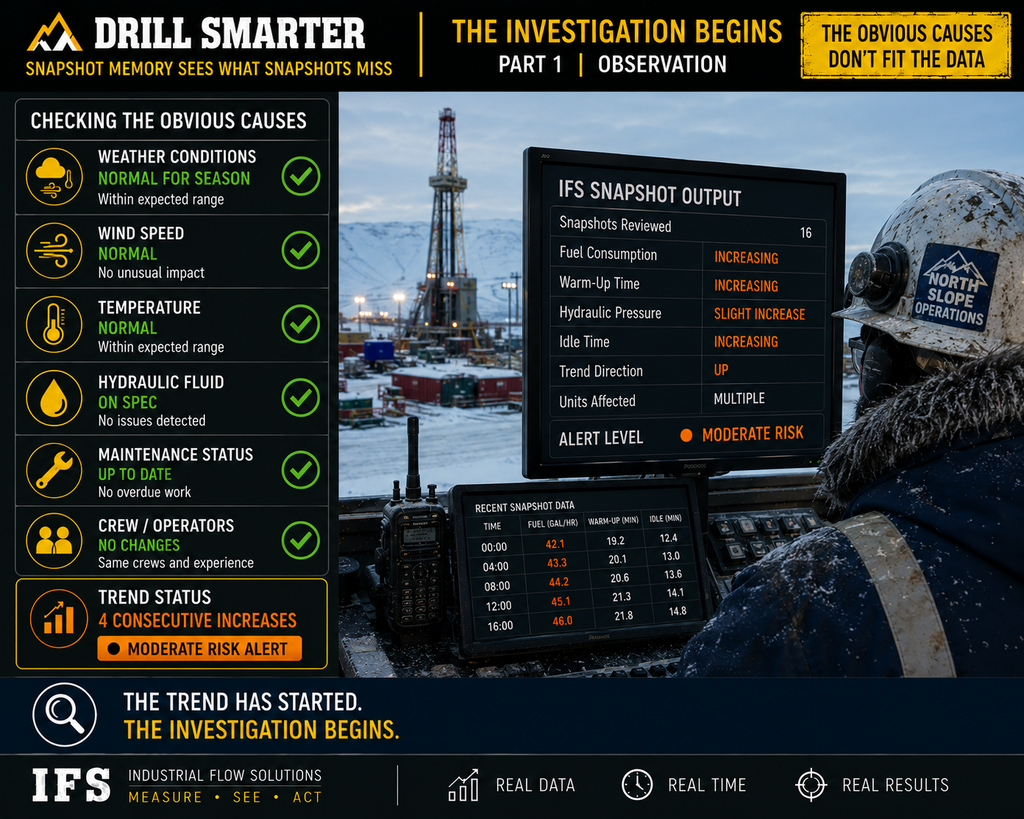
During this drilling period, Snapshot Memory identifies a subtle but consistent operational trend.
Across sixteen operational snapshots, several indicators begin moving together:
Fuel consumption gradually increases.
Equipment warm-up times become longer.
Hydraulic pressure rises slightly.
Idle time slowly increases.
Multiple operating units show similar behavior.
No single measurement exceeds an operational limit.
Nothing has failed.
The drilling operation continues normally.
Yet the trend continues building.
Before searching for complex explanations, IFS follows a structured elimination process.
The investigation begins by reviewing the most common external influences that typically affect drilling efficiency.
Current observations show:
Weather conditions remain normal for the season.
Wind speeds are within expected limits.
Ambient temperatures remain consistent.
Hydraulic fluid is operating within specification.
Preventive maintenance is current.
No crew or operator changes have occurred.
Each of these possibilities is examined—not assumed.
At this stage, every obvious explanation remains unlikely.
One of the most common mistakes during troubleshooting is deciding on the answer before gathering enough evidence.
IFS deliberately avoids that trap.
Instead of asking:
"What caused the problem?"
The system first asks:
What has changed?
What has remained stable?
Which variables are moving together?
Which possible causes can already be eliminated?
Only after those questions are answered does the investigation move deeper.
Every additional operational snapshot strengthens the investigation.
Rather than focusing on one shift or one event, Snapshot Memory records the developing behavior across the entire operation.
At this stage, the system raises a Moderate Risk Alert.
Not because it knows the answer.
Because it knows the trend deserves attention.
The investigation has officially begun.
The data is speaking.
Now the challenge is listening carefully enough to understand what it is saying.
In Part 2, the obvious causes are systematically eliminated. As each possibility is ruled out, the investigation becomes more focused, bringing the real source of the operational trend closer into view.

In Part 1, Integrated Flow Systems (IFS) identified a developing operational trend. Fuel consumption was rising, equipment warm-up times were increasing, idle time was growing, and hydraulic pressure showed a gradual upward shift.
Nothing had failed.
Nothing appeared abnormal when viewed individually.
Yet Snapshot Memory continued recognizing the same direction across multiple operational snapshots.
The investigation now moves to its next phase.
Experienced troubleshooting is often less about finding the answer immediately and more about systematically removing the wrong answers.
Rather than jumping to conclusions, IFS follows a structured elimination process.
Every likely cause is reviewed using operational data instead of assumptions.
The question becomes:
"If this isn't the cause, can we prove it?"
The investigation reviews every major external factor capable of influencing equipment performance.
The findings remain remarkably consistent
Weather conditions remain within seasonal expectations.
Wind speeds show no unusual operational impact.
Ambient temperatures remain normal.
Hydraulic fluid continues operating within specification.
Preventive maintenance is fully up to date.
Crew assignments and operator experience remain unchanged.
Every major variable expected to explain the trend has now been examined.
None explains what Snapshot Memory continues observing.
This is one of the most valuable moments in any investigation.
The operational trend has not disappeared simply because the obvious explanations have been ruled out.
Fuel consumption continues increasing.
Warm-up times continue lengthening.
Idle time remains elevated.
The operational behavior has not changed.
Only the list of possible causes has become much shorter.
Many investigations become delayed because teams continue revisiting explanations that have already been disproven.
IFS avoids this by documenting every eliminated possibility.
Snapshot Memory records not only what was discovered, but also what was not responsible for the developing trend.
This creates a much clearer path for the next stage of investigation.
Instead of searching everywhere, the team can now concentrate on areas where meaningful answers are still likely to exist.
At this stage, the investigation is no longer asking whether weather, maintenance, equipment servicing, or staffing caused the problem.
Those possibilities have been effectively removed.
What remains are the operational processes, system interactions, and workflow changes that have not yet been examined.
The investigation has become smaller.
The probability of finding the true cause has become much larger.
In Part 3, Snapshot Memory begins connecting operational events instead of individual measurements. A strong correlation emerges, revealing that the trend isn't random—it consistently begins after a specific operational change, shifting the investigation from "what" is happening to "why" it is happening.
In Part 2, the investigation became much more focused. Weather conditions were normal. Wind speeds showed no unusual influence. Temperatures remained within seasonal expectations. Hydraulic systems were operating within specification.
Maintenance records were current, and the same experienced crews continued operating the equipment.
The obvious causes had been eliminated.
Yet the operational trend remained.
Now the investigation shifts from eliminating possibilities to discovering relationships.
One of the greatest strengths of Integrated Flow Systems (IFS) is that it doesn't simply collect operational snapshots.
It compares them.
As Snapshot Memory reviews additional operational periods, something remarkable begins to emerge.
The increases are not random.
They consistently occur after the same operational event.
That changes the entire investigation.
Rather than asking what component is failing, IFS begins comparing operational events against the developing trend.
Several possibilities are tested:
Do the increases follow specific operators?
Do they occur during colder temperatures?
Are they connected to changing weather?
Are certain pieces of equipment responsible?
Is there a common event occurring before every increase?
One by one, the comparisons eliminate more possibilities.
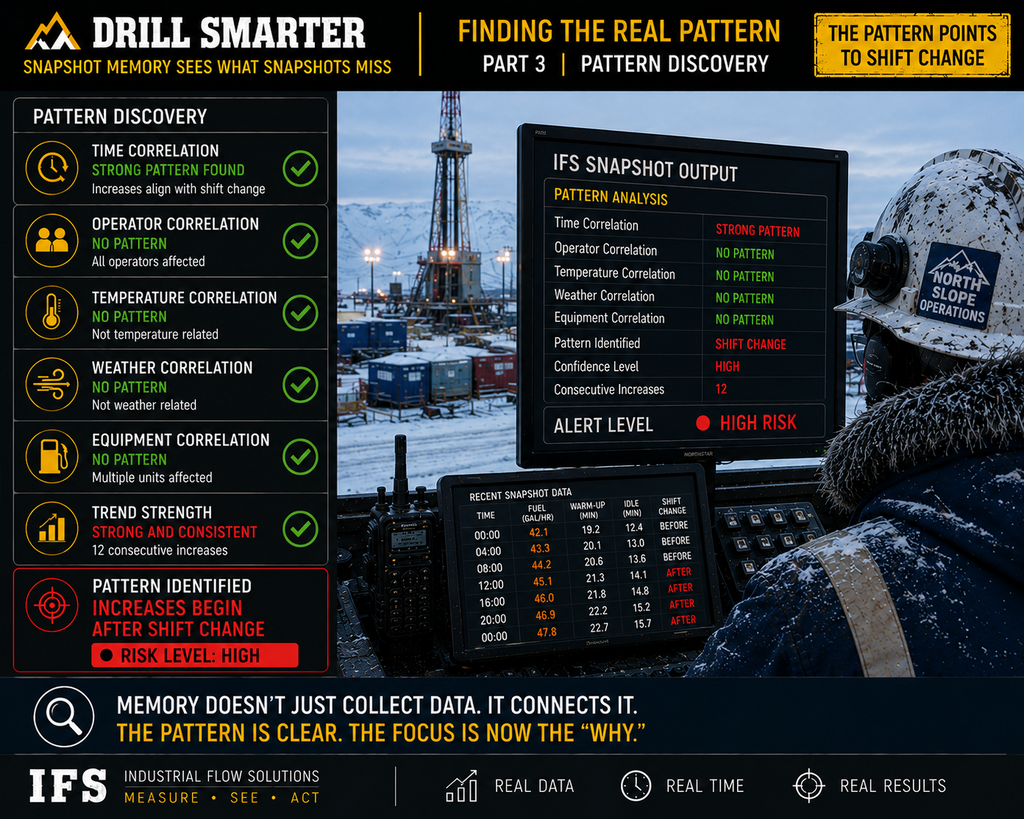
No operator pattern.
No weather pattern.
No temperature pattern.
No equipment pattern.
Only one relationship remains.
Across twelve consecutive operational increases, Snapshot Memory identifies the same sequence.
The increases begin after shift change.
Every time.
Regardless of weather.
Regardless of crew.
Regardless of equipment.
The operational timing remains remarkably consistent.
This is no longer coincidence.
It is correlation.
Finding a strong pattern does not automatically identify the root cause.
It identifies where to look next.
This distinction is critical.
Many investigations stop when a correlation is found.
IFS treats correlation as the beginning of the final investigation—not the conclusion.
The system now knows when the trend begins.
The next objective is understanding why.
At this stage, the search has become highly focused.
Instead of reviewing hundreds of possible causes, engineers can now concentrate on the operational procedures that occur immediately after shift changes.
What changed?
What is being done differently?
Has a procedure been modified?
Was a new practice introduced?
Has something become standard that was never fully evaluated?
These questions now have a clear direction because Snapshot Memory connected the operational timeline instead of reviewing isolated events.
The investigation has moved from observation to understanding.
The trend is no longer simply increasing.
It now has a consistent point of origin.
That single discovery dramatically shortens the path to the true constraint.
The investigation is no longer searching everywhere.
It knows exactly where to look.
In Part 4, the final pieces fall into place. A recently revised startup procedure is identified as the hidden constraint driving the entire trend. By correcting the procedure—not the equipment—the operational pattern reverses, fuel consumption drops, idle time decreases, and the investigation ends with a permanent improvement instead of another temporary fix.

In Part 3, Snapshot Memory uncovered the breakthrough that changed the entire investigation.
The increasing fuel consumption, longer warm-up periods, higher idle time, and gradual rise in hydraulic pressure were not random events.
They weren't connected to weather.
They weren't connected to operators.
They weren't connected to equipment.
Every significant increase began after the shift change.
The investigation finally had a direction.
Now it was time to discover why.
One of the easiest mistakes in industrial troubleshooting is assuming that every operational problem must originate from mechanical failure.
IFS challenged that assumption.
Instead of inspecting another component, the investigation examined what actually changed during the shift transition.
A review of operating procedures revealed something that had quietly become routine.
Three weeks earlier, a revised startup sequence had been introduced.
The change appeared minor.
No alarms were generated.
No equipment faults were reported.
The procedure worked exactly as intended.
Or so it seemed.
When the revised startup sequence was compared against Snapshot Memory, the relationship became undeniable.
Every increase in fuel consumption followed the new procedure.
Every extended warm-up period began after its implementation.
Every increase in idle time traced back to the same operational change.
The equipment wasn't creating the trend.
The procedure was.
What initially appeared to be an equipment performance issue was actually a process constraint introduced through a well-intentioned operational change.
Because the startup sequence affected every shift, its influence spread throughout the operation.
The result wasn't a single problem.
It was a chain reaction.
The revised procedure created:
Longer equipment warm-up times.
Increased engine idle periods.
Higher fuel consumption.
Additional hydraulic loading.
Increased equipment wear.
Reduced operational efficiency.
Each symptom appeared independent.
Snapshot Memory revealed they all shared the same origin.
Once the root cause was confirmed, the solution became straightforward.
The startup procedure was reviewed and revised.
The unnecessary delays were removed.
The operational sequence was optimized.
As new snapshots were collected, the results became immediately visible.
Fuel consumption declined.
Warm-up times returned to normal.
Idle time decreased.
Hydraulic performance stabilized.
Most importantly, the trend reversed.
Not because equipment was repaired.
Because the operational constraint had been eliminated.
Without a structured investigation, this issue could have resulted in months of unnecessary maintenance, component replacements, or equipment inspections.
Instead, IFS followed a disciplined process:
Observe the trend.
Eliminate the obvious causes.
Identify the pattern.
Confirm the constraint.
Correct the true root cause.
The result was a permanent operational improvement rather than another temporary repair.
Industrial systems rarely hide their problems.
They hide their relationships.
The equipment was never the issue.
The weather was never the issue.
The operators were never the issue.
The constraint existed within the process itself.
Integrated Flow Systems (IFS) transformed hundreds of ordinary operational snapshots into one clear operational story—revealing that the most effective solutions often come not from replacing equipment, but from understanding how the entire flow system works together.
Because the best investigation doesn't simply explain what happened.
It reveals why it happened, corrects it, and ensures the same constraint is recognized even earlier the next time.
Whether you're looking to reduce downtime, improve efficiency, preserve equipment, or better understand your operational data, we're ready to help.
Complete the form below and we'll discuss how Integrated Flow Systems can be applied to your operation.
Let's start the conversation.