Explore operational insights, industry graphics, reference materials, and practical examples designed to support better decisions and more consistent performance across complex industrial systems.

In Part 1, Integrated Flow Systems (IFS) identified something most operational systems would have ignored.
One well wasn't failing.
It was quietly outperforming the others.
Production had increased slightly above neighboring wells. Connection times were improving. Drilling efficiency continued climbing. Four consecutive gains had been recorded while every comparable well remained essentially unchanged.
At first, it looked like good fortune.
Now, the evidence is becoming much stronger.
Every drilling operation experiences occasional good days.
A favorable section of formation.
A smooth shift.
An efficient connection.
These happen throughout the life of every well.
What separates luck from opportunity is consistency.
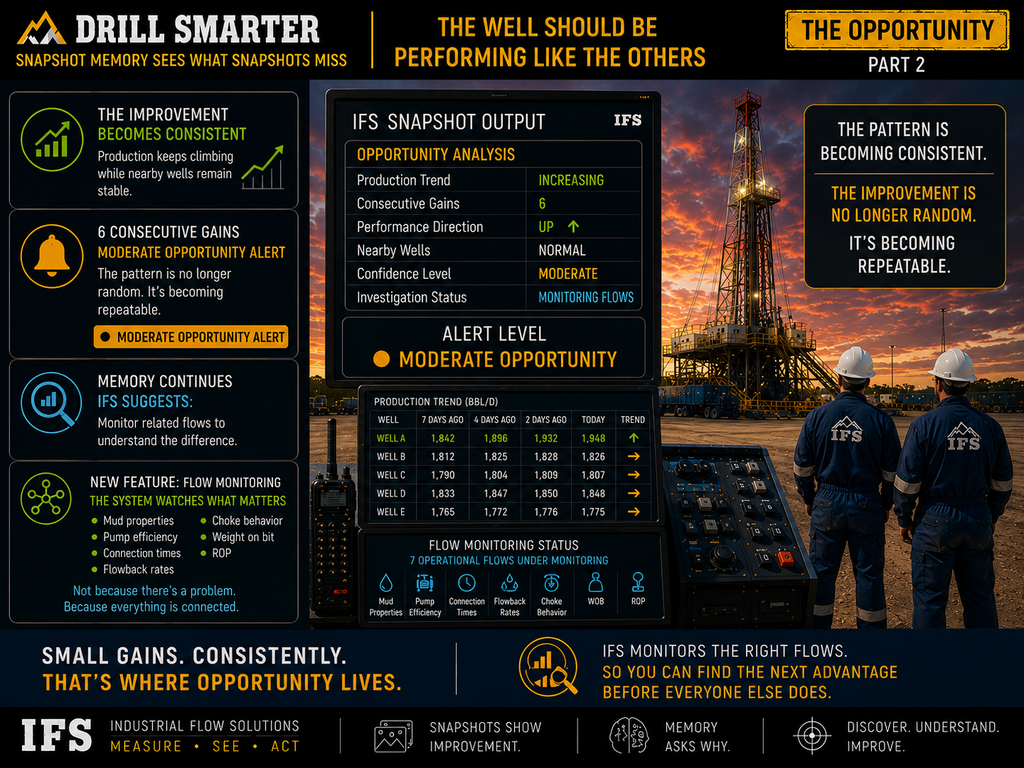
As additional operational snapshots are collected, the same well records six consecutive gains while surrounding wells continue performing within their normal range.
The improvement is no longer occasional.
It is becoming repeatable.
IFS evaluates opportunity the same way it evaluates operational risk.
Confidence increases with every consistent result.
Because the improvement continues repeating, the Opportunity Alert advances from Low to Moderate.
The production gains are no longer viewed as isolated successes.
They are becoming an operational pattern.
That pattern deserves investigation.
Production is the outcome.
IFS wants to understand the process that created it.
Snapshot Memory now expands the investigation by monitoring the operational flows connected to drilling performance.
The system begins comparing:
Mud properties.
Pump efficiency.
Connection times.
Flowback rates.
Choke behavior.
Weight on Bit (WOB).
Rate of Penetration (ROP).
These systems are monitored together because no operational improvement exists in isolation.
Every gain begins somewhere inside the flow architecture.
Most monitoring systems wait until something fails before looking deeper.
IFS investigates success before anyone else notices it.
The objective isn't to explain higher production.
The objective is to discover which operational flow quietly improved first.
Somewhere inside these connected systems, a small operational advantage is repeating itself.
Snapshot Memory is now watching every related flow to find it.
The well continues outperforming expectations.
Nearby wells continue operating normally.
The improvement keeps repeating.
Nothing suggests equipment differences.
Nothing suggests geological differences.
Yet the operational advantage continues growing.
That is exactly when organizations should become curious.
Because the greatest competitive advantages often begin as small operational differences that no one realizes are creating extraordinary results.
In Part 3, the Opportunity Alert escalates again. Eight consecutive gains confirm that the improvement is no coincidence. Snapshot Memory begins connecting operational relationships across the drilling process, narrowing the search until one small anomaly begins separating this well from every other well in the field.

In Part 2, the opportunity became impossible to dismiss.
The well had now recorded six consecutive gains while nearby wells continued performing within their normal operating range.
Production kept increasing.
Connection times continued improving.
Drilling efficiency remained consistently higher.
The question was no longer whether the well was outperforming.
The question had become:
"What is creating the advantage?"
Every operational improvement leaves a trail.
It may be hidden.
It may be subtle.
But if the improvement continues long enough, Snapshot Memory will eventually reveal the pattern.
With each new operational snapshot, IFS gains greater confidence that this isn't a temporary fluctuation.
The well now records eight consecutive gains.
The Opportunity Alert advances to High Opportunity.
Not because production has dramatically increased.
Because the improvement has become remarkably consistent.
At this stage, the investigation shifts from monitoring results to monitoring relationships.
IFS begins comparing every operational flow that could influence drilling performance.
Rather than studying production alone, Snapshot Memory analyzes:
Mud properties.
Pump efficiency.
Connection times.
Flowback rates.
Choke behavior.
Weight on Bit (WOB).
Rate of Penetration (ROP).
Overall drilling continuity.
Each operational flow is evaluated against every production improvement.
The objective is simple:
Find the one flow that changes every time performance improves.
One of the unique strengths of Integrated Flow Systems is that it investigates success with the same discipline normally reserved for failure.
Nothing is broken.
Nothing requires repair.
No alarms have activated.
Instead, Snapshot Memory is asking a different question.
What small operational difference keeps producing better results?
Somewhere within these connected flow systems, one subtle variation continues repeating.
IFS doesn't ignore it.
It follows it.
Individual shifts rarely notice tiny operational improvements.
Snapshot Memory does.
As every new snapshot is added, the relationships become stronger.
One operational flow begins separating itself from the others.
Not enough to identify the cause.
But enough to point the investigation in the right direction.
The operational story is becoming clearer.
This isn't simply higher production.
It's a repeatable operational pattern.
At this stage, the investigation has narrowed dramatically.
The system no longer searches through hundreds of possible explanations.
Instead, it focuses on the few operational flows consistently associated with the improving well.
The answer is close.
The data has already identified the direction.
Now it is time to identify the difference.
Because operational excellence rarely comes from doing everything differently.
It usually comes from doing one small thing slightly better than everyone else.
In Part 4, the investigation uncovers the hidden advantage. A single driller had quietly developed a more efficient connection sequence—not as a formal procedure, but as a personal habit. Snapshot Memory proves that this one small operational difference reduced connection time, improved drilling continuity, and ultimately increased production. One well's success becomes a repeatable best practice for the entire drilling program.
In Part 3, the investigation reached a turning point.
The well had now recorded eight consecutive production gains.
Connection times continued improving.
Operational efficiency remained consistently higher than neighboring wells.
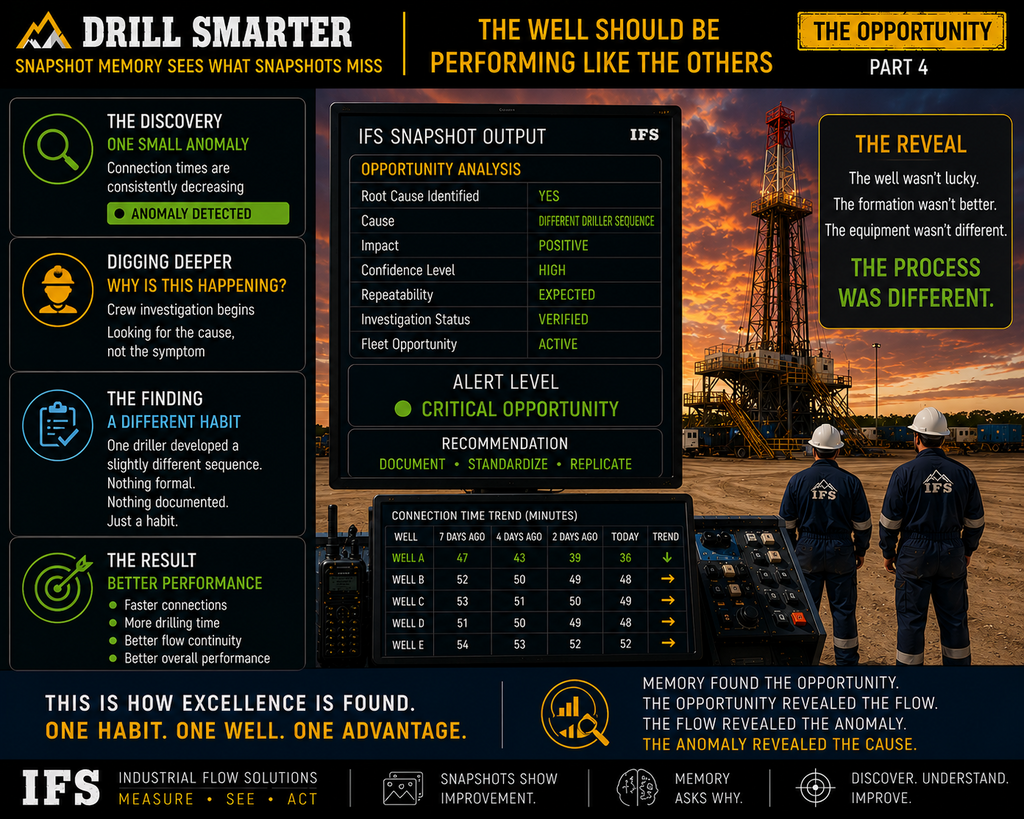
The Opportunity Alert had been raised to Critical Opportunity.
Snapshot Memory had already answered one question.
This wasn't luck.
Now it was time to answer the next one.
Why?
The engineering team began reviewing every possible explanation.
The formation was nearly identical to nearby wells.
The drilling equipment matched the rest of the fleet.
Mud properties remained within program.
Pump performance was normal.
Hydraulic performance showed no meaningful differences.
Nothing mechanical explained why this one well continued outperforming every other well.
The answer had to be somewhere else.
As Snapshot Memory continued comparing hundreds of operational snapshots, one small difference finally emerged.
Connection times on this well were consistently shorter.
Not dramatically.
Just enough to stand out after dozens of drilling cycles.
The difference wasn't caused by equipment.
It wasn't created by geology.
It wasn't part of the drilling plan.
It came from the driller.
Further investigation revealed that one experienced driller had quietly developed a slightly different connection sequence.
It wasn't documented.
It wasn't part of the operating manual.
It wasn't even intentional.
Through experience, the driller had refined the order of several routine tasks, reducing unnecessary pauses while maintaining safe operating practices.
Each individual connection saved only a small amount of time.
No one noticed.
Until Snapshot Memory connected hundreds of them together.
Those few saved seconds accumulated throughout the drilling program.
The improved sequence produced:
Faster connection times.
More productive drilling minutes.
Better drilling continuity.
Less interruption between drilling cycles.
Higher overall drilling efficiency.
Increased production performance.
The production gains weren't created by better equipment.
They weren't created by better geology.
They were created by a better process.
Without Integrated Flow Systems, this improvement might have remained with one driller for years.
Instead, Snapshot Memory transformed one person's experience into organizational knowledge.
The recommendation became clear:
Document the improved connection sequence.
Verify it across additional wells.
Standardize the procedure.
Train every drilling crew.
Continue monitoring results.
One person's habit had become a fleet-wide opportunity.
Most companies investigate failure.
The most successful companies investigate excellence.
Every unexplained improvement is a chance to discover a better way of operating.
IFS treats outstanding performance exactly as it treats operational risk.
It asks:
What changed?
Why did it work?
Can it be repeated?
Can everyone benefit?
When those questions are answered, isolated success becomes a repeatable competitive advantage.
Operational excellence rarely arrives through dramatic breakthroughs.
It usually begins with small improvements repeated consistently over time.
A slightly better connection.
A smoother sequence.
A better habit.
Individually, they appear insignificant.
Connected through Snapshot Memory, they become measurable, understandable, and repeatable.
That is how one exceptional well becomes the benchmark for every well that follows.
Because the greatest opportunity isn't finding the best-performing well.
It's discovering why it performs better—and giving every crew the ability to achieve the same result.
Integrated Flow Systems (IFS) transforms operational experience into measurable improvement by recognizing positive trends, uncovering hidden best practices, and turning one well's advantage into lasting performance gains across an entire drilling fleet.
Whether you're looking to reduce downtime, improve efficiency, preserve equipment, or better understand your operational data, we're ready to help.
Complete the form below and we'll discuss how Integrated Flow Systems can be applied to your operation.
Let's start the conversation.